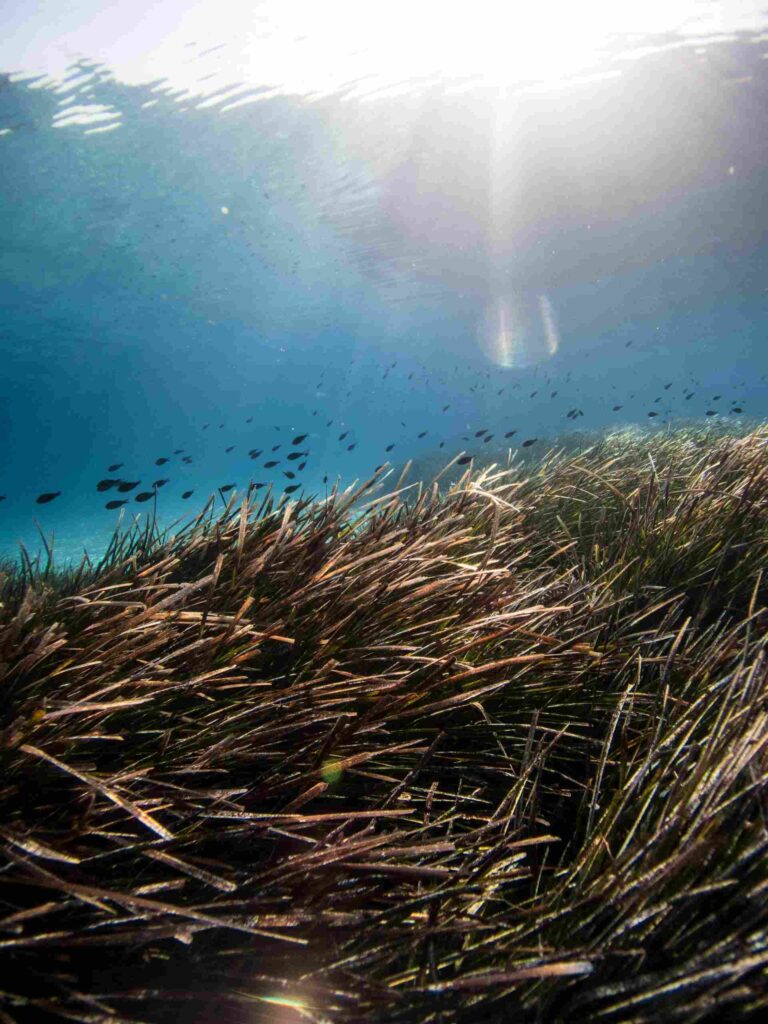
There is a submerged forest in the Mediterranean on which the health of the sea depends. It consists of long green leaves swaying on the seafloor: these are the Posidonia oceanica seagrass beds, a marine phanerogam that supports entire ecosystems and helps store large amounts of carbon. The European Union classifies Posidonia meadows as a priority habitat because they are home to hundreds of marine species.
For years this natural infrastructure has been under pressure, partly because of boat anchors. In Greece, one of the countries most exposed to nautical tourism, a concrete response is being attempted. In Porto Rafti Bay, near Athens, a pilot project has begun to install moorings, dubbed “ecological,” designed to reduce damage to the seabed.
The anchor that rips the sea
For decades, recreational boats have dropped anchor directly on posidonia-covered bottoms. When the anchor is retrieved, it often drags whole clumps of plants and their root systems with it, leaving scars that can take decades to heal.
“Very often I have noticed abandoned anchors on Posidonia meadows,” diver Rouli Prinianaki of the NGO Aegean Rebreath told AFP news agency. The problem is not marginal: according to the Greek environmental organization OFYPEKA, anchoring represents “one of the most significant threats” to this habitat.
How “green” moorings work
The new system tested at Port Rafti tries a different approach. Instead of lowering an anchor on the seabed, the boats attach to a buoy connected to a fixed anchor. During operations, professional diver Makis Sotiropoulos uses a special auger to drill the seabed to about three meters and install a structure with two symmetrical fins.
“We pull upward to lock it in place before attaching a chain and a signal buoy,” he explained to AFP. The result is a stable mooring point that allows boats to stop without dragging chains or anchors on the underwater grasslands.
The initiative is coordinated by the Greek Ministry of Navigation and Insular Policy. The goal is to create a national network of buoys along the country’s more than 13,000 kilometers of coastline.
“When we implement a national network of mooring buoys, those who own boats will be able to dock safely, quickly and efficiently, without damaging the seabed,” ministry secretary general Evangelos Kyriazopoulos told AFP.
An ally against the climate crisis
“Posidonia is among our best allies in the fight against climate change and deserves our full attention,” explained Maria Salomidi of the Hellenic Center for Marine Research (HCMR). “Grasslands capture and store carbon under their rhizomes, produce oxygen, filter and purify water, and support biodiversity. They are natural ecological infrastructures that perform multiple functions simultaneously: coastal protection, fish nursery and climate regulation.
The challenge of nautical tourism
The problem is that the Mediterranean is also one of the busiest areas in the world for recreational boating. In Greece, especially in summer, bays and inlets are filled with thousands of boats. So far, about 40 “eco-friendly” moorings have been installed in the country, mainly in the Ionian Sea marine parks and near the island of Alonissos. A number still far from the real needs.
In Alonissos, for example, fifteen ecological buoys have been installed, but according to fishing expert Spyridon Iosifidis “they are not enough for the thousands of boats that arrive in the summer.” For researchers, the solution cannot be limited to technology. Stricter regulations are also needed.
WWF Greece biologist Vangelis Paravas argues that Athens should follow the example of the Balearic Islands and the French Mediterranean coast, where anchoring in posidonia meadows is regulated.
Protecting the sea without stopping tourism
Despite the difficulties, many experts see ecological moorings as a solution that can reconcile economy and environmental protection. According to project proponents, a well-managed network of buoys could also become an organized tourist service, improving the quality of the experience for boaters and reducing damage to the sea.
“It is extremely important to develop a network of mooring buoys throughout the country, both to protect the environment and to support the growth of maritime tourism,” Kyriazopoulos said.