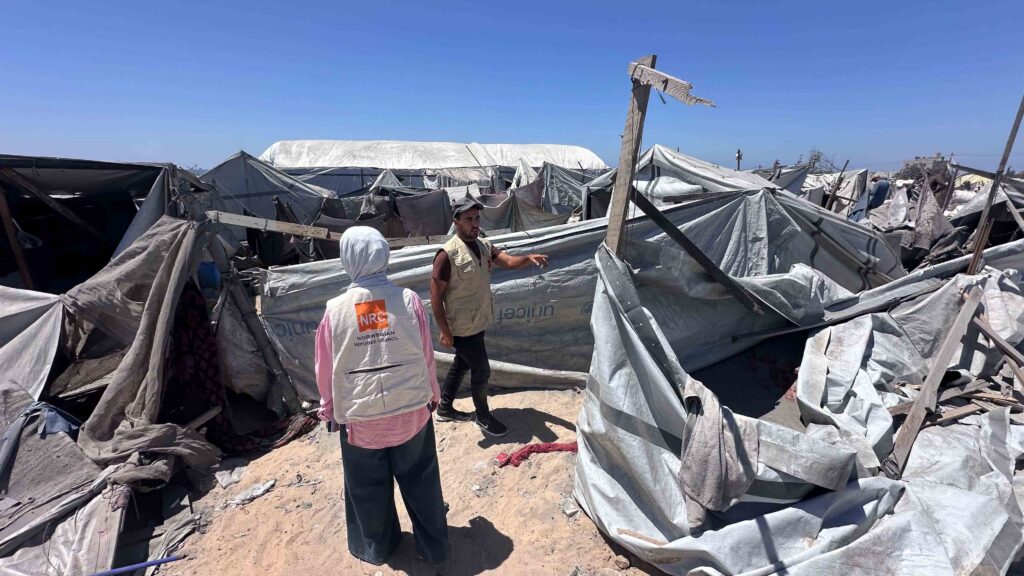
Among the many images coming out of Gaza, there is one that receives less attention than it deserves: rows of tents stretching along the Middle Eastern coast as the temperature continues to rise. Hundreds of thousands of people live inside these shelters without adequate ventilation, sufficient water, or protection from the sun. Thus, the summer is adding pressure to a population already exhausted by more than two and a half years of war, turning the climate into a decisive factor in the humanitarian crisis.
Summer Inside a Tent
The war has left behind rubble, displacement, and a housing crisis of enormous proportions. According to the Norwegian Refugee Council (NRC), which coordinates the Shelter Cluster in Palestine, approximately 170,000 families are currently living in tents in the Gaza Strip—nearly one million people. Another 5,000 families are sleeping outdoors, and 52,000 are housed in overcrowded facilities. As of early June, approximately 850,000 people still lacked essential materials to improve the conditions of their shelters.
Perhaps the most significant finding concerns the very nature of the emergency. Humanitarian organizations are, in fact, describing a housing crisis caused by the destruction of buildings and repeated displacements, exacerbated by difficulties in accessing the materials needed to build or repair emergency shelters.
According to a joint assessment by the United Nations, the European Union, and the World Bank, as early as October 2025, 76.6% of the housing units in the Gaza Strip had been destroyed or damaged: more than 371,000 homes were affected out of approximately 485,000.
The climate is entering a crisis
With the arrival of summer, an already dire situation takes on a new dimension. The Red Cross and Red Crescent Climate Center estimates that average daytime temperatures during the hottest season will reach 34.5 degrees, while instances of temperatures exceeding 35 degrees are set to increase.
For those who live in a house, the heat is a nuisance. For those who live in a tent, it can become a health risk.
“Simple measures such as shade, ventilation, and basic structural improvements can significantly reduce risks and improve living conditions,” explained Jehan Salim, coordinator of the Shelter Cluster project. These are minimal interventions that, according to the organization, are currently difficult to implement due to a shortage of available materials.
The consequences are felt most acutely by the most vulnerable segments of the population. Children, the elderly, and people with chronic health conditions are most at risk of heat stress, dehydration, and respiratory problems. In the most crowded camps, there are also issues related to hygiene, privacy, and safety, particularly for women and girls.
The Beach as a Refuge
These days, a growing portion of the population is seeking relief along the Mediterranean coast. A report published by Reuters describes a scene that would have seemed paradoxical just a few years ago: families leaving their sweltering tents to spend hours in the sea, even though they know the water is contaminated.
“The only way out of the Gaza Strip, from north to south, is the sea,”Wadie al-Ras, a 36-year-old displaced Palestinian, tells Reuters . The tents, he adds, have become “a form of torture. “
The collapse of the water and sewage infrastructure has compromised the quality of coastal waters. “The seawater isn’t clean. It contains sewage and is full of dirt,” explains another displaced person, Shehab al-Suwaireki. Yet thousands of people continue to use it to wash, cool off, and even do their laundry.
According to Husni Muhanna, a spokesperson for the Gaza Municipality, many water pumps and water treatment plants have stopped working or sustained serious damage during the conflict. As a result, the population is forced to choose between the stifling heat of the tents and the health risks posed by a polluted sea.
An emergency that also raises environmental concerns
The images of tents under the sun reveal something that is often overlooked in war reports: the role of the environment in contemporary humanitarian crises. Water, shade, ventilation, air quality, and waste management are just as crucial as food or healthcare.
The summer of 2026 is highlighting just how much climate vulnerability can amplify the effects of a war. In the Gaza Strip, where millions of square meters of buildings have been destroyed and much of the essential infrastructure has been compromised, the sun has become one of the key factors in the crisis.