The water crisis doesn’t build up gradually. It strikes suddenly. In just a few weeks, it causes the liquid treasure—on which the livability of cities, the yield of the countryside, the productivity of factories, and the electricity grid (not based on solar, wind, or geothermal power) depend—to evaporate. Is this a surprise? No, these are phenomena that have been predicted for decades and described in thousands of scientific reports. What should surprise us is the fact that most governments—with the Italian government at the forefront—only take notice of climate issues when they are forced to confront them head-on. Not a minute before, nor a minute after: in the intervals between one climate disaster and the next, they spend public money to prop up the fossil fuels that are destabilizing the climate.
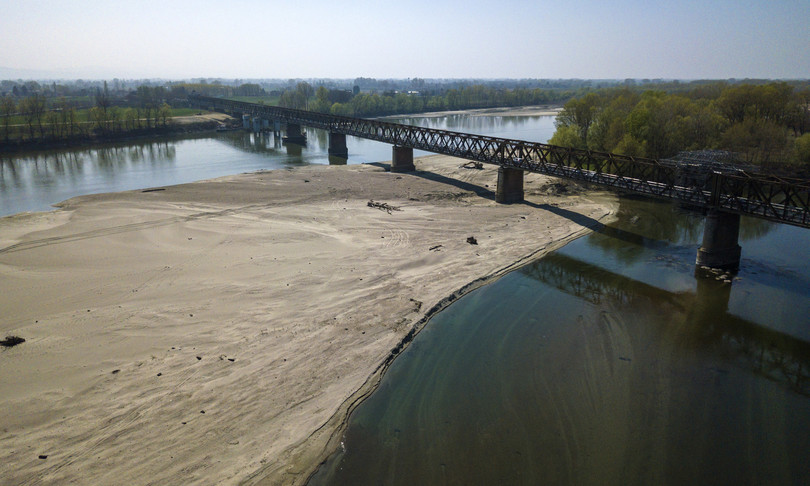
If we were serious, we’d be discussing the figures in the climate plan—focusing on prevention, not emergency response. But the Meloni government’s climate plan is a phantom. So let’s discuss the drought figures, pretending it’s a surprise. Here are the figures summarized in recent daysby ANBI (the National Association of Consortia for Land and Irrigation Water Management and Protection). On June 1, at the Pontelagoscuro gauging station—the main monitoring point on the Po River—the river’s flow rate exceeded 1,000 cubic meters per second. Ten days later, it had dropped below 450. Shortly after mid-month, it was at 300. In less than three weeks, Italy’s longest river lost more than two-thirds of its water.
Four hundred and fifty cubic meters per second is the minimum flow rate required to ensure the proper functioning of the two saltwater barriers located in the Delta, on the Po di Tolle, and on the Po di Donzella. Below that level, seawater flows inland. And that is exactly what is happening: by mid-June, the saltwater wedge had already advanced ten kilometers past the river mouth. The Po Delta Reclamation Consortium had to close some irrigation canals to prevent saltwater from reaching the fields.
Gutters without a reservoir
This isn’t just a seasonal drought. Or at least, not only that. It’s a sign of a structural change in the way water moves through Northern Italy’s water system.
Alex Vantini, president of ANBI Veneto, used a striking image: waterways are turning into “gutters” that quickly drain rainwater into the sea. In the past, glaciers were responsible for slowing down these flows. They functioned as natural reservoirs at high altitudes: they accumulated snow and ice in the winter and released water slowly during the summer, when water demand is at its peak.
The Value of Natural Ecosystems
Environmentalists often talk about the value of natural ecosystems. To some, these seem like abstract concepts. But the reality of the situation becomes strikingly clear when one of these systems breaks down. This time, it’s the ice reservoirs that are disappearing. In recent decades, the Alps have lost a significant portion of their glacial mass. What remains is no longer enough to compensate for variations in precipitation. As a result, June begins with heavy rains—the first ten days of the month were relatively rainy—but when the rain stops, the river runs dry within a few days.
Obviously, the crisis on the Po is not an isolated case. The same trend risks spreading to the other major rivers in the Veneto region, starting with the Adige and Brenta. For now, no saltwater intrusion has been recorded in those rivers, but the alert level is high. And the cause is the same: the lack of snowpack at high elevations has reduced water availability during the months when runoff normally ensures a reserve.
If the situation were to worsen—and the heat wave forecast for the coming days won’t help— the introduction of irrigation schedules will be considered. This is an emergency measure that, in the agricultural areas of the Northeast, brings to mind difficult years such as 2022, when the Po River reached extremely low levels.
A systemic shock, not an anomaly
What sets this situation apart from past droughts is not only its severity—although experts have described the rapid drop in the Po River’s water level over ten days as “extraordinary and concerning”—but the structural nature of the change. We are not talking about an exceptional event or an anomalous year. We are talking about a water system that is being reshaped under the pressure of the climate crisis.
When nature loses a resource accumulated over millennia— the ice of the Alps—it sends a brutally simple message: less water, more salt, less food. The Pontelagoscuro monitor is one of many tools that science has made available to track what’s happening in real time. It’s time we started paying attention to it.