When people talk about war, the focus is inevitably on civilian casualties, destroyed cities, affected hospitals and razed infrastructure. But there is another front, less visible and often overlooked: that of the environment. Modern wars, especially when they affect energy and industrial infrastructure, can generate environmental disasters on a regional scale, with effects that continue long after the fighting ends.
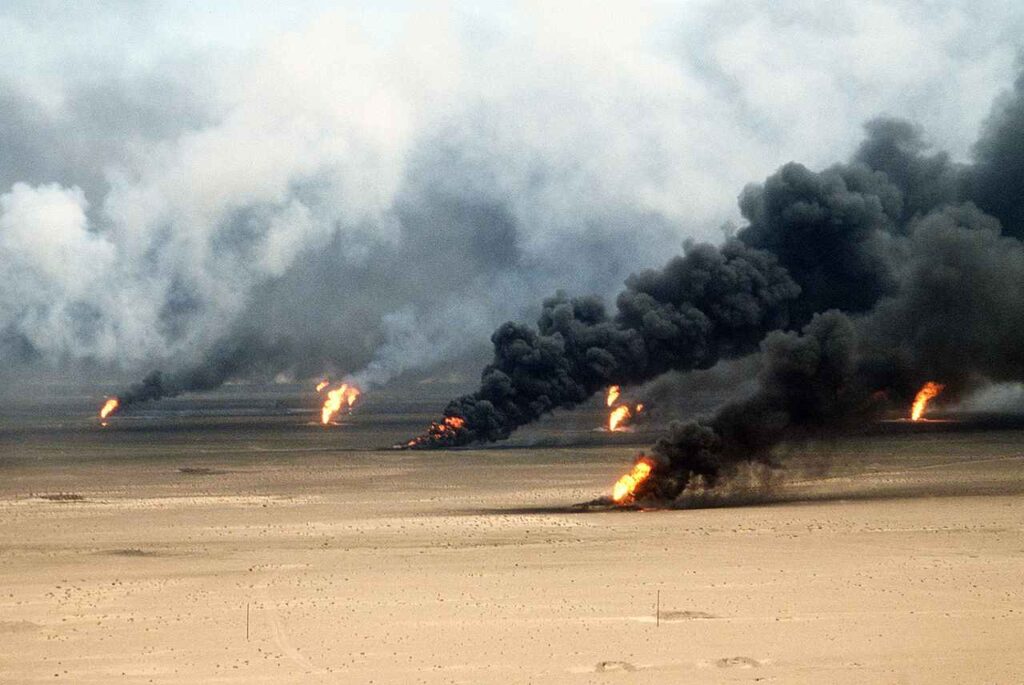
One of the most dramatic examples remains the Kuwaitioil well fires in 1991. During the retreat from the Gulf War, Iraqi troops set fire to more than six hundred oil wells. For months the sky over the Persian Gulf was darkened by huge columns of black smoke, visible even from space.It was one of the largest air pollution episodes ever caused by an armed conflict. Thousands of tons of soot, fine particulate matter, sulfur dioxide, nitrogen oxides and toxic hydrocarbons were released into the atmosphere and carried over vast areas of the region.
The immediate effects were obvious. Military personnel and exposed populations complained of coughing, eye irritation, breathing difficulties and other symptoms related to inhaling toxic fumes. The air in some areas became almost unbreathable.
But the disaster did not only affect the air. At the same time, millions of barrels of oil were spilled into the Persian Gulf, contaminating coastlines, seabeds and coastal ecosystems. Entire areas of the Kuwaiti desert were covered with lakes of crude oil and a crust of sand and solidified oil.
That catastrophe demonstrated for the first time on a large scale how war can produce complex environmental damage: not just immediate destruction, but persistent contamination of air, water and soil.
Long-term health consequences are difficult to measure with scientific accuracy. Epidemiological studies have clearly documented acute respiratory effects, while evidence of substantial increases in chronic diseases remains more uncertain, in part because of difficulties in reconstructing the actual exposure of populations.
But one thing is clear: pollution generated by conflicts of this magnitude can remain in the environment for years, with effects that extend well beyond the duration of the war. And today the Middle East is in danger of facing a scenario reminiscent of Kuwait.
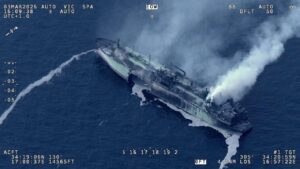
In the conflict that the United States and Israel have initiated against Iran, attacks on fuel depots, refineries and energy infrastructure have already resulted in fires and clouds of toxic smoke above some cities. Substances released from the fires can settle on soil and water, enter the food chain and contaminate ecosystems for years.
In a region like the Gulf, where millions of people depend on seawater desalination plants for their drinking water supply, marine pollution also poses a direct threat to water security.
It is a dimension of war that is still too little talked about. Contamination of the environment can last for decades. Agricultural soils can become unusable. Aquifers can remain contaminated for a long time. Marine and terrestrial ecosystems can take generations to recover.
This is why more and more experts are talking about a real “toxic legacy” of armed conflicts. The case of Kuwait demonstrates this powerfully: an event that lasted only a few months required years of environmental cleanup and billions of dollars of interventions to try to restore devastated territories.
Yet despite these lessons, energy infrastructure continues to become military targets in contemporary conflicts.
War doesn’t just kill with bombs. It poisons the air we breathe, the water we drink and the land on which our survival depends. And while cities can be rebuilt, a contaminated environment can scar the health of entire populations for generations.This is perhaps the most underestimated dimension of war. But also one of the most dangerous for the future.
*Roberto Bertollini is WHO Representative to the European Union.