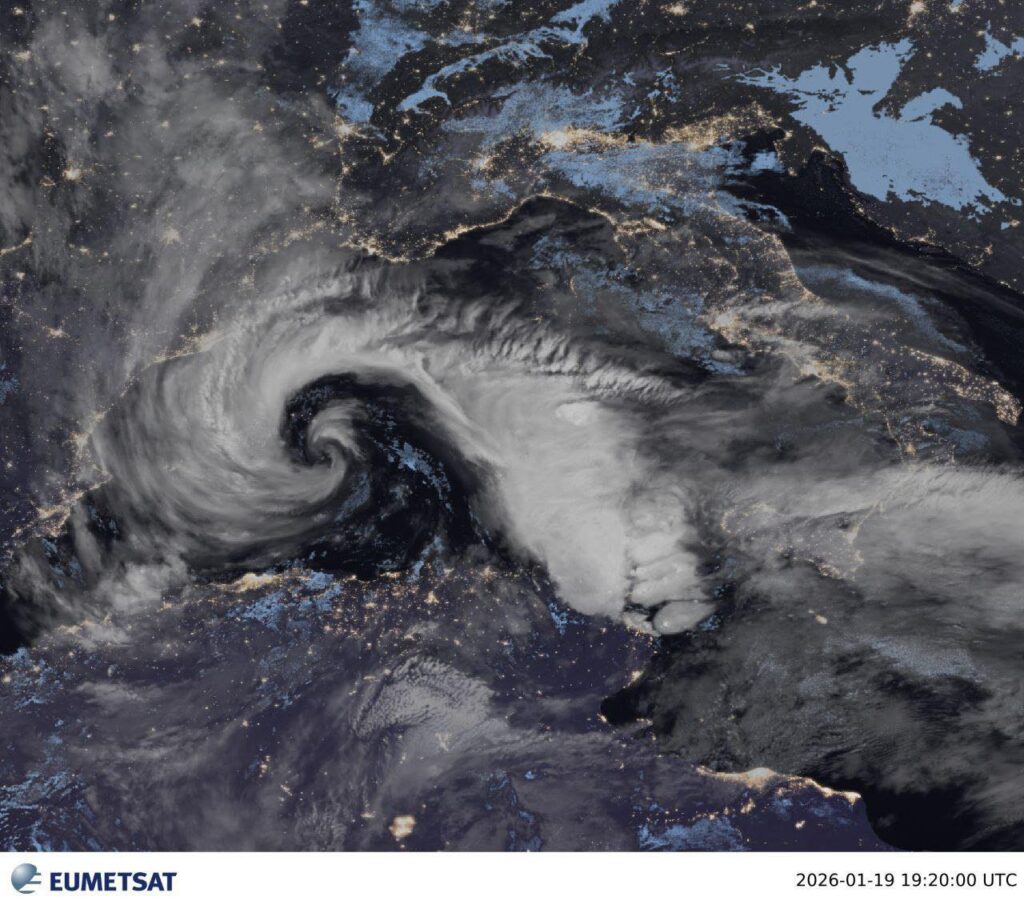
The extraordinary council convened for 12 p.m. today at the Orléans Palace by President Renato Schifani is not a formal act. Sicily must handle the request for a national state of emergency after Cyclone Harry hit the island, along with Calabria and Sardinia, with weather-marine parameters rarely recorded in the Mediterranean. Minister Nello Musumeci and Civil Defense chief Fabio Ciciliano are expected to inspect the coastlines of Santa Teresa di Riva and the Ognina waterfront in Catania this afternoon.
The dynamics of storm waves
Technical data explain the devastation of the eastern coastline. This was not a common storm surge, but a storm surge (storm wave) combined with a phenomenon of a swell (long swell) with oceanic characteristics. Deep low pressure caused sea level rise, while winds in excess of 120 km/h acted on a very large sea surface.
Durante una diretta sul lungomare: il sindaco di Taormina, Cateno De Luca, e il sindaco di Santa Teresa di Riva, Danilo Lo Giudice, mentre mostravano in live i danni provocati dal ciclone Harry, sono stati improvvisamente travolti da un’onda. Le immagini raccontano in modo… pic.twitter.com/kKIKWzgRzW
— La Sicilia (@lasiciliait) January 20, 2026
This combination generated waves with a maximum height of 16 meters and a “period” of 10 seconds. In physical terms, it means that a mass of water hit the coast with a frequency and force of impact comparable to the ocean. In Syracuse, the retaining wall of Via Arsenale gave way, while in Mascali and Acireale, the sea knocked down the boundary walls of waterfront homes. According to Fabio Morreale (Natura Sicilia), the extent of the damage is linked to an unresolved issue: “the excessive proximity of buildings to the shore.”
Railways disrupted and cities isolated
Mud and storm surges have compromised infrastructure connections. While traffic has resumed on the Caltanissetta-Agrigento and Syracuse-Caltanissetta lines, the situation remains critical on the Ionian coast. In Scaletta Zanclea, Messina, the force of the sea destroyed the embankment: the tracks of the Messina-Catania line were suspended in the void, making it impossible for trains to pass.
Work is under way in Santa Teresa di Riva to restore minimum services. The main water main was destroyed and technicians had to make an emergency bypass to supply the southern area, while Enel is using generator sets to make up for the blackouts. Mayor Danilo Lo Giudice confirmed the arrival of the army to support the population in clearing the debris.
Monitoring in schools
In Catania, Mayor Enrico Trantino has extended the closure of schools, parks and public gardens. The decision is linked to the need for structural checks in buildings after torrential rains, which reached 600 millimeters in the Etna area. “We are preparing the resolution for the state of calamity,” Trantino explained, “the damage could run into tens of millions of euros.
Despite the gradual eastward movement of the low depression, the alert remains high. Final improvement is expected today, Jan. 22, but counting structural damage to coastal defenses and the rail network will take much longer.