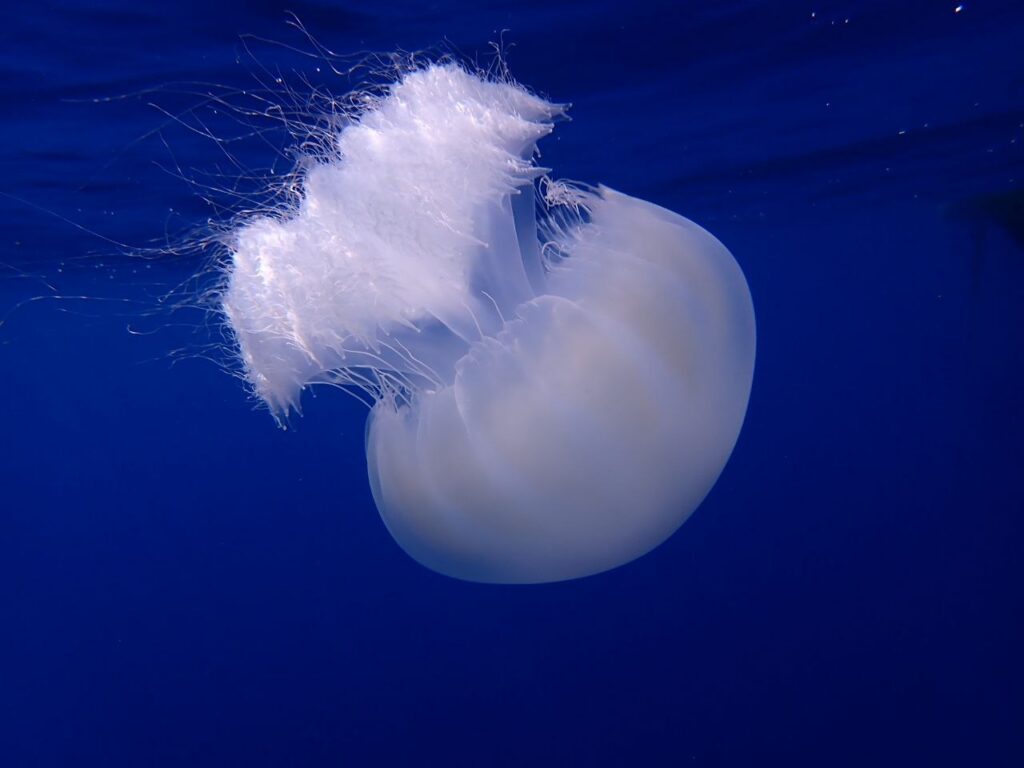
It can weigh up to 40 kilograms, moves in swarms of hundreds or thousands of individuals, and has tentacles capable of causing even severe skin reactions. It is the nomadic jellyfish (Rhopilema nomadica), an invasive species that is occupying an increasingly large area of Italian waters. In Sicily, sightings are increasing faster than elsewhere.
The nomadic jellyfish is native to the Red Sea and the Indo-Pacific region and entered the Mediterranean through the Suez Canal. The first sightings date back to the 1970s, along the coast of Israel. From there, over the decades, the species has spread further and further into the basin. In Italy, it was first documented in September 2015, in the waters off Pantelleria.
Sicily Under Special Surveillance
Recently, ISPRA has received reports from numerous locations across the island: Trapani, the Egadi Islands, Ustica, Lampedusa, Cefalù, the Gulf of Castellammare, and Palermo. In some cases, these are individual specimens; in others, they are actual groups. According to the Institute, this situation requires close monitoring of the species’ presence and distribution.
It can make it difficult to use the beaches, with repercussions for tourism and beach activities. But the problem doesn’t just affect swimmers: when they form large swarms, these nomadic jellyfish can end up in fishing nets en masse and hinder fishermen’s work. For anyone spending time at the beach, there’s only one rule: never touch them, not even when they’re washed up on the shore and seem harmless.
Participatory Monitoring
To track its expansion, ISPRA relies on the collaboration of those who experience the sea every day: citizens, fishermen, boaters, divers, and maritime industry professionals. Anyone who spots one is asked to photograph or film it without approaching or touching it. The report should then be sent to alien@isprambiente.it, indicating the date and location of the sighting.
“Every piece of information collected helps expand our knowledge of the species’ distribution and strengthen our ability to monitor and protect our marine ecosystems,” explains Maria Alessandra Gallone, president of ISPRA and SNPA. “Protecting the sea means, first and foremost, understanding it: collaboration between the scientific community and citizens is an essential resource for safeguarding biodiversity and addressing ongoing changes with awareness, because the sea is a shared heritage. Understanding, observing, and monitoring it is everyone’s responsibility.”