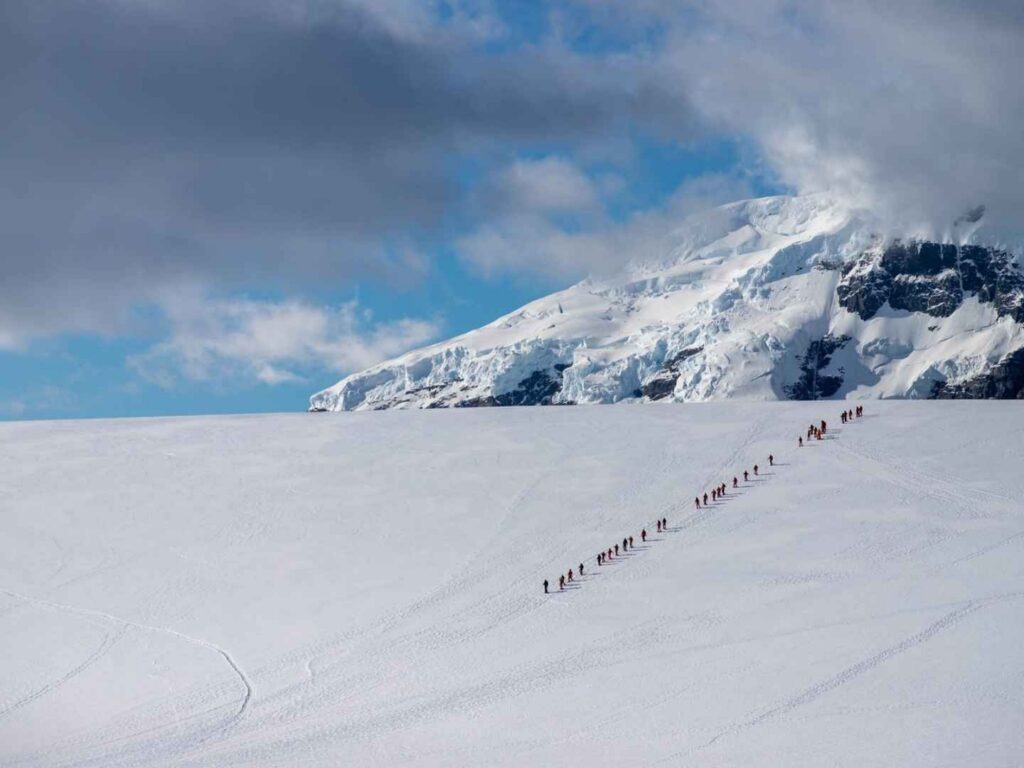
It’s hard to imagine a more striking paradox: the warmer Antarctica gets, the more people want to see it before it changes. Demand has been growing quietly for years, focusing mainly on the Antarctic Peninsula, where the waters are largely ice-free, making logistics less daunting. In 2015, there were just under 37,000 visitors; in 2023–24, the IAATO, the International Association of Antarctic Tour Operators, counted 122,072, before the number dropped to 118,491 in the 2024–25 season. Early estimates for the recently concluded 2025–26 season indicate a further decline, to around 113,500 visitors: this would mark the second consecutive drop after years of nearly uninterrupted growth.
However, this does not appear to be a demand issue: the decline is primarily driven by new regulations affecting large cruise ships, which do not allow passengers to disembark, and are penalized by the ban on the use of heavy fuel oil in Antarctic waters introduced by the International Maritime Organization in 2024 and by the 2025 IAATO restrictions on ships carrying more than 500 passengers. The tourism segment involving shore excursions—the most economically significant for the industry—continues to grow, however.
Kayaking among the boulders, helicopter rides
The narrative remains the same as in the brochures: icebergs, humpback whales surfacing, penguins. In recent years, however, the range of activities has expanded far beyond simple wildlife viewing: kayaking among the ice floes, helicopter flights, and landings on blue ice runways. In 2021, an Airbus A340 landed on an Antarctic runway for the first time, an event that marked the beginning of a new era. At the same time, the fleet of “ice-class” ships—with reinforced hulls and hotel-style amenities on board—has grown. A study by Queensland University of Technology, the University of Tasmania, and the CSIRO estimates that visitor numbers could approach half a million by 2033, despite the slowdown over the past two years.
This emotional drive has a specific name: “last chance tourism”—the idea of seeing a place before it changes forever. The Antarctic Peninsula is among the areas of the planet warming the fastest, and the ice sheet continues to lose mass every year, according to NASA satellite data. The desire to witness the “before” intersects with the ambassador’s rhetoric: see in order to protect. But here a more uncomfortable contradiction arises: according to some estimates cited by the international press, the carbon footprint of a single trip to Antarctica is close to the annual emissions of an average citizen.
The concerns of scientists and environmentalists are not limited to climate issues but also extend to health and biology. Antarctica is a microbial desert, and introducing organisms from outside—even just seeds lodged in the laces of a boot—can have unpredictable effects. In recent years, the arrival of avian flu carried by South American migratory birds has forced a tightening of protocols: no contact with wildlife, strict social distancing, and cleaning of boots and equipment before every landing. “You can find all sorts of things between the tongue and the laces,” say those who have been leading expeditions for years.
A hantavirus outbreak
The risks do not affect only wildlife. Between April and May 2026 , an outbreak of Andean hantavirus aboard the MV Hondius—an expedition ship that departed from Ushuaia on April 1 on a voyage that took it to the Antarctic mainland, the Falkland Islands, South Georgia, and Saint Helena before heading toward Cape Verde, has refocused attention on public health management on the high seas. The final toll was three deaths and thirteen confirmed cases.
The World Health Organization has determined that the first case, a 70-year-old Dutch passenger, had been infected before boarding—most likely through contact with a rodent during a trip to Argentina—while the infection then spread among passengers through close contact, in accordance with the known mode of transmission for the Andes strain, the only one capable of spreading from person to person. The operator, Oceanwide Expeditions, did not report any rodent infestations on board. No infections occurred on the Antarctic continent: the outbreak developed during the Atlantic crossing, and the WHO declared the emergency over on July 2, 2026.
After all, the traces of human activity are not limited to biological ones. Trails form where there was once only snow; thin layers of soil erode; and the underwater noise from engines and inflatable boats can disturb marine mammals. At sea, more ships mean greater risk: collisions with ice and unmapped shoals, emergencies days’ sail away from a well-equipped port. The sinking of the MS Explorer in 2007 remains in the collective memory, with the oil slick remaining visible for months. The industry counters with reinforced hulls, better-protected fuel tanks, and less harmful fuels, and also claims to play a useful role: supplying scientific bases, transporting researchers, and promoting environmental education.
The Antarctic Treaty of 1959
The problem, however, remains systemic. The rules exist and are stricter than those of any other remote destination, but they are based on regulations designed when Antarctica was a destination for only a few. The 1959 Antarctic Treaty established a framework that protects research and the value of the region; the industry has established a self-regulatory body, the IAATO, which defines sites, landing schedules, and limits for ships with more than 500 passenger capacity—limits that were actually strengthened in 2025. It works, as long as the numbers remain manageable. But what happens if visitor numbers start rising again to nearly half a million? Who decides how many people can set foot on a headland where penguins nest? And how can voluntary governance be reconciled with the proliferation of independent operators, both by sea and by air?
Amid these questions, various positions have emerged. Some, such asthe Antarctic and Southern Ocean Coalition, are calling for updated safeguards and stronger protection for penguins, cetaceans, and krill—which form the basis of the food chain. And there are those who urge us to shift our perspective: Antarctica is a place to be protected and understood, not necessarily to be visited in person—one can write great books about the ice without ever having been there, and mediocre ones after having been there. Yet, in the background, there remains an idea shared by many: a footprint left there can remain visible for decades.
Absence as a Form of Healing
Meanwhile, the future remains uncertain amid conflicting forces: on the one hand, new regulations that have already reduced traffic from large cruise ships; on the other, a demand for experiential tourism that, according to travel insurers, grew by more than a third in 2026 alone despite the hantavirus outbreak. This is the moment when the logic of the Treaty—a common good for science and peace—must contend with the logistics of mass tourism. Neither the individual traveler’s awareness nor clean hiking boots are enough: we need access restrictions tied to the sites’ carrying capacity and shared standards between those arriving by land and those arriving by air. It is a complex task, but it is the one that will allow us, in a few years, to avoid having to choose between shutting everything down or regretting what we failed to regulate in time.
Perhaps the real question isn’t whether to go to Antarctica, but whether one is willing to accept that, in certain places, absence can be a form of healing.