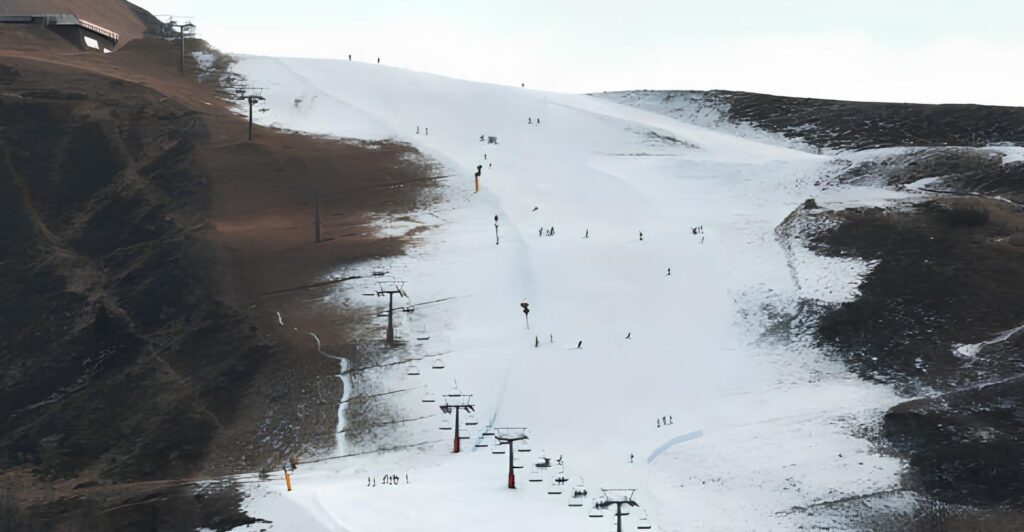
Italy’s mountains are changing rapidly: rising temperatures and reduced snowfall are making the “snow system” increasingly fragile, but public policies are struggling to adapt. According to the dossier Nevediversa 2026 by Legambiente, about 90 percent of public funds earmarked for mountain tourism continue to support ski facilities, while only marginal resources reach the reconversion of infrastructure and diversification of the tourism offer.
The report offers an up-to-date snapshot of the Alps and the Apennines in a context marked by the climate crisis, showing how many resorts are increasingly struggling to maintain the traditional slope-based model.
Closed and abandoned facilities
One of the most obvious signs of the ongoing transformation is the increase in unused ski infrastructure. In Italy there are 273 disused ski facilities surveyed along the Alpine arc and in the Apennines. Alongside these are 247 “suspended buildings,” or abandoned or underutilized hotels, residences and other tourist facilities.
Piedmont is the region with the highest number of abandoned facilities, followed by Lombardy. In terms of abandoned buildings, however, the highest numbers are recorded in Valle d’Aosta, Lombardy and Piedmont along the Alpine arc, while on the Apennines widespread situations emerge in Tuscany, Abruzzo, Marche and Sicily. Among the symbolic cases cited in the dossier is the Grand Hotel Wildbad in San Candido, a historic structure now in a state of severe deterioration that represents the difficulties of many mountain resorts in reinventing their future.
Plants that survive thanks to funding
Next to permanently abandoned facilities there is also a vast area of intermediate situations. There are 106 temporarily closed facilities in Italy, while 98 operate intermittently, alternating seasons of opening and closing. Even more significant is the number of facilities that continue to operate only thanks to public economic support: there are 231 cases defined as “therapeutic care,” that is, facilities that remain in operation despite economic and climatic difficulties.
Lombardy, Abruzzo and Emilia-Romagna are the regions where this situation is most prevalent, a sign of a system struggling to adapt to increasingly uncertain environmental conditions.
Between artificial snow and new “Mountain Luna Park“
To compensate for the decrease in natural snowfall, investments in artificial snowmaking are multiplying. Across the Peninsula, 169 reservoirs have been surveyed for programmed snow production, concentrated mainly in the Alpine regions.
In parallel, new attractions designed to keep resorts attractive even in the absence of snow are emerging. The dossier points to the spread of so-called “mountain amusement parks,” facilities with tubing tracks, rail bobsleds or other recreational activities integrated with ski resorts. In Italy, 28 have been surveyed, with a significant presence in Lombardy and Tuscany.
According to Legambiente, however, these solutions risk accentuating the artificialization of mountain environments without really addressing the structural causes of the winter tourism crisis.
Olympics and major events under pressure
Climate change is also challenging the future of major snow-related sporting events. Scientific studies indicate that within a few decades nearly half of the Winter Olympic venues could lose the climate reliability needed to host competitions, while for the Paralympics the number of suitable locations could shrink dramatically.
In this context, the Milan-Cortina 2026 Olympics are also being closely watched. Amid construction delays, high costs, and massive infrastructure, the debate over the legacy of these events remains open, especially in light of an increasingly fragile mountain environment.
Rethinking the future of mountains
Data show how the snow season in the Alps has shortened significantly compared to half a century ago and how snowpack thickness has decreased significantly. On the Apennines, the presence of snow has become even more uncertain, making it difficult to plan ski seasons.
Ski-related tourism is also showing signs of slowing down. For the 2025-2026 season, a significant drop in daily skiers and a slight decline in tourist stays is estimated, even in an industry that continues to generate significant economic volume for mountain resorts.
For Legambiente, the answer cannot be limited to sustaining a model that is now in trouble. The “Manifesto of the Caravan of Mountain Hospitality” proposes focusing on a more diversified tourism that can enhance landscapes, culture and local communities and reduce dependence on snow.
The mountains, in other words, are being called upon to rethink their future. In a rapidly changing climate, continuing to focus only on slopes risks becoming an increasingly difficult gamble.