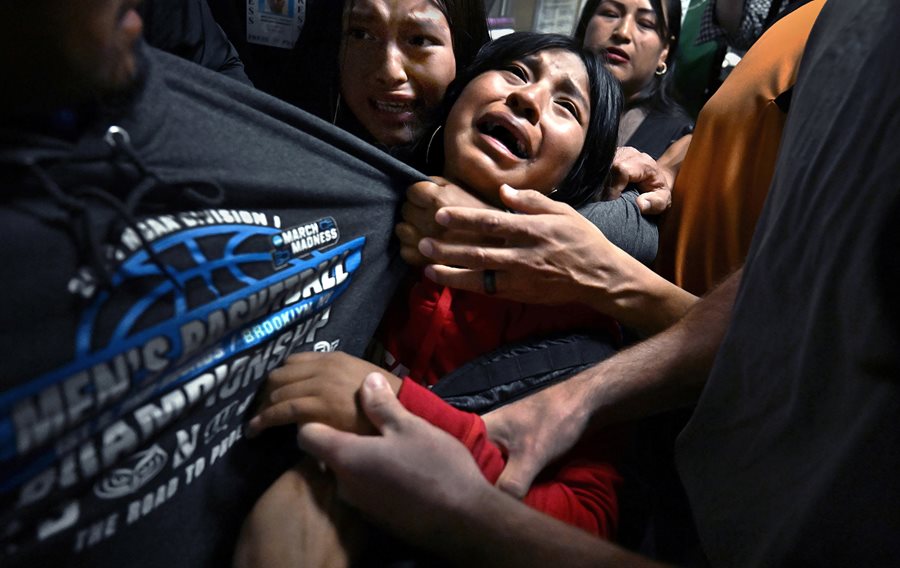
There is one photograph that is not easily forgotten. Two little girls cling to their father, Luis, an Ecuadorian migrant, in the hallway of a New York federal building. ICE agents are taking him away. He has no criminal record. He was there for an immigration court hearing. The photo is called Separated by ICE, was taken by Carol Guzy for the Miami Herald in August 2025, and is the Photo of theYear for World Press Photo 2026, the oldest and most influential award in world photojournalism.
The foundation announced the winners on April 23 in Amsterdam, where the main exhibition opened the following day at De Nieuwe Kerk. The numbers for this edition give the measure of the feat: 57,376 photographs selected, 3,747 photographers from 141 countries, six regional juries and one global jury. In the end, one image takes home the most important recognition. And the one chosen by jury chair Kira Pollack – a researcher at Harvard and former director of photography for Time and Vanity Fair – says something definite about the goal of photojournalism in 2026.
Guzy captured the scene in one of the very few U.S. federal buildings still accessible to photographers: a single hallway, manned day after day by a handful of reporters. Luis’s family-his wife Cocha and three children between the ages of seven and 15-was left alone after his arrest. He was the core’s only economic support. The photo captures the exact moment when the damage is done, before it becomes statistics or trial memory. Guzy, who has been following the consequences of migration policies on families for years, dedicated the award to those who opened their lives to her camera: “This award belongs to them, not to me.”
The finalists: Gaza and Guatemala
Alongside Guzy’s shot, the jury selected two finalists that broaden the picture of global emergencies in 2025. The first is Aid Emergency in Gaza by Saber Nuraldin for EPA Images: a crowd of Palestinians climbing into a truckload of flour at the Zikim crossing during a brief suspension of Israeli military operations. By 2025 the famine had escalated to levels that a UN commission called part of a genocide. Nuraldin’s image does not discount: compressed bodies, collective urgency, hunger as a weapon. The jury wrote that the composition “forces the viewer to pause” before a reality that it would be more comfortable to ignore.
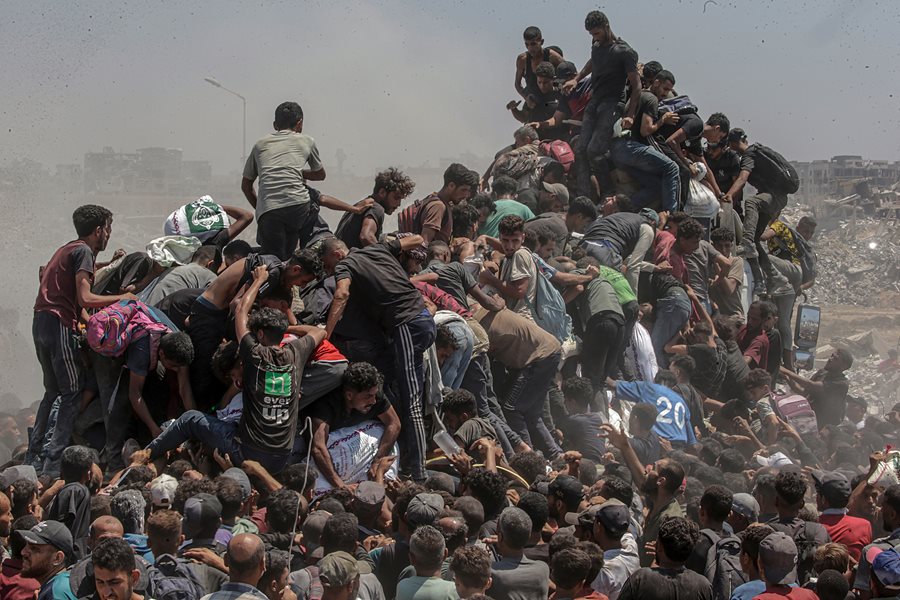
Saber Nuraldin, EPA Images
The second finalist is from Guatemala. Victor J. Blue, for the New York Times Magazine, portrayed Doña Paulina Ixpatá Alvarado with other Maya Achi women outside the Guatemala City courthouse on May 30, 2025, the afternoon three former civilian militia members were sentenced to 40 years for rape and crimes against humanity. The legal battle had lasted fourteen years; the crimes dated back to 1983. Blue’s photograph chooses the calm frontality of those who have waited decades for a sentence. No emphatic gestures, just the presence of women who have turned their survival into a legal act.
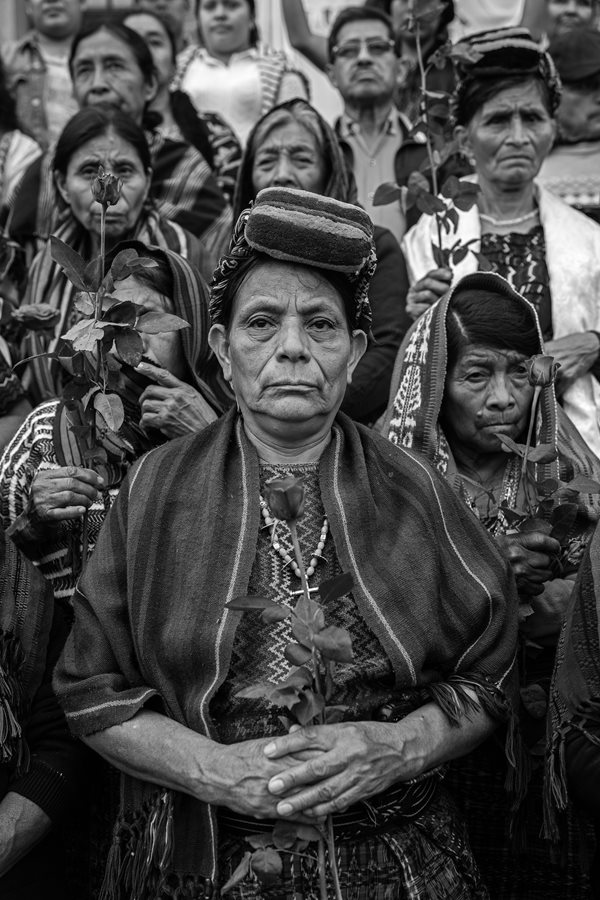
Victor J. Blue, for The New York Times Magazine
An Italian among the awardees
There is also an Italian signature to report in the 2026 edition. Chantal Pinzi won in the Stories for Africa region category with her project Farīsāt: Gunpowder’s Daughters, dedicated to the women who participate in the Moroccan Tbourida, the equestrian tradition that evokes ancient warfare techniques and remained exclusively male for centuries. Pinzi documented female riders defying entrenched social conventions amid smoke and gunpowder, claiming the right to inhabit a culture that had excluded them. “For centuries women were not allowed to ride horses,” the photographer explained. “Today these horsewomen are rewriting history.” A work that fits into this edition’s common thread: stories of silent resistance, slow transformations within closed structures.
A contest that questions itself
The model adopted by World Press Photo since 2021-with six geographic areas and separate regional juries-shifts the contest’s center of gravity. This year 31 of the 42 prize-winning entries are by photographers who originate from the places they documented. It means that less and less international photojournalism is the outside look of those who arrive, shoot and depart. It means stories told from the inside, with different times and relationships. Participants from South America are up 11 percent from 2025, those from Asia-Pacific up 14 percent.
The themes running through the 2026 edition are those that marked 2025: conflicts (Gaza, Ukraine), the climate crisis (fires in Los Angeles and Spain, floods in the Philippines), protests (from Columbia University to Portland, from Madagascar to Nepal), and struggles for rights.
The traveling exhibition will touch more than 60 venues around the world. In Italy it will come to the Palazzo delle Esposizioni in Rome from May 7 to June 29, then to Lodi for the Ethical Photography Festival (Sept. 26-Oct. 25) and finally to Bologna, at the Galleria Modernissimo (Oct. 30-Nov. 30). Seeing it is the best way to understand why World Press Photo still exists: not to elect the most beautiful photograph, but to remind us that there are places where elementary rights are violated. And that someone, with a camera in hand, has the courage to document the abuses.