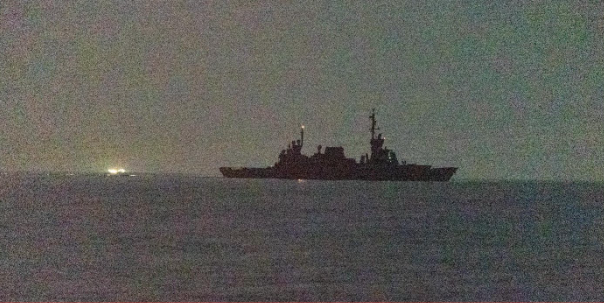
The Mediterranean has never been so small, nor so dangerous for those who decide to cross it with a cargo of solidarity. On the night of April 29-30, 2026, what international law textbooks would probably call an act of piracy took place some 500 nautical miles off the Israeli coast. In international waters, close to the island of Crete, in a maritime quadrant that geographically and politically belongs to Europe, Israel’s navy intercepted and boarded the Global Sumud Flotilla.
Our boats were approached by military speedboats, self-identified as “israel”, pointing lasers and semi-automatic assault weapons ordering participants to the front of the boats and to get on their hands and knees.
— Global Sumud Flotilla (@gbsumudflotilla) April 29, 2026
Boat communications are being jammed and a SOS was issued. pic.twitter.com/qjkFKLjqPw
The toll is at least 22 civilian boats seized out of 60 total, 175 activists arrested (some sources speak of 400) and forcibly taken to Ashdod port. This is not the first time a humanitarian mission has attempted to break the siege of Gaza, but the distance at which the attack occurred marks a point of no return. Whereas in the past interceptions took place close to the edge of territorial waters, today Tel Aviv’s reach has extended to the center of the Mare Nostrum.
Israeli forces have intercepted around a dozen Gaza-bound aid boats from the Global Sumud Flotilla in international waters near the Greek island of Crete, more than 1,000km from Israel.
— Al Jazeera Breaking News (@AJENews) April 30, 2026
Organisers call it an illegal attack on civilians in international waters. pic.twitter.com/anFDUK3f4M
The boarding
Testimonies gathered from trackers and SOS messages sent before the communications blackout describe scenes of an operation of war against unarmed civilians. “They aimed lasers and semi-automatic assault weapons, ordering participants to move to the bow and get on their knees,” report mission organizers. The Flotilla-the name “Sumud” recalls the resilience and steadfastness of the Palestinian people-had left Sicily laden with medical and food aid for a population that has been living under bombardment for more than two years.
Vittorio Sergi, an activist from the Marche region at the helm of one of the Italian-flagged vessels, managed to send a final account before the interception: “We were headed for a nonviolent protest action against the Zim Emeralda ship, which left Genoa with a dangerous cargo. This is a sign that peace initiatives bother those who have made the Mediterranean their backyard.”
An insurmountable legal knot
While images show armed soldiers boarding recreational boats, the Israeli Foreign Ministry posted a diametrically opposed narrative on social media, calling the operation “professional and determined” against “delusional agitators.” On X, Israel’s official account posted videos talking about a “condom flotilla” and claiming that medical aid consisted of contraceptives and drugs. An attempt to ridicule the mission that jars with the seriousness of the territorial violation denounced by activists.
Approximately 175 activists from more than 20 boats of the condom flotilla are now making their way peacefully to Israel.
— Israel Foreign Ministry (@IsraelMFA) April 30, 2026
In the video: the activists enjoying themselves aboard Israeli vessels pic.twitter.com/0sz8kDpKLX
Defense Minister Israel Katz signed a decree to sanction expeditionary fundraising, accusing the organization of direct ties to Hamas. “The anti-terrorism law allows the seizure of assets intended for terrorist activities,” the Tel Aviv government said. But an insurmountable legal knot remains: with what authority can a sovereign state operate seizures and arrests on civilian vessels in international waters, nearly a thousand kilometers from its borders?
An impunity that questions Europe
“This is abduction of civilians on the high seas. Israel operates with total impunity under the eyes of the world,” is the harsh comment of Flotilla spokeswoman Maria Elena Delia. The Farnesina, through Minister Tajani, has activated the Crisis Unit and requested information from Athens and Tel Aviv to protect the Italian citizens involved. But the political issue is deeper: if the Mediterranean becomes an area where the right of force prevails over the right of navigation, no one is safe anymore.
The action of the Global Sumud Flotilla was not just an act of humanitarian assistance to a Gaza exhausted by 72,000 dead, but an attempt to reaffirm the sea as a space of brotherhood and peace. The boarding of Crete turns that sea into a gray area, where European sovereignty seems to evaporate in the face of the security needs of a third state. The silence of international institutions, in this context, risks appearing as a dangerous form of complicity. If piracy becomes practice, the Mediterranean ceases to be a bridge and becomes an open-air prison.