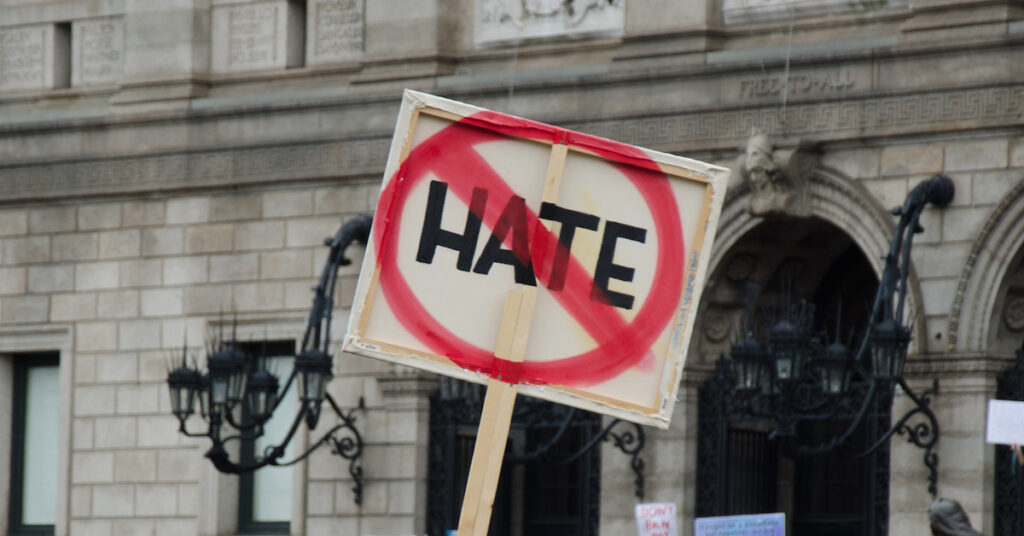
Concerns about the growth of hate circulating online, often linked to a wave of racism and attacks on science and the environment, return cyclically in the European public debate. The Spanish government led by Pedro Sánchez has intervened on this sensitive issue: it has announced plans to develop tools capable of systematically monitoring the spread of hate speech online. The goal is to analyze how much and how certain content circulates on social networks and to verify the response of digital platforms, that is, their effectiveness (or ineffectiveness) in suppressing incitement to violence and hatred.
An increasingly poisoned climate
The starting point is an obvious fact: in recent years the climate of public communication has become much more aggressive. Social networks have amplified phenomena that already existed, making insults, threats and delegitimization campaigns more visible-and more viral.
Political and cultural polarization has helped create a toxic system in which violent language is likely to appear normal. Studies of online conversations show that a significant portion of comments under news and political posts are dominated by aggressive sentiments. Although explicit hate speech accounts for a minority share of posts, the general level of hostility in digital debate is very high.
In this context, the idea of systematically monitoring the phenomenon stems from the need to better understand where and how hatred spreads. This is not just a linguistic issue, but a social and democratic problem: when the public climate becomes too aggressive, the risk is that some voices-minorities, journalists, researchers-will be silenced by the growing noise.
The boundary between monitoring and control
Of course, any attempt to measure language online also opens up sensitive questions. Who determines what is hate and what is mere criticism? And most importantly: does a monitoring system risk turning into an instrument of political control? These are legitimate questions, which explain why the proposal has elicited mixed reactions. In many European democracies, balancing freedom of expression and countering hate is one of the most complex issues of the digital age.
However, there is another aspect that is often overlooked in the debate: hate is not the only problem that crosses the information sphere. Another wave, that of fake news and scientific misinformation, has also been spreading strongly in recent years. And very often the two problems merge because fake news is frequently launched with arrogance and violence, in total disregard of knowledge accumulated over centuries of research and scientific and ethical debate.
Conspiracy theories, denial of scientific data, and targeted disinformation campaigns have thus contributed to undermining trust in institutions and research.The case of climate change is emblematic. Although the scientific consensus is now overwhelming, content denying or minimizing the climate crisis continues to circulate on social media, often accompanied by personal attacks against climatologists and researchers.
A challenge for digital democracy
The real crux, then, is not just measuring hate but finding counter measures capable of curbing the phenomenon. A particularly dangerous phenomenon because insults, propaganda, data manipulation and fake news are often part of the same circuit. Very often aimed at a deligitimization of science that leaves the field open to powerful lobbies.
Monitoring these phenomena can be useful, but alone it is not enough. What is needed is transparency in platform algorithms, accountability in information, and above all, greater scientific and digital literacy among citizens.Because the quality of public debate – online and offline – does not depend only on technological tools. It depends above all on the ability of our societies to stand up for facts, science and mutual respect.And without respect for facts and people, it is democracy that sinks.