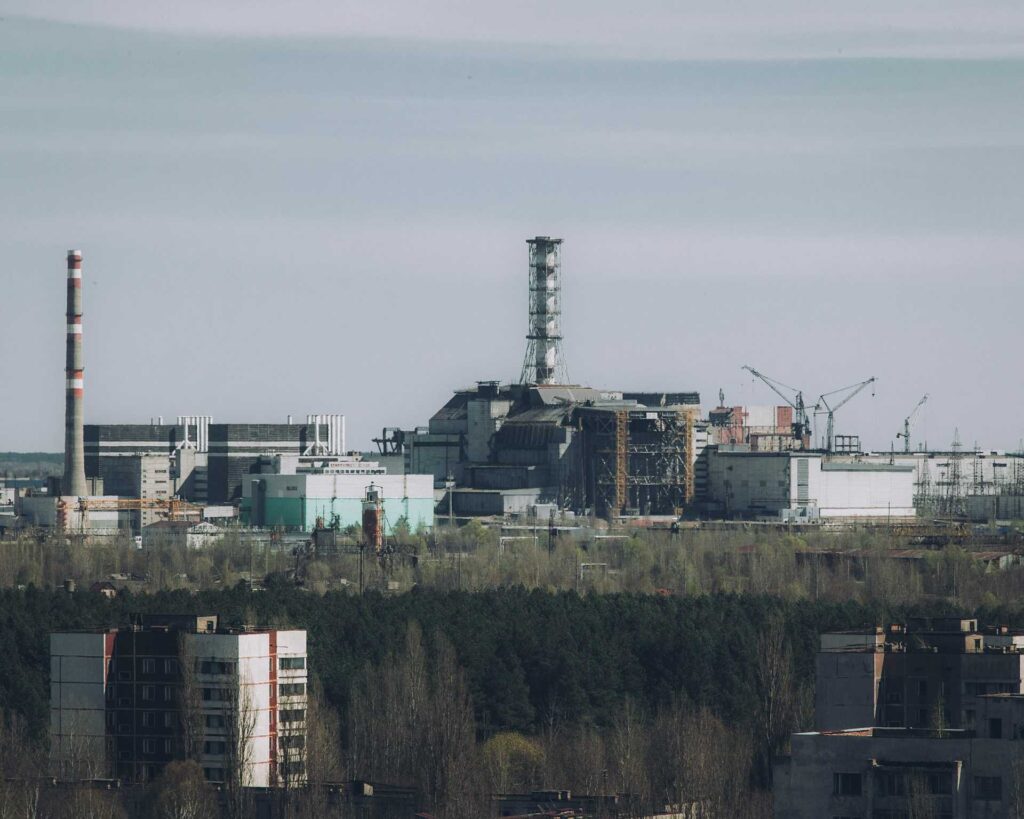
There is a tiny intruder that has been roaming the Italian forests for forty years. Less and less but still there. It is Cesium 137 one of the radionuclides released on April 26, 1986 by the collapse of the Chernobyl power plant. The radioactive cloud arrived in our country after a few days, despite reassurances from Italian authorities that we would not pay the consequences of that disaster. Cesium 137 is still there, particularly in mushrooms and in some wild animals that eat them such as wild boars. Nothing to worry about, the radioactivity has dropped sharply, and you can safely eat the mushrooms and wild boar meat.
A radioactive memorial and a present danger
But it remains, and will still be detectable for a few decades: a tiny memorial to a huge disaster, reminding us once again that “we are all in the same boat” as Pope Francis said on March 27, 2020 at the height of the Covid pandemic, in a light rain, in a St. Peter’s Square dramatically empty of people but full of messages. The same light rain that brought down the water-soluble Caesium 137 over part of our territory. And all this needs to be remembered even more now that the war in Ukraine puts at risk that country’s nuclear power plants, including Chernobyl, which have become targets of the Russians.
Iodine-131 and Cesium-137: two radionuclides, two fates
Helping us understand the past and present is someone who has to take care of our very safety. He is Fabrizio Trenta, nuclear safeguards and physical protection area manager of theNational Nuclear Safety and Radiation Protection Inspectorate (ISIN). Let’s start from 40 years ago, from the very serious accident that released a large amount of fission products into the atmosphere, that is, all those radionuclides that are generated by the fission of U-235 nuclei contained in nuclear fuel.
“Among the most abundant fission products that are generated and can be carried by winds over great distances are iodine-131 and cesium-137,” Trenta explains. “While iodine-131 has a half-life (i.e., the time it takes for 50 percent of the radioactive nuclei to decay, thus reducing the initial radioactivity by 50 percent) of about 8 days, so it decays very quickly, Cesium-137 has a half-life of 30 years so, once dispersed in the environment, it remains there for much longer.” Various consequences and therefore also the actions needed to protect the public.
“While iodine-131 represents the most important indicator during the early stages of an accident (to protect against which there are specific countermeasures such as administering stable iodine to the population affected by the radioactive cloud), in the medium to long term, Cesium-137 represents the most important indicator and for which there are other countermeasures to protect the health of the population, including sheltering indoors, banning imports from areas affected by the passage of the radioactive cloud, and banning the consumption of certain foods (milk, vegetables, meat, fish),” Trenta continues.
Contamination in Italy: where we are today
All the countermeasures to be taken in the event of a nuclear accident are outlined in the National Plan for Radiological and Nuclear Emergency Management, updated in 2022. But let’s go back to April 26, 1986. “The radioactive substances that were released into the environment during the accident spread more to the Scandinavian and Eastern European regions, and some areas of Italy, particularly in the northeast, were also affected,” Trenta recalls. Precisely the areas where Cesium 137 is still found. “Thanks also to the leaching action carried out by atmospheric agents, the presence of Cesium 137 is still detected in some environmental samples on flora and wildlife, particularly mushrooms that are bio accumulators and then wild boars that feed on them. But the concentration is very low, such that it does not pose a risk to public health. They can be eaten, let’s not create alarmism.”
Zaporizhzhia under the bombs
In short, the legacy of Chernobyl is still there, the radioactivity will still drop and disappear in more than a century, but without risk. Instead, war scenarios worry. “No nuclear power plant in the world is designed to withstand a bombing, in any case such an event at the Zaporizhzhia plant would have consequences especially for the areas surrounding the plant, since with the 6 reactors all shut down long ago, a situation like the one that occurred at Chernobyl with the release of fission products that reached the altitude of thousands of meters and were intercepted and carried by the winds over long distances could no longer be realized.”
Monitoring networks
Italy could be affected but with not particularly serious consequences. “The consequences of a release of radioactivity of a magnitude equal to that estimated for the Chernobyl accident, localizing the event at the Zaporizhzhya power plant,” Trenta further says, have been analyzed on a very precautionary basis. “The estimation of the consequences, carried out taking as reference meteorological conditions directly involving the national territory, allows us to state that the possible contamination would not reach values for which it is necessary to take direct protective measures on the population (iodoprophylaxis, i.e., the administration of stable iodine), while the resulting ground contamination could require the application of restrictive measures on food production, distribution and consumption, as well as actions to protect livestock in the areas affected by the radioactive fall-out.” Pretty much the same as forty years ago. But now we are better prepared. Back then it was found that the detection network was insufficient, few stations and little coordination.
“After the Chernobyl accident, monitoring networks for the detection of radioactivity in the environment, especially automatic early warning networks, were enhanced worldwide. In this regard, supranational bodies were organized to collect data collected in different countries and provide for their rapid exchange among countries. At the European level, the EURDEP platform which collects all data from the automatic early warning networks in the event of a nuclear accident. At the national level, ISIN operates two early warning networks, the GAMMA network with 64 control units and the REMRAD network with 6 control units, which represent two major infrastructures in radiological and nuclear emergency response planning: the Gamma network, distributed throughout the country, is capable of monitoring the radiological situation should a radioactive cloud affect the national territory, while the REMRAD network, located at specific border points of the national territory, and equipped with a very high sensitivity capable of detecting the smallest presence of radioactivity in the air and performing and providing radiometric analysis in a fully automatic manner.”
The coordination of emergencies
In addition to the ISIN’s two networks, regional and autonomous province monitoring networks, managed by the various Environmental Protection Agencies (ARPA/APPA), and the Fire Department’s network distributed extensively throughout the country, are also located throughout the country. Finally, Trenta recalls that “in the event of an accident, coordination and all the structures at the national level in various capacities involved, are established in the National Plan for the management of radiological and nuclear emergencies, which assign the Presidency of the Council of Ministers – Department of Civil Protection the coordination of operations. In the territory, the operations to be carried out are then transmitted to the Prefectures, which coordinate and implement them on the basis of the developed plans.”
This is a very different situation from 1986, when different competencies clashed on how to intervene: from the Ministry of the Interior to the Ministry of Health, from Civil Defense to the Ministries of Industry and Economy, from ENEA to the Higher Institute of Health. Today, “in the event of an emergency situation occurring, ISIN is responsible for alerting National Authorities based on information received from international prompt notification systems, performing initial assessments of the event, and estimating, through the atmospheric radioactivity dispersion forecasting systems present at its Nuclear Emergency Center, the potential involvement of the national territory. In addition, ISIN hosts and coordinates the Data Processing and Evaluation Center (CEVaD) composed of experts in various disciplines who process the data collected and provide their assessments to the authorities responsible for managing the emergency to identify the necessary measures as well as to those responsible for disseminating information to the population. In addition, during the emergency, ISIN coordinates the activities of the national RESORAD network, which collects all data produced on environmental samples at the local level by the laboratories of the regional/provincial agencies, and makes them available to CEVaD through the national radioactivity information system (SINRAD platform).” And this, too, is a major step forward from 40 years ago, when transparency abounded.