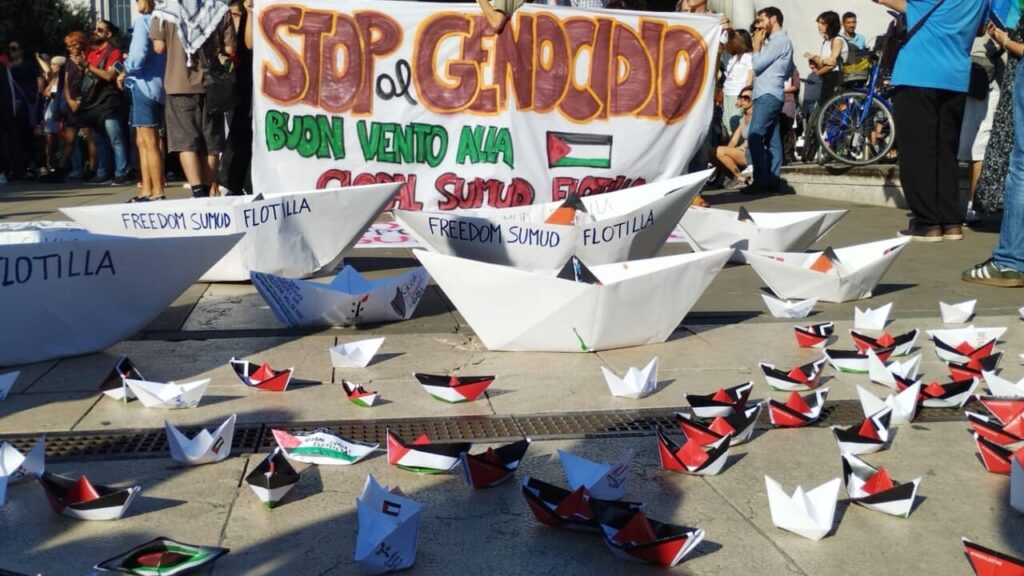
The Mediterranean is once again the scene of one of the largest civil mobilizations in recent years. The Global Sumud Flotilla, the international sailing coalition aiming to break the Israeli naval siege on the Gaza Strip, set sail April 15 from Barcelona with 39 boats, after an initial postponement imposed by bad weather. It is what organizers call the“Spring 2026 Mission“: the most ambitious ever attempted by international civil society by sea.
About a hundred boats and more than a thousand activists from some 70 countries will participate in the initiative organized by a coalition that brings together for the first time under one banner acronyms with different histories and backgrounds: the Freedom Flotilla Coalition, the Global Movement to Gaza, the Maghreb Sumud Flotilla and the Sumud Nusantara. The government of Malaysia is also participating. A convergence that breaks the divisions of the past and, in the intentions of the initiators, should result in a critical mass that is impossible to ignore.
Greenpeace and Open Arms in the field
Among the organizations flanking the fleet are also Greenpeace and Open Arms, and not in a purely symbolic role. Greenpeace has deployed its historic icebreaker ship Arctic Sunrise, assigning it technical and logistical support functions in addition to maritime security duties during the Mediterranean crossing. The environmental organization’s presence marks a further expansion of the frontline of those who choose to bear witness on the high seas, bringing with them decades of experience in international maritime campaigns. Open Arms, for its part, participates with experience gained from more than a decade of defending human life in the Mediterranean, providing on-board medical assistance, logistical support and risk assessment during the crossing.
But the mission is not just about transporting aid. Before even reaching disputed waters, the Flotilla has already made a gesture that does not go unnoticed. In the waters between Tunisia and western Sicily, a part of the flotilla broke away from the main convoy and intercepted the MSC Kaya, a nearly 400-meter-long cargo ship bound for the Israeli port of Ashdod with steel and dual-use materials on board, including those of military interest. Thirteen sailboats approached the ship’s bow, taking advantage of the right of way that the navigation code gives to sailboats. The freighter slowed down and changed course, at least temporarily. Over the radio, an activist read a message to the crew of the MSC Kaya, asking them to reverse course and choose, as she put it, “humanity versus complicity.” The only response received was a dry “shut up.”
Sicily, hub of the mission
Meanwhile, Sicily has become the beating heart of the second phase of the mission. About 25 boats are moored at the Xiphonia port in Augusta, Syracuse, while another 30 are expected to arrive from Spain, totaling about 500 people. The official departure of the expanded fleet is scheduled from Syracuse around April 24. Public events, meetings with local institutions and moments of cultural debate have multiplied throughout Sicily.
The Flotilla is not limited to symbolic value: it includes a concrete operational dimension, with basic necessities on board and professional figures such as doctors, engineers and psychologists ready to stay in the Strip to help with reconstruction. The medical fleet numbers a thousand doctors and nurses, gathered on dedicated boats. Participants include Greta Thunberg, who was already present on the October 2025 Flotilla that failed to pass the Israeli blockade. Her presence reaffirms how the Palestinian cause is increasingly becoming a point of convergence for movements that come from different traditions and struggles.
Gaza, six months after the ceasefire
The context in which this mission operates has changed since last year, but not necessarily for the better. Since the ceasefire of Oct. 10, 2025, Israeli attacks have claimed more than 700 lives, according to the Gaza Ministry of Health, and the vast majority of the civilian population remains displaced, while Tel Aviv’s army maintains control of nearly 60 percent of the Strip’s territory. The theoretical ceasefire has not stopped the violence, nor has it opened the humanitarian corridors that the international community has been calling for. Israel continues to block the entry of goods essential for survival: food, medicines, medical equipment, water purification materials. In this context, the Flotilla’s action acquires a significance that goes beyond the symbolic dimension: it is a concrete challenge to a blockade that many international bodies consider illegal.
The Italian knot and hostile Tunisia
On the Italian side, the affair is intertwined with an underlying political tension. Prosecutors in Rome have opened an investigation for kidnapping, robbery, damage with danger of shipwreck and torture regarding the treatment of Italian activists detained during the Israeli operation last October. Several participants reported violence, threats, sleep deprivation and restricted access to water while in Israeli detention. At the same time, PM Meloni announced the suspension of the automatic renewal of the defense agreement with Israel-a signal of distance, albeit cautious, that at least partially reshapes the diplomatic framework.
On the Tunisian side, however, the situation worsened. Unlike last September’s mission-when the Flotilla made a stopover in Tunis, moreover suffering an attack with drone-launched firebombs-this time the flotilla avoided the Tunisian coast. Seven Tunisian Global Sumud activists were arrested in early March on financial embezzlement charges, and only one has since been released. President Kais Saied has effectively declared war on the pro-Palestinian movement in the country, making Tunisia an impossible stop.
The route to the forbidden waters
The fleet is now aiming for Crete, at Ierapetra, the last safe haven before entering international waters. The final approach to Israeli-banned waters is conceivable in the last days of April or early May. Previous missions have all been intercepted: the ship Madleen in June 2025, the Handala in July, and then the major operation last October, when Israel stopped all boats in the flotilla about 120 miles from Gaza, in international waters, detaining passengers for days.
Oscar Camps, founder of Open Arms, has no illusions about the possible outcome but is not backing down. He explained that the expedition aims to bring what is happening in Gaza back to the center of media attention, and that in all likelihood the Flotilla will be intercepted before a hundred miles from the coast. But the organizers are willing to take that risk, convinced that the action is in accordance with international law and that any blockade in open waters is a reportable violation.
Visible in spite of everything
This is the bet of the Spring 2026 Mission: not necessarily to arrive, but to make every interception a visible act. Every blockade in international waters is a documented violation. Every stopped activist is a witness. At a time when Gaza has disappeared from the world’s news radar-obscured by war involving Iran, Lebanon, and Gulf dynamics-the flotilla is first and foremost a visibility device. A reminder that lasts, that moves, that occupies physical space and media space. Silence is the first enemy of those resisting under siege. And the sea is a difficult space to close altogether.