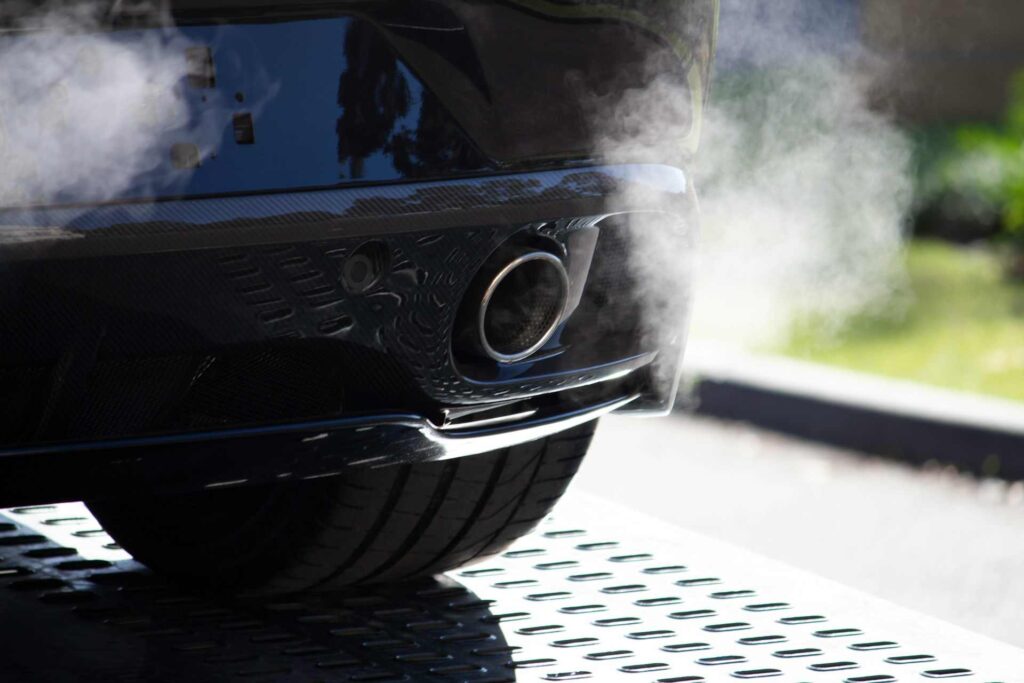
An electric car sold in Europe in 2025 emits 73 percent fewer greenhouse gases over its lifetime than an equivalent gasoline car. The figure comes from the most up-to-date study by the International Council on Clean Transportation, published in July 2025, which analyzed emissions over the entire life cycle: vehicle production, battery manufacture, raw material extraction, energy production for charging, use, maintenance and disposal. A 73 percent reduction is a significant achievement. It is not zero.
European legislation classifies electric cars as “zero-emission vehicles.” Regulation (EU) 2023/851, which strengthened CO₂ emission standards for new cars, defines “zero emissions” on the basis of tailpipe emissions. A battery electric car has no tailpipe: zero grams of CO₂ leave the vehicle while driving. For regulatory purposes, this is sufficient. For life cycle, no.
According to the ICCT study, an electric car with the average European electric mix projected for the period 2025-2044 emits 63 grams of CO₂ equivalent per kilometer over its full life cycle. A gasoline car emits 235. The difference is huge in favor of electric, but 63 grams is not zero. Where are they? Largely in production: manufacturing an electric car produces about 40 percent more emissions than a combustion car, mainly from the battery. These additional emissions are offset by use after about 17,000 kilometers, that is, in the first or second year of driving. And then in energy: even if the European electricity grid becomes progressively cleaner (56 percent of EU electricity in 2025 comes from renewable sources), producing electricity still involves emissions.
The analogy is with a diet. Going from 3,000 to 800 calories per day is a radical and measurable change. Declaring “zero-calorie diet” because you don’t eat traditional meals, while taking in 800 calories in some other form, is technically misleading. The electric car is the 800-calorie diet: incomparably better than the previous one, but not zero.
The legislation takes this into account, albeit slowly. Regulation 2023/851 required the Commission to present by 2025 a methodology for assessing CO₂ emissions over the entire lifecycle of cars sold in the EU. From June 1, 2026, manufacturers will be able to start reporting the lifecycle emissions of their vehicles on a voluntary basis, using this common methodology. For now, “zero emissions” in the legislation continues to refer only to exhaust.
In December 2025, the regulatory situation became even more complicated. The European Commission proposed lowering the 2035 target from 100 percent to 90 percent reduction in tailpipe emissions, allowing manufacturers to offset the remaining 10 percent through the use of low-carbon steel, e-fuels, and biofuels. The proposal maintains the electrification target but opens the way for hybrids, plug-in hybrids and combustion vehicles powered by synthetic fuels even after 2035. “Zero emissions by 2035” is no longer what the legislation calls for.
This is not an argument against electric cars. The ICCT study is explicit: only battery electric cars can achieve the emission reductions needed to meet climate goals in road transport. Hybrids reduce emissions by 20%, plug-in hybrids by 30%. Electrics by 73 percent, with prospects for improvement as the grid decarbonizes. The label, however, tells a different story.
This column has documented the same mechanism in nine different words: a statement with a precise technical meaning is used in contexts where the reader attaches a broader meaning to it. “Zero emissions” is the most literal case: zero, in regulation, does not mean zero in the life cycle.
The next time you read “zero-emission vehicle” in an advertisement, incentive or legislation, the question is: zero where? At the tailpipe, yes. In the life cycle, no. The EU is developing a methodology to measure the difference.