For years the bicycle has been told as an urban accessory: useful, environmentally friendly, even “cool,” but rarely as a policy tool capable of changing the face of cities. That’s part of the reason why Velo-city 2026, the most important international summit dedicated to bicycle mobility, to be held in Rimini June 16-19, weighs much more than an industry event.
After the Italian edition in 1991, the conference promoted by the European Cyclists’ Federation returns to our country with numbers that tell the dimension of the phenomenon: more than 1,500 delegates from 60 countries, more than 80 sessions and about 400 international speakers. But the real question is another: why does an Italian city decide today to put the bicycle at the center of its urban model?
The laboratory city
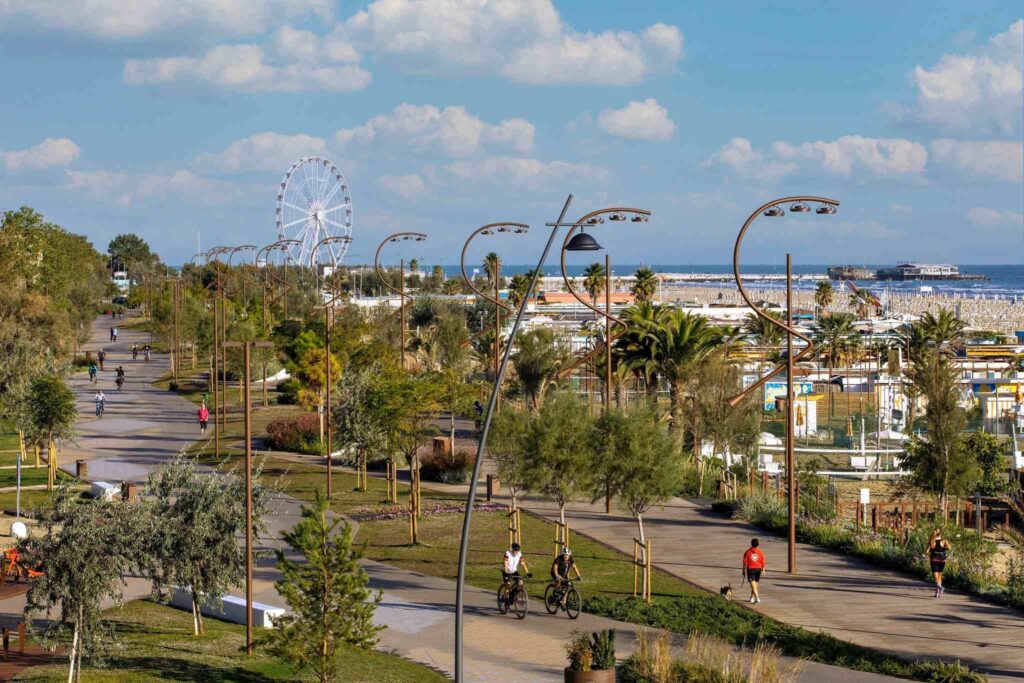
In recent years, the city of Romagna has accelerated the transformation of public space, focusing on the redevelopment of the waterfront, the extension of bicycle infrastructure and an idea of mobility that is less dependent on the automobile.
The definition used by organizers-“people-first city”-describes a paradigm shift: less space for private cars, more space for pedestrians, bicycles, public transportation and shared areas.
It is a transition that has been going on for years in Europe, while in Italy it continues to run up against cultural and political resistance. Just look at the cyclical debate over “empty” bike lanes, 30 km/h limits or lanes taken away from cars.
Yet, according to the European Cyclists’ Federation, investing in cycling yields economic benefits related to public health, reduced air pollution and urban congestion. It is a matter of health costs, air quality, road safety and urban competitiveness.
Sustainable mobility or urban marketing?
The risk, of course, is that sustainability becomes just window dressing. European cities have learned very well to use words like “green,” “smart,” and “regeneration.” More difficult is to translate them into permanent transformations.
Velo-city will therefore also be a test of credibility. Because organizing an international summit on active mobility means exposing oneself to global scrutiny: urban planners, administrators, transportation experts, and associations will be looking not only at the panels in the Palacongressi, but more importantly at the real city. The challenge is to demonstrate that cycling is a structural component of urban life.
The program of the event will discuss street design, integration between public transport and bicycles, sustainable tourism, public health and social inclusion. Issues that directly affect the quality of life in European cities today.
It is no coincidence that the theme chosen for the 2026 edition is“Delivering the Urban Dream,” meaning building more livable, green and accessible cities. An ambitious expression, but one that captures a node that is now evident: contemporary cities need to rethink themselves quickly, because the urban model built around the private car is showing increasingly obvious limits.
The bicycle as an urban indicator
The bicycle, after all, is also an indicator. A city where cycling is safe is almost always a city that also functions better for children, the elderly, and pedestrians.
For this reason, the Rimini summit will also have a symbolic value for Italian administrations. In fact, within the program there will be a ceremony dedicated to the 160 municipalities of the Comuni Ciclabili FIAB network, the project that evaluates the commitment of territories on bicycle mobility.
Many municipalities in Italy still lack adequate technical expertise to design safe and integrated bicycle infrastructure. And without design, sustainable mobility remains a communication exercise.
The Bike Parade and the Royal City
The most visible image of the event will probably be the Bike Parade on June 17: a collective bicycle ride open to citizens, families, schools and international delegates that will cross Rimini from the Sea Park to the historic center. Rimini Mayor Jamil Sadegholvaad made it clear:“We want this event to leave a concrete legacy.”