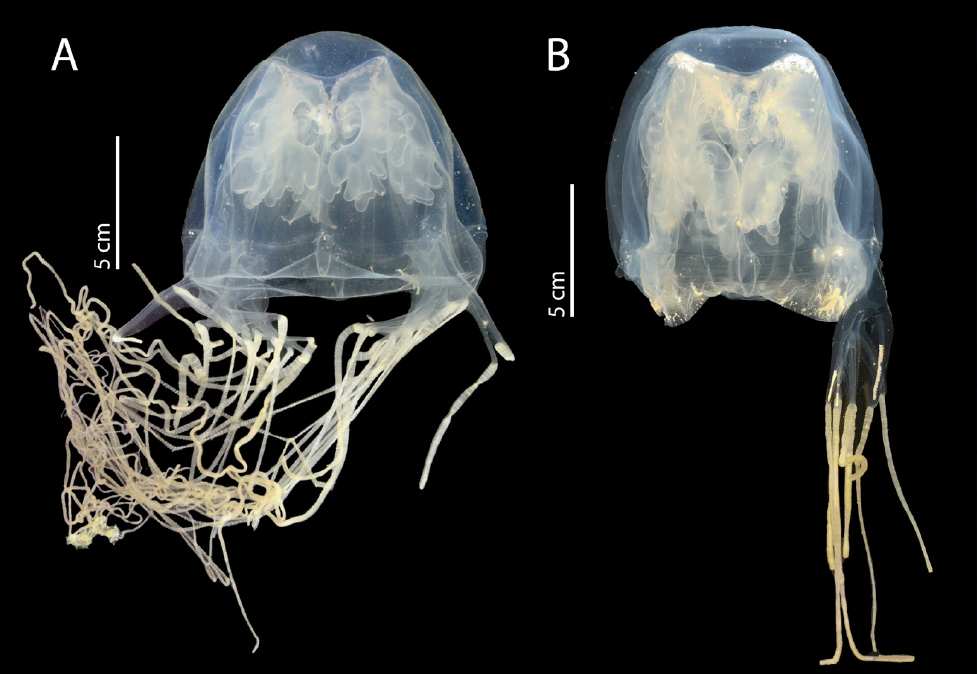
Transparent, difficult to detect in water, and belonging to one of the world’s most dangerous jellyfish genera. A new species of cubomedusa has been identified in Singapore waters: Chironex blakangmati, described in “Raffles Bulletin of Zoology” by a team of researchers from Tohoku University. A discovery that raises questions about how Southeast Asia’s coastal ecosystems are changing.
Unknown biodiversity
Until now, the genus Chironex had three recognized species: C. fleckeri, among the world’s deadliest jellyfish; C. yamaguchii, widespread between Japan and the Philippines; and C. indrasaksajiae, described in Thailand in 2017. Chironex blakangmati is the fourth, and the fact that it has emerged in an urbanized and relatively well-studied area like Singapore suggests that other species may still elude our knowledge.
The study authors themselves speak of “substantial gaps” in understanding the distribution of cubomedusae.
Because she had remained invisible
The term cubomedusa (or, more technically, class of Cubozoa) refers to the characteristic conformation of these animals, equipped with a cube-shaped bell from whose vertices tentacles originate.
The biology of the species partly explains the delay in discovery. The bell of Chironex blakangmati is virtually transparent, with slight yellowish hues, and the tentacles are thin and difficult to distinguish in water. The specimens collected on Sentosa Island were initially classified as Chironex yamaguchii: only morphological and genetic analysis revealed that it was a distinct species, with definite differences in the shape of the velarium channels, the arrangement of the tentacles, and the structure of the stinging capsules.
Changing coasts, shifting species
Perhaps the most significant part of the study concerns the temporal distribution of sightings. In Singapore, after a documented case in 1974, reports of cubomedusae had become rare for nearly four decades. Then something changed: between 2017 and 2022, observations multiplied, with sightings at Sentosa, East Coast Park, Lazarus Island, and Changi Beach, as well as episodes of stings that required medical intervention.
The authors cite the possible role of “anomalies in environmental factors”: from variations in sea currents to climate change. The growth of beach activities could also weigh in.
An underestimated risk
Cubomedusae cause dozens of deaths each year worldwide, but the real figure is likely higher: in many tropical areas, cases are not properly recorded or are attributed to other causes. The venom of species in the genus Chironex acts rapidly on the cardiovascular and nervous systems. Chironex blakangmati has not yet been extensively studied toxicologically, but the authors believe similar toxicity to related species is plausible.
In Singapore, the institutional response has already begun: some beaches have been temporarily closed after sightings and public warning systems have been installed. But risk management, researchers warn, cannot go without a more solid understanding of the species and its distribution.
What this finding tells us
We do not know whether this jellyfish is really expanding its range, whether it had already been present for decades without being recognized, or whether both are true in part. What we do know is that coastal marine ecosystems are changing rapidly, that climatic and anthropogenic pressures are altering their established balances, and that our ability to monitor these changes is still insufficient.