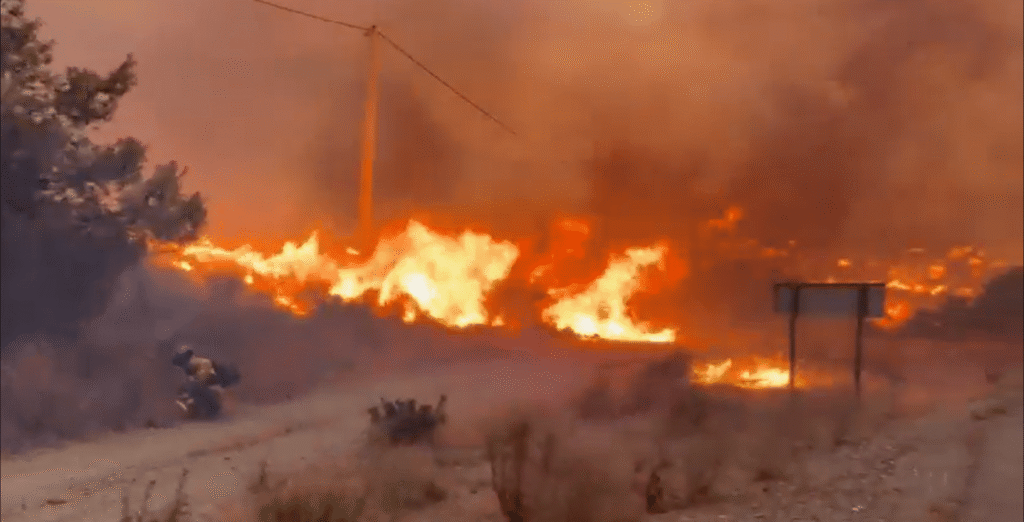
The death toll rose by the hour: first six victims, then twelve. The fire that broke out Thursday afternoon in Los Gallardos, in the province of Almería, turned overnight into one of the worst environmental tragedies in Andalusia’s history. The first reports reached the 112 emergency service around 5 p.m. From there, fueled by extremely high temperatures, low humidity, and gusts of wind, the flames devoured the dry vegetation and reached the municipality of Bédar within a few hours, where all the victims were found. Some bodies were found inside cars engulfed in flames: people caught by the fire while trying to flee along the area’s roads.
🔴 #IFLosGallardos (#Almería). Estas imágenes nos ayudan a entender la magnitud de este incendio y las condiciones en las que han trabajado los bomberos forestales. pic.twitter.com/YCUFZ39OQt
— EMA INFOCA (@Plan_INFOCA) July 10, 2026
A thousand people evacuated, villages deserted
The emergency response was triggered by the activation of the regional firefighting plan, which was quickly raised to emergency level 2. On the ground, 150 firefighters were deployed, supported by fire trucks, planes, and helicopters, while sections of the A-7 highway and the N-340A state road were closed.
About 1,000 residents were forced to leave their homes: Bédar and several nearby villages were evacuated, with the Los Gallardos cultural center and the Turre stadium turned into makeshift shelters. The fire also left at least six people injured, including a woman with burns and a person suffering from smoke inhalation, both of whom were hospitalized. An investigation has been launched into the cause of the fire: according to some witnesses, it may have been sparked by a power line falling onto parched vegetation, a theory that authorities have not yet confirmed.
The Impact of the Heat Wave
The tragedy unfolded in the midst of the second heat wave of the Spanish summer. In recent days, the Aemet weather agency issued alerts across much of the country, with temperatures peaking at over 44 °C in the Valencia region; on Thursday, in the province of Almería itself, some towns reached 43 °C. Extreme heat, prolonged drought, and dry thunderstorms laden with lightning: a combination that pushed the fire risk to “very high” and “extreme” levels across nearly the entire peninsula.
🌡️ En los próximos días seguiremos bajo la presencia de masas de aire muy cálidas.
— AEMET (@AEMET_Esp) July 9, 2026
➡️ Atención la próxima semana al este peninsular y Baleares. Allí, las masas de aire podrán alcanzar temperaturas superiores o más altas registradas entre 1991 y 2020: probable calor extremo. pic.twitter.com/LBzVEOTnpZ
Prime Minister Pedro Sánchez expressed “sadness and despair” for the victims, noting that this year Spain has deployed the largest summer wildfire response effort in its history.
The Era of Mega-Fires
The fire in Almería is not an isolated incident. As of 2026, the area burned in Spain is already about twice as large as it was during the same period last year—which itself had been the hottest summer on record. Experts are speaking of a “new era of megafires”: the abandonment of rural areas leaves enormous amounts of biomass in the forests, and when this fuel encounters record heat, wind, and dry air, the fires become faster, more intense, and harder to stop. The Mediterranean, climatologists point out, is warming faster than the global average. And every summer, by now, we’re paying the price.