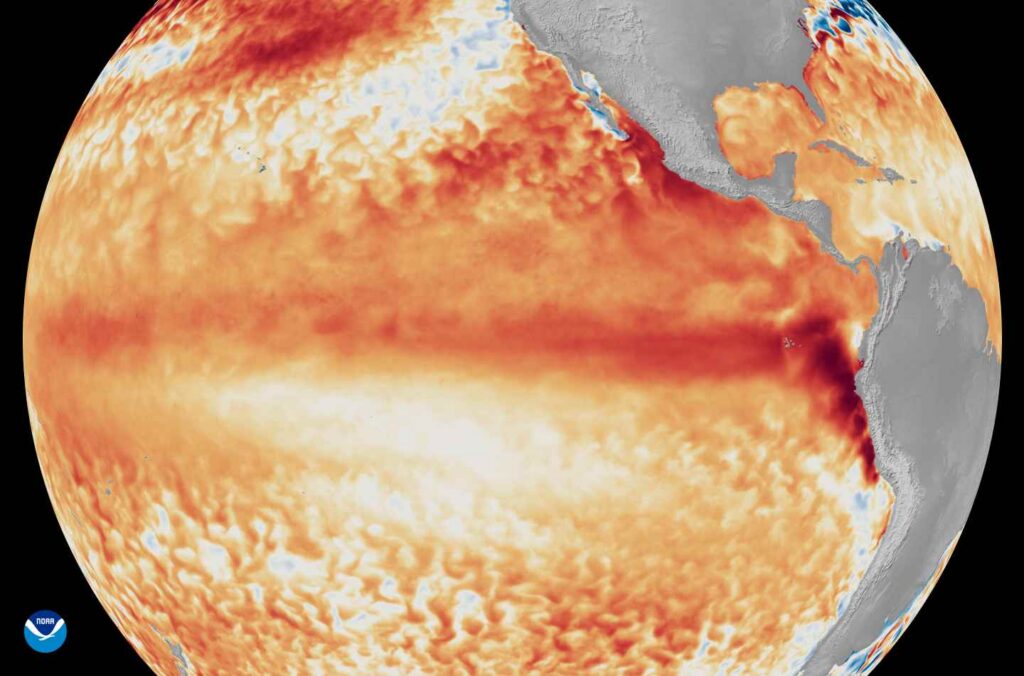
El Niño is back. The National Oceanic and Atmospheric Administration (NOAA) has confirmed that conditions typical of a new phase of the phenomenon have now become established in the tropical Pacific. Forecasts also indicate a possible strengthening in the coming months, with a significant probability of reaching moderate or strong intensity by fall.
This is not, in and of itself, an exceptional event. El Niño occurs cyclically every two to seven years and is one of the main natural regulators of the Earth’s climate: it affects ocean temperatures, alters precipitation patterns, and influences—albeit temporarily—global atmospheric balances. What is new is the context.
An often-overlooked distinction
Every new episode today unfolds on a planet that continues to accumulate heat. This is why scientists are closely monitoring the interaction between natural variability and global warming.In public debate, this distinction is often blurred: El Niño is a natural phenomenon, whereas climate change is a long-term trend linked in part to human activities. They are not the same thing, nor do they operate on the same timescale.
El Niño typically lasts for months and subsides within about a year. Climate change, on the other hand, is slowly but structurally altering the Earth’s climate system. The two processes, however, overlap: when a natural cycle of this kind occurs in a system that is already warmer, the effects can be amplified.
What scientists observe
According to NOAA, sea surface temperature anomalies in the central and eastern Pacific could exceed two degrees Celsius above average in the coming months—a threshold typically associated with the most intense events, sometimes referred to as “Super El Niño.”
The strongest El Niño events in the past have been linked to significant climate impacts: droughts in Australia, India, and East Africa, and extreme rainfall with flooding along the Pacific coasts of the Americas. Global average temperatures also tend to be affected. The heat accumulated by the oceans is transferred to the atmosphere, contributing to a temporary rise in global temperatures. However, there is no direct, deterministic link between El Niño and individual weather events: climatology works with probabilities and trends, not certainties.
What about Italy?
Europe is far from the epicenter of the phenomenon, in the tropical Pacific, and the local effects are generally indirect. This does not mean that there is no impact. Changes in global atmospheric circulation can still affect the Mediterranean basin. Some seasonal models suggest the possibility of a hot and humid second half of summer and an autumn with greater atmospheric energy available.
Beyond seasonal forecasts
The return of El Niño serves as a reminder that the climate is the result of the ongoing interaction between natural processes and fundamental changes in the Earth system. Natural oscillations remain fundamental, but today they are acting on a profoundly altered planet: warmer oceans, increasingly frequent record-breaking temperatures, and greater climate instability.
That is why NOAA’s confirmation is not just about forecasts for the coming months. It concerns the way in which one of the planet’s main climate drivers is adapting to a new global reality. More than a forecast, it is an open question—and likely one of the most important for understanding the climate in the era of global warming.