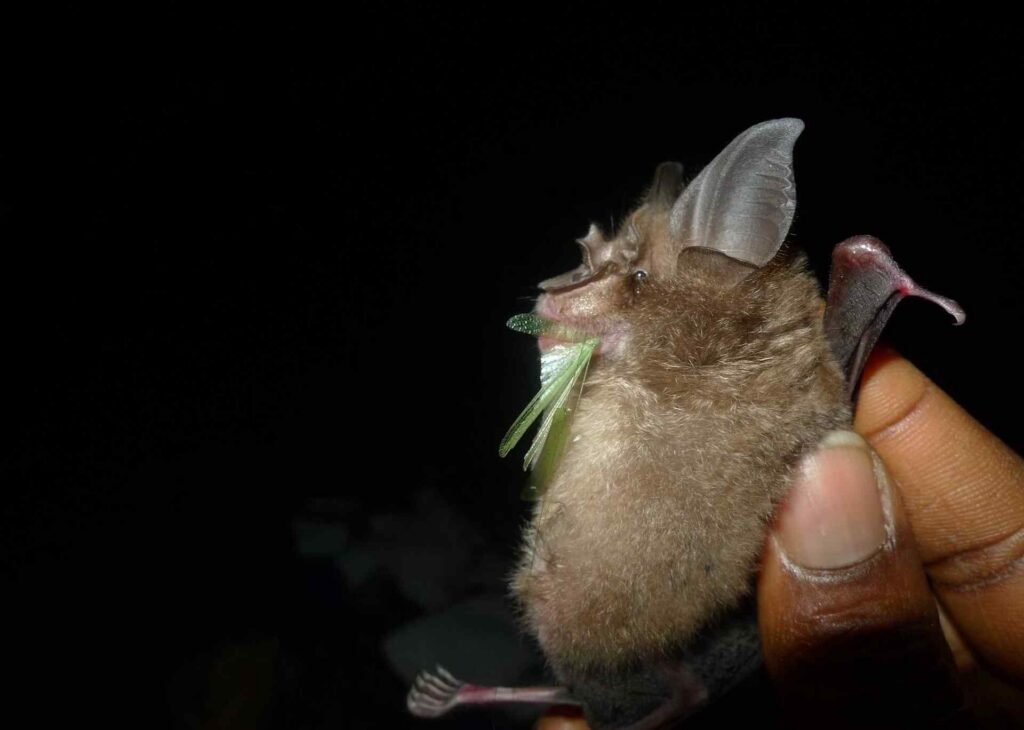
It’s a bat that weighs as much as a teaspoon of salt. It had disappeared from the scientific radar since the 1970s. Then biologist Iroro Tanshi shone a red flashlight into a cave in the Cross River Forest and set in motion a journey that led her to the highest global honor in environmentalism.
Reaching the Afi Mountain sanctuary in southeastern Nigeria requires hours of travel and trails that wind deep into the rainforest. This protected area, which is as large as the city center of Paris, is home to critically endangered gorillas, drill monkeys, and the world’s only confirmed colony of Hipposideros curtus, the short-tailed round-leaf bat.
The discovery dates back to 2016. Iroro Tanshi, a Nigerian biologist conducting research for her Ph.D., was examining bats captured in nets when she noticed that one of the specimens had unusual characteristics: large ears, weighing just a few grams, and a particularly elaborate nasal structure. She consulted the identification guide and realized she was looking at a species that had not been observed in the field for nearly half a century. “That was the moment that changed everything.”
Forty-five Years of Silence
The last recorded sighting of Hipposideros curtus in the wild dated back to the 1970s. The species was known to inhabit certain forest caves between Cameroon and Equatorial Guinea, but by 2010, all known habitats had been compromised by deforestation, agricultural expansion, and human pressure. Many researchers believed it had since gone extinct.
Following the discovery, Tanshi launched new monitoring campaigns in the caves of Afi Mountain and the nearby Cross River National Park. The research led to the identification of fifteen additional bat species and confirmed the existence of a small colony of H. curtus, which remains the only known population.
Selective Wildlife Conservation
The discovery also highlighted another problem. Local conservation strategies had focused primarily on large mammals. Gorillas and drill monkeys enjoyed well-established social protection; bats, far less so.
In many Nigerian communities, bats continue to be associated with superstitions and bad omens. In some rural areas, they are also hunted and sold as game meat. All of this makes their conservation particularly challenging.
Guardians of the Forest
In 2016, Tanshi and his colleague Benneth Obitte founded the Small Mammal Conservation Organization ( Smacon), dedicated to the protection of bats and small mammals. The following year, the Zero Wildfire Campaign was launched to combat wildfires that threaten forest habitats. The project has introduced early warning systems for controlled burns and trained groups of volunteers—the “Forest Guardians”—tasked with monitoring the area. According to Smacon, fires in the area have decreased significantly over the past five years.
This extraordinary collective effort and the results achieved on the ground led to Iroro Tanshi being awarded the Goldman Environmental Prize in 2026.
The Species Nobody Looks For
The story of Hipposideros curtus also highlights the limits of scientific knowledge. The Cross River Forest is one of Africa’s most important biodiversity hotspots, yet it remains largely unexplored. “Something we thought was extinct was found in this wonderful place, where no one ever goes,” Tanshi noted. More than just a zoological curiosity, the discovery serves as a reminder of an often-overlooked reality: many species are at risk of disappearing far from the spotlight, while others may be surviving in corners of the forest that researchers have barely explored.