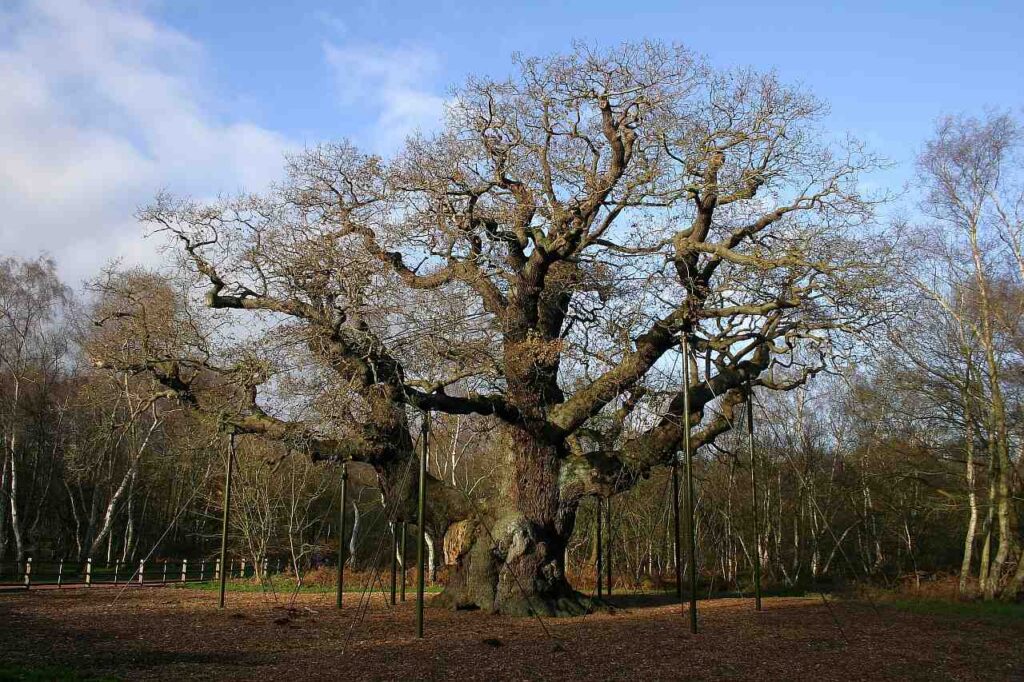
In Sherwood Forest, in Nottinghamshire, there is a new absence. The Great Oak —with a circumference of eleven meters, a canopy that stretched twenty-eight meters, and over a thousand years of life—did not produce any leaves this spring. England’s most famous tree, and one of the oldest in Europe, has died.
It had been linked to the legend of Robin Hood for centuries: it was said that the outlaw and his band found refuge there while fleeing from the Sheriff of Nottingham. Every year, it attracted 350,000 visitors. It was a place, a symbol, almost a presence. In the winter of 2010, the snow that had fallen on the tree trunk had formed the image of Friar Tuck—and the photo had gone viral around the world.
A Death Foretold in Three Acts
There is no single cause for its demise. It is the result of a series of traumas that have accumulated over time. The first is tourism: two centuries of visitors have compacted the soil around the roots, depriving it of oxygen and microbial life. The second is industrial: underground coal mining has altered the aquifer. The third is climate-related: the most recent and most brutal.
Five consecutive summers of low rainfall and abnormal temperatures have worn the tree down to the bone. The final blow came during the heat wave of July 2022, when temperatures in Great Britain exceeded forty degrees for the first time. A thousand-year-old oak tree that had weathered invasions, famines, and plagues could not withstand four decades of global warming.
The Paradox of Treatment
There is one striking detail in this story: even the attempts to save it contributed to its eventual demise. In 1904, struts and metal chains were installed to support the branches. In the 1960s, the hollows in the trunk were filled with concrete, and the branches were coated first with lead and then with fiberglass. These interventions seemed reasonable, perhaps even necessary. But they turned out to be a mistake.
If left undisturbed, ancient oaks lose their branches as they age and grow downward, reducing their water requirements. It is a survival strategy refined over millennia. The artificial supports prevented the tree from following that path: they forced it to pump water to its outer branches instead of concentrating its energy in the trunk. The Quercia Maggiore was never able to age as it would have liked.
The RSPB, which has managed the site since 2018, had tried over the past three winters to aerate and nourish the suffocated roots, with some success in the soil. Too late. Last year, there were very few leaves; this year, not even a single shoot.
It will remain standing
The tree will not be cut down. Dead wood is home to a quarter of all forest species, and the oak retains an ecological value that does not disappear with the last leaf. It will remain standing, doing what ancient oaks know how to do even in death.
But the story of this tree is worth telling not just as an environmental news item. It serves as a mirror. It shows us what happens when a living being is loved in the wrong way: too many visitors, too many interventions, too much ill-advised care. And it shows us what happens when the climate changes faster than a millennia-old organism can adapt.