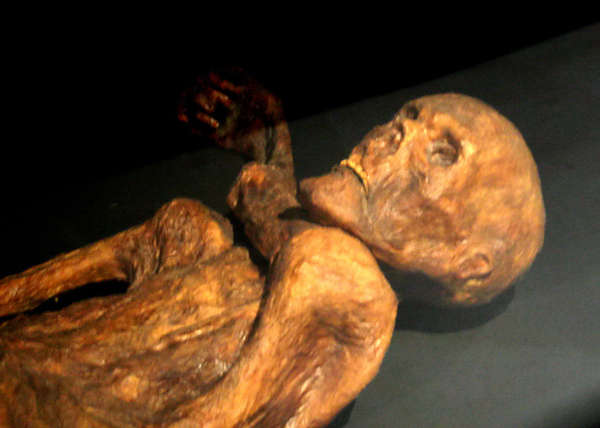
The cold storage room at the Bolzano Archaeological Museum is set at −6 °C. Yet something is growing on Ötzi’s skin. This was confirmed by a study published in June 2026 in the scientific journal *Microbiome* by researchers at the Institute for the Study of Mummies at Eurac Research. Europe’s most famous mummy—a man who lived between 3300 and 3100 BCE and was discovered in 1991 on the glaciers of the Senales Valley—is not an inert artifact. His body is home to bacteria dating back to the Copper Age and modern microorganisms that, despite the extreme cold, show signs of biological activity.
Inside and Outside
The researchers analyzed dozens of samples: the ice covering the body’s exterior, the water inside the mummy, swabs taken from twelve different points on the skin’s surface, and fragments of muscle tissue. For comparison, they also used soil collected at the Tisa Pass in 1991, at the time of the discovery.
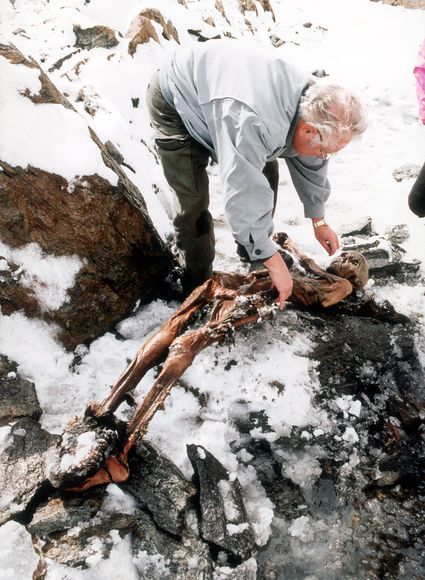
What emerges is a distinction between the inside and the outside. Bacteria that were present in Ötzi’s intestines and colon five thousand years ago, when he was alive, still survive there today. Their DNA bears the marks of time—chemically altered in the way typical of very ancient material—and bears no resemblance to the gut microbiome of modern humans. It offers a direct window into the bacterial ecosystem of the Copper Age. On the skin, however, the situation is very different.
Active Yeast
On the surface of the body, researchers found and cultured in the laboratory four species of yeast adapted to extreme cold: Glaciozyma watsonii, Mrakia robertii, Phenoliferia glacialis, and a species of Gofeauzyma. These organisms are normally associated with glacial environments such as the Arctic and Antarctica. Their presence on Ötzi is not surprising: they almost certainly originated from the glacier where the body remained for millennia.
What’s surprising is that they’re still active. By comparing skin samples taken in 2010 and 2019, the researchers found that one of these yeasts, Glaciozyma, has become increasingly abundant over time, rising from 85% to 98% of the skin fungal community. Its DNA in the most recent sample is intact, not degraded—a sign that the cells are reproducing, not dying.
The phenol that acted as a natural selection mechanism
There’s a story within the story. Immediately after its discovery in 1991, the body was treated with a phenol-based solution to halt fungal growth. An understandable choice in an emergency, but one with unforeseen consequences: the yeasts now dominant on Ötzi’s skin are precisely those capable of breaking down phenol, using it as a nutrient. The disinfectant eliminated the sensitive microorganisms and favored the resistant ones—which have survived. Something similar happened with the sterile water periodically sprayed onto the body to maintain humidity. This water introduced bacteria resistant to standard sterilization treatments, which, after 2010, spread across the mummy’s entire outer surface.
The risk to tissues
Some of the identified bacteria carry genes that produce enzymes capable of degrading collagen, the protein that forms the structure of the skin and connective tissues. The psychrophilic yeasts found on the surface, in turn, possess the genetic makeup to break down fats and proteins. The study does not claim that Ötzi is decomposing. It states that the microorganisms present have the means to do so, and that at −6 °C, the line between dormancy and activity is more subtle than previously thought.
The researchers propose regular genomic monitoring: periodic analyses of the microbial community, using samples taken from the meltwater during routine maintenance operations, without touching the tissues. “Conservation,” the authors write, “must move beyond static preservation toward proactive monitoring.”