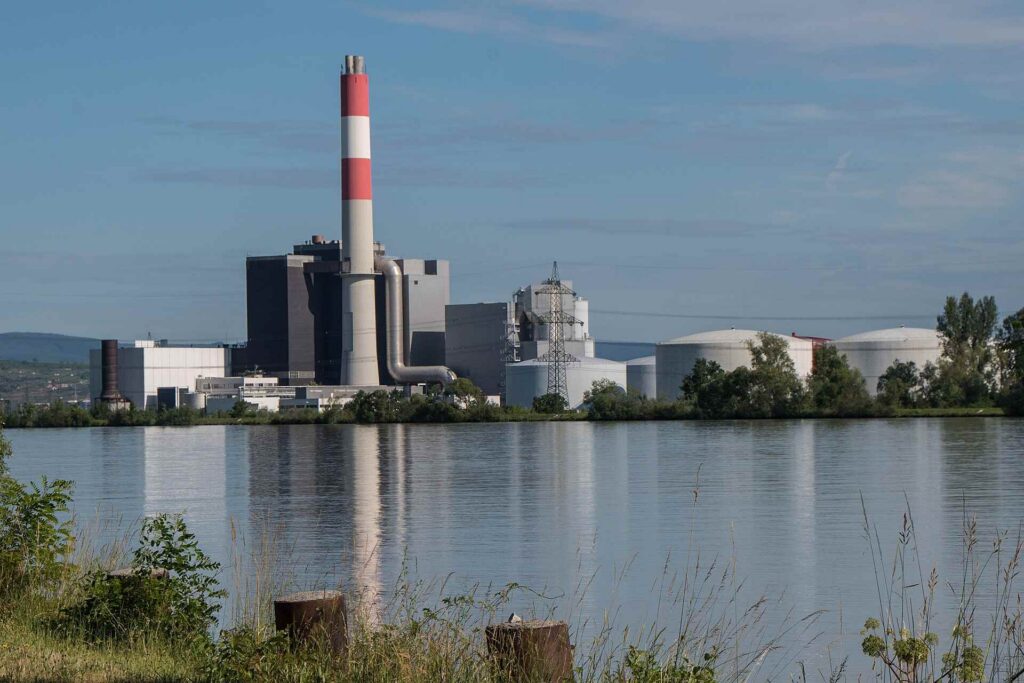
In the midst of the gas price crisis, Europe continues to plan new fossil-fuel-fired power plants. A report published on June 15 by the organization Beyond Fossil Fuels, titled Merchants of Crisis, lists nearly 60 gigawatts of new plants currently under development on the continent. If built, they would consume about 28 billion cubic meters of gas per year—equivalent to 9% of the European Union’s projected gas imports in 2025 and the annual consumption of 46.4 million European households.
According to the report, this expansion risks increasing Europe’s dependence on energy imports at a time when geopolitical volatility continues to affect the markets. The authors also cite an IEEFA estimate suggesting that a 60% increase in electricity prices could result in additional costs of up to 120 euros per year per household.
Germany: The Debate Over Capacity Auctions
In May, the German government approved a plan that provides incentives for 12 gigawatts of new “dispatchable” electricity capacity—that is, capacity available when requested by the grid. According to Beyond Fossil Fuels, the auction structure would largely favor gas-fired plants, while storage systems and demand-side management tools would play a limited or no role.
The report also cites documents and rumors published by the German press. Handelsblatt reported on the existence of a proposal attributed to RWE that allegedly advocated criteria that would favor gas-fired power plants over storage facilities. Der Spiegel, on the other hand, reported that the Ministry of Economy had asked EnBW for evidence supporting the use of gas in the electricity system; the company confirmed that it had prepared the material at the ministry’s request.
Poland: The Role of State-Controlled Utilities
In Poland, the government holds significant stakes in the major energy companies, including PGE, ENEA, Orlen, and Tauron. According to Beyond Fossil Fuels, the recent capacity auctions scheduled for 2029 and 2030 would allow only new gas-fired plants to participate.
The report also highlights the growing role of U.S. liquefied natural gas in Poland’s energy strategy. The authors cite both Orlen’s initiatives in the LNG import sector and the efforts by the energy attaché at the U.S. Embassy in Warsaw to promote U.S. energy exports.
Climate Minister Paulina Hennig-Kloska has repeatedly emphasized the need for natural gas during the transition away from coal. However, a study by the Silesian University of Technology is cited, suggesting that greater development of renewables, storage, and grid flexibility could significantly reduce the need for new gas-fired power plants by 2040.
Romania, Energy Policy, and State-Owned Enterprises
Another case analyzed in the report concerns Romania, where the Ministry of Energy is also the majority shareholder in key companies in the sector, including Romgaz and OMV Petrom. The authors highlight how the government supports both new gas facilities and the Neptun Deep offshore project in the Black Sea, which involves investments of approximately 4 billion euros and the extraction of about 100 billion cubic meters of gas.
Beyond Fossil Fuels also cites the criticisms raised by Greenpeace Romania and the assessments by ENTSO-E, according to which some of the new gas-fired capacity envisaged in the national energy plan may not be economically viable in the medium term.
While the European Council is discussing the AccelerateEU package, the report argues that the emergency measures adopted in recent years are not sufficient to ensure long-term energy security. According to the authors, a strategy based on renewables, storage, grids, and system flexibility would be more effective in reducing Europe’s exposure to gas market volatility.