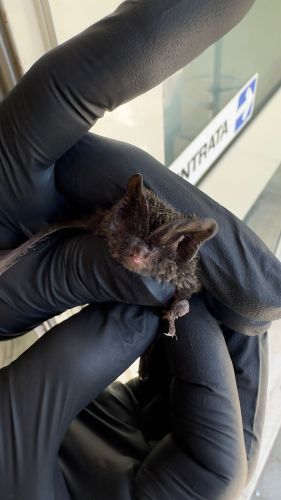
An animal that scientists had not recorded in the heart of Rome for nearly a century and a half has reappeared. It is aBarbastella barbastellus, one of Europe’s rarest and most endangered bat species, rescued in the historic center of the capital by the LIPU Wildlife Rescue Center in Rome.
The identification was made possible thanks to researchers from the Institute for Terrestrial Ecosystem Research of the National Research Council (CNR-IRET), who served as experts on bats in urban areas as part of projects under the National Recovery and Resilience Plan (PNRR) and the National Biodiversity Center.
The scientific significance of the discovery is remarkable: the last recorded sighting of the species in the capital dates back to 1878. The animal, an adult female, was found a few hundred meters from the site of the 19th-century sighting, although—as experts point out—it is not possible to establish any connection between the two incidents.
“To our great surprise, we discovered that it was indeed a barbastello bat.”
Leonardo Ancillotto of CNR-IRET recounts the story. “The LIPU Rescue Center contacted us for an expert opinion on a bat they had taken in,” he explains. “When we examined it together with our colleagues, we were astonished to discover that it was a barbastelle, an extremely rare species, especially in central and southern Italy.”
In recent years, the research group has been working extensively on historical and current checklists of Italian urban bats, as part of Spoke 5 of the National Biodiversity Future Center, analyzing the presence of different species in major cities. “Historical data for Rome did indeed exist, dating back to the 19th century,” Ancillotto continues. “Since then, however, the species had never been recorded again. Rediscovering it here today is both intriguing and scientifically significant.”
A Guardian of Healthy Ecosystems
The barbastelle is closely associated with well-preserved forest habitats, particularly mature and ancient forests, and is considered a valuable indicator of the ecological quality of an area. In Italy, it is classified as “endangered” on the Red List of Vertebrates and is listed in Annex II of the European Union’s Habitats Directive, which identifies priority species for conservation.
For this very reason, the researchers emphasize, the discovery has significance that goes beyond this single specimen. “The finding confirms how important it is to continue monitoring urban biodiversity,” Ancillotto concludes. “Even heavily human-altered environments can still hold surprises and be home to species of great conservation value.”