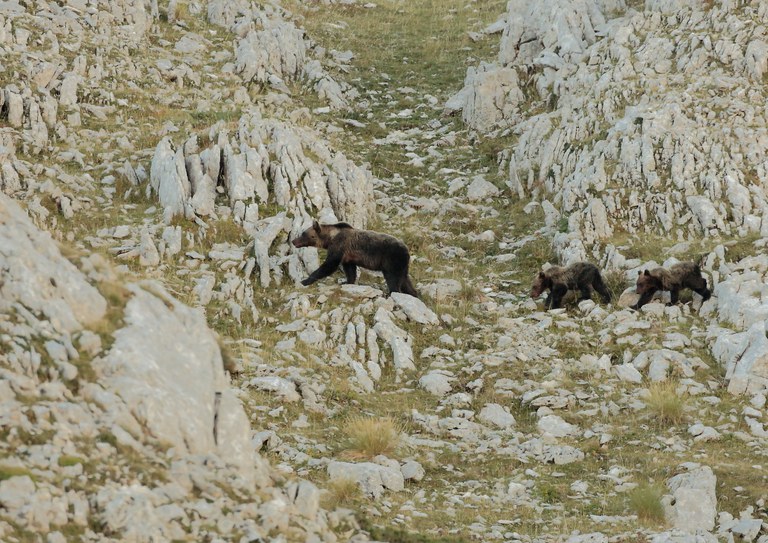
Eighty-one Marsican brown bears are distributed across more than 6,000 square kilometers of the central Apennines. This is the most up-to-date snapshot of this Italian endemic subspecies, based on the genetic monitoring study presented by the Ministry of the Environment and Energy Security (MASE) and ISPRA—the most extensive study ever conducted on the Marsican brown bear.
The analysis estimated a population of 43 females and 38 males. According to experts, the actual total number could range from 73 to 88 individuals. This figure confirms that the situation remains essentially stable compared to previous surveys.
Beyond the Park
The Abruzzo, Lazio, and Molise National Park and its Contiguous Zone remain the main stronghold of the Marsican brown bear, where the population appears to be stable or slightly increasing compared to the 2014 estimate. The most significant development , however , concerns the peripheral areas of the range, where approximately 16 individuals were recorded.
The presence of these animals confirms a slow but steady process of expansion into new territories, a development considered crucial for the future of the subspecies. In fact, population growth alone is not enough: for the population to become established, the bears must be able to move between different areas without encountering insurmountable obstacles.
The Challenge of Ecological Corridors
This is precisely where the main challenges arise. As highlighted by MASE and ISPRA, the expansion process will have to contend with habitat fragmentation, the degradation of ecological corridors, and the growing presence of human activities in areas outside the park’s boundaries.
Ecological corridors are natural connections that allow animals to move between suitable habitats, facilitating interaction among individuals and the gradual colonization of new territories. Their protection is considered one of the key factors in ensuring the long-term survival of the Marsican bear, which is still classified today as one of Europe’s most endangered subspecies.
The most extensive monitoring ever conducted
The census was funded through the National Recovery and Resilience Plan (PNRR), as part of the DigitAP project dedicated to the digitization of national parks and marine protected areas. The project involved MASE, ISPRA, national and regional parks, regional governments, the Carabinieri Forestali, Marsican bear monitoring networks, environmental organizations, and the laboratories responsible for genetic analysis.
Samples were collected using non-invasive techniques, through hair and other biological samples collected in the field. Genetic analysis made it possible to identify individual animals and obtain a much more accurate estimate than traditional monitoring systems.
As MASE and ISPRA point out, the results “do not merely provide updated figures,” but offer practical guidance to inform future conservation policies. Starting with the strengthening of the Action Plan for the Protection of the Marsican Bear (PATOM), the goal will be to consolidate the species’ expansion by balancing biodiversity conservation with economic activities and the presence of local communities. For the Marsican bear today, the challenge is not only about the number of individuals, but also about the Apennines’ ability to remain a connected habitat, capable of ensuring space and continuity for one of the iconic species of Italian wildlife.