Spain will not be home to the world’s first industrial octopus farm. The multinational company Nueva Pescanova, based in Galicia, has abandoned the project that was to be built in the port of Las Palmas, on Gran Canaria. This was confirmed by the city’s Port Authority, which announced the withdrawal of the permit application.
The story began in 2021, when the company announced its intention to transform the common octopus —which until then had only been caught at sea— into a new species for intensive aquaculture. The facility would have raised and processed approximately one million octopuses per year to produce thousands of metric tons of meat. This model was based on the one already used for fish and crustaceans but was being extended to a mollusk for the first time.
Behind this reversal lies a five-year campaign that brought together scientists, animal rights activists, environmentalists, and ordinary citizens from around the world. In the last few weeks alone, more than 43,000 people wrote to the Port Authority asking it to shelve the project. The campaign was led by Compassion in World Farming (CIWF), which today is claiming a historic victory. A significant factor in the outcome was that the company had never submitted the environmental assessment required to obtain approval.
Complex Minds in Bare Tanks
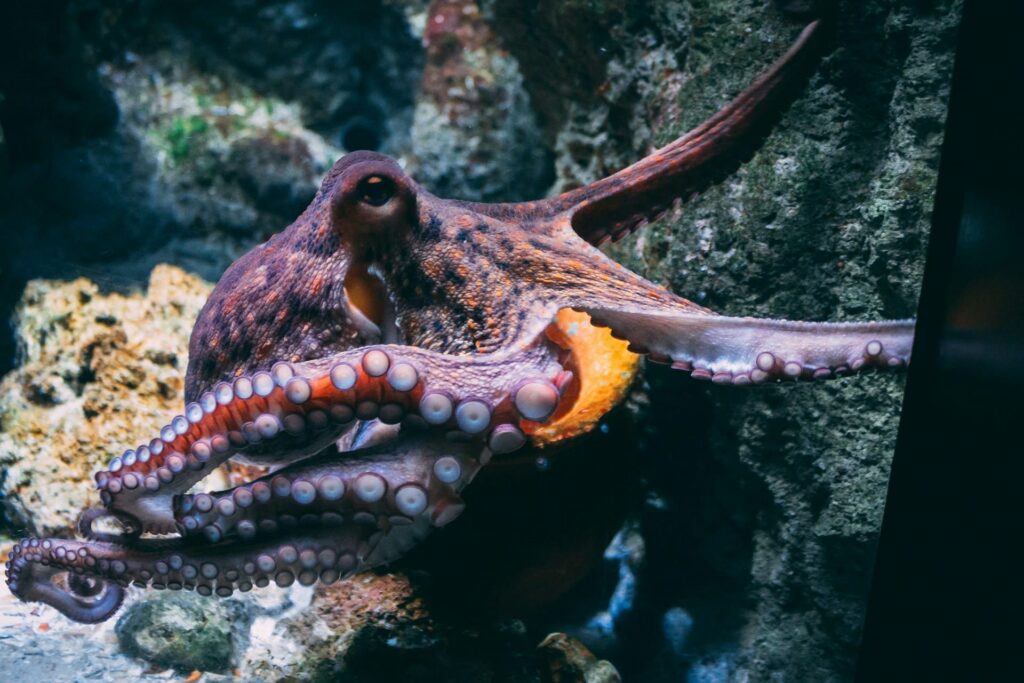
The core issue of the protest was animal welfare. The octopus is not a fish: it is a mollusk with a surprisingly advanced nervous system, capable of learning, solving problems, exploring, and remembering. In the wild, it lives a solitary and territorial life in environments rich in stimuli.
Confining such creatures in overcrowded, unstimulating tanks would have meant condemning them to chronic stress, aggression, and cannibalism. Added to this is a problem that has never been resolved: there is no scientifically recognized method for killing octopuses on a large scale without causing them suffering. “Octopuses are intelligent wild animals, not commodities to be confined on a farm,” commented Elena Lara, a researcher at CIWF.
The Hefty Price for the Oceans
In addition to ethical concerns, the environmental impact is significant. According to a report released by CIWF, in order to produce approximately 3,000 metric tons of octopus meat, the facility would have consumed—in its very first year alone—nearly 28,000 metric tons of wild fish for feed.
It’s the paradox of every carnivorous fish farm: to fill the tanks, the sea is emptied. This puts further pressure on fish stocks that are already overexploited and on the coastal communities that depend on that fish. Instead of easing the burden on the oceans, as the company claimed, the facility would have made it worse.
We need a law now
This decision sets an important precedent: for the first time, a major project of this kind has been halted before it even got off the ground. But for activists, this isn’t enough. A ban already exists—the state of Washington, in the United States, banned these farms a couple of years ago—while research continues elsewhere. That is why CIWF is now calling on Spain, the Canary Islands, and the European Union to introduce legislation that explicitly bans octopus farming and curbs the expansion of aquaculture based on carnivorous species. Because such intelligent animals, the conclusion is, deserve to remain what they are: inhabitants of the oceans, not products on a store shelf.