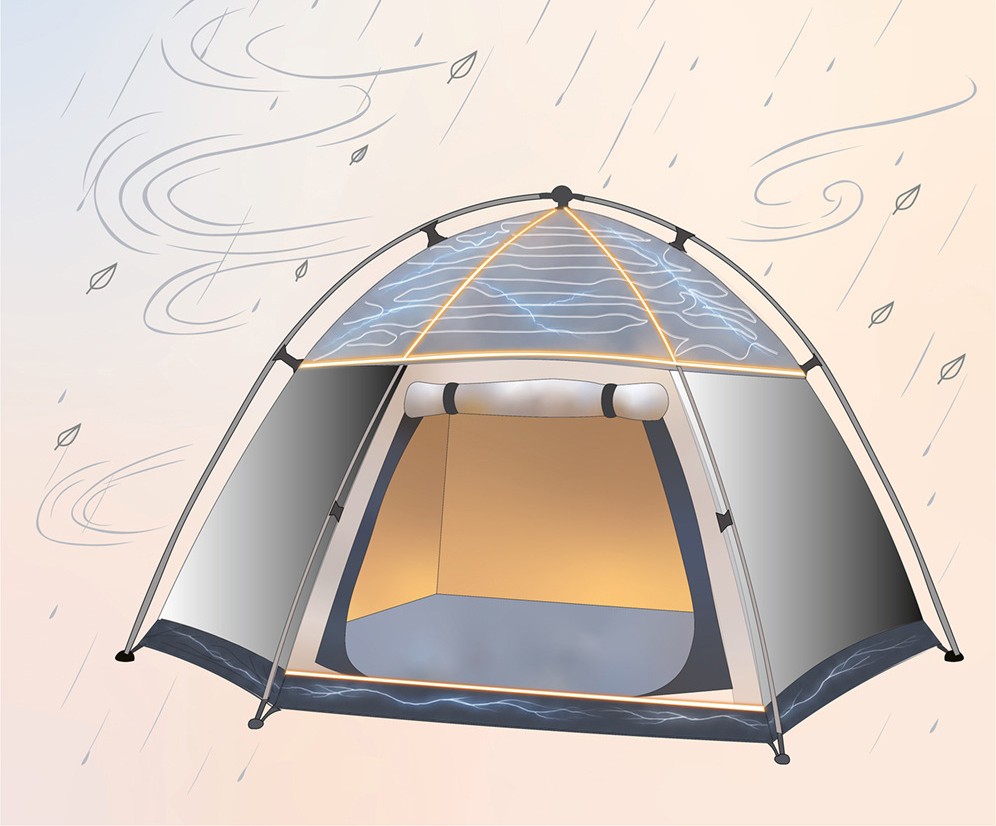
Imagine a tent that, instead of consuming energy, generates it simply by standing in the wind. It’s not science fiction: a group of engineers in Singapore has built a prototype capable of converting the movement of the fabric, the movement of people inside it, and even sound vibrations into electricity.
The secret lies in a property of materials called magnetoelasticity, first described in 1865 by physicist Emilio Villari: when a magnetic material is bent or stretched, its magnetic response changes, and that variation can be converted into an electric current through induction. Researchers at Nanyang Technological University have applied this principle to the fabric of a tent. The floor is lined with magnetoelastic strips, while the roof is constructed in layers, featuring conductive fibers and a strain-sensitive film. Every time the tent fabric flexes—whether due to a gust of wind, someone moving inside, or even just during setup—the structure harvests a small amount of energy.
Numbers Are Still Small
The study, published on July 31 in the journal Matter, shows promising but modest results. In the lab, by tapping a small sample of material with one hand, the researchers charged a 0.22-microfarad capacitor to 5.8 volts in just one and a half seconds. That’s not enough to power a smartphone, but it’s enough to demonstrate that even a tiny piece of fabric can convert motion into electricity.
The idea wasn’t conceived for luxury camping. The creators are thinking primarily of places where electricity is lacking or unreliable: refugee camps, disaster-stricken areas, and campsites far from the power grid. There, even a few watts make a difference, because they allow you to turn on an LED light, charge a phone, or run a small heater. The advantage over solar power is clear: the tent doesn’t need sunlight and continues to produce energy in the shade and after sunset, as long as the fabric keeps moving. And compared to traditional generators, it eliminates the need for fuel, weight, and maintenance.
Unanswered Questions
Much remains to be seen. No one yet knows how much electricity the tent can actually generate in the field, how long the fabric will withstand repeated folding and exposure to the elements, or whether it can be manufactured affordably on a large scale. For now, it is a supplementary energy source, not a replacement for the power grid. But the prototype suggests that a simple shelter might one day do much more than just keep us dry.