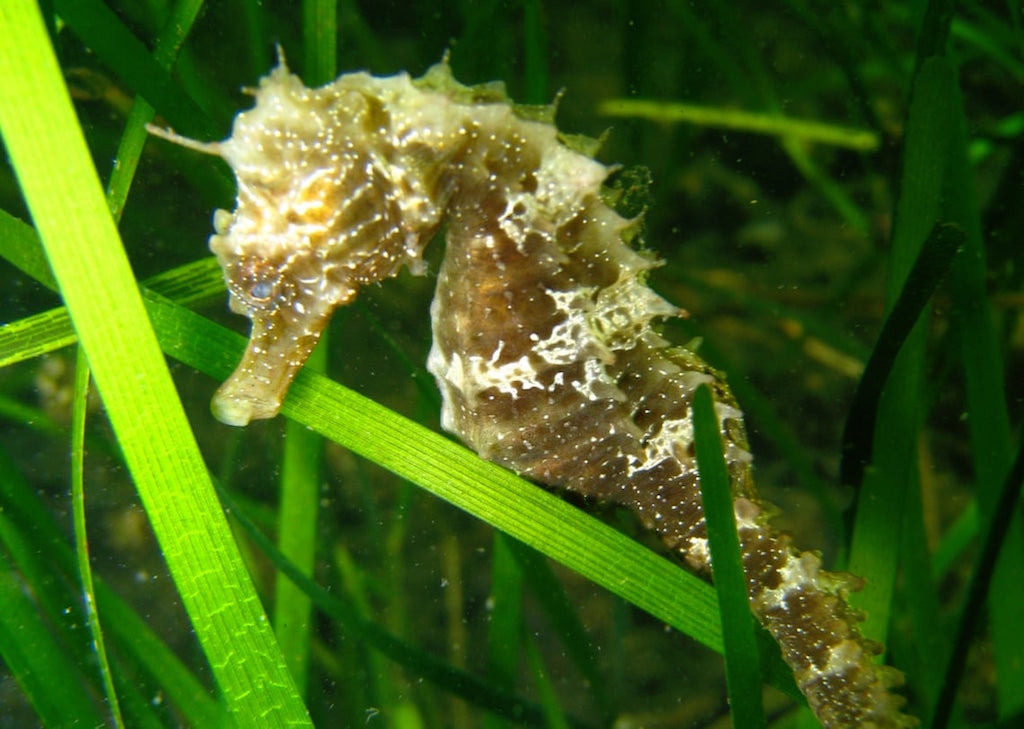
In Studland Bay, Dorset, England, the seafloor is recovering. The bare patches left for decades by anchor chains in the seagrass beds have shrunk almost everywhere, and with them, the fauna that depends on this habitat is returning: seahorses, conger eels, and spider crabs. This is according to a study by the University of Southampton led by Kira Dunn, who monitored the effects of the introduction of eco-friendly moorings installed by the Studland Bay Marine Partnership starting in 2021 for five years, as reported by the Guardian.
The Mooring That Doesn’t Kill Plants
The problem with traditional moorings is mechanical, even before it is ecological. A chain anchored to the seabed drags back and forth with every tidal movement, tearing the rhizomes of marine phanerogams and preventing them from regrowing. The eco-friendly mooring system eliminates this friction: a two-meter-long helical screw is securely fastened to the seabed and connected to a two-meter-long elastic tube that extends up to a surface buoy. As the tide rises or falls, it is the hose that stretches and retracts, not the chain dragging across the seabed. As a result, the sediment and the plant’s roots remain intact.
The data
The data collected by Dunn confirm the system’s effectiveness. In the area where ten experimental eco-friendly moorings were installed in 2021, the areas devoid of Posidonia decreased by an average of 94% between 2021 and 2025. In a second area, where traditional chain moorings remained in use until 2023, the reduction in habitat damage stopped at 65%—a difference that clearly isolates the impact of mechanical pressure from anchors alone on habitat degradation.
“The results clearly show that Posidonia seagrass beds are recovering in areas where physical disturbance has been eliminated,” Dunn said. “It’s incredibly encouraging to see how quickly this important habitat can regenerate when given the opportunity.”
Seagrass beds are not only a refuge for marine life: they store carbon and mitigate coastal erosion, two functions that make them one of the most valuable ecosystems on the planet. Globally, they are in decline due to pollution, coastal development, and climate change, and Studland Bay is particularly vulnerable because the bay is heavily used by recreational boaters. Since 2019, the area has been a marine protected area and is home to one of the largest seagrass beds in the United Kingdom, providing a habitat for the spiny seahorse—a protected species—and, occasionally, the short-snouted seahorse.
Since the introduction of eco-friendly moorings, volunteer divers monitoring the seahorse population have reported an increase in sightings, along with other species that have returned to inhabit the seagrass beds, such as conger eels and wrasse.
What the Experts Say
David Brown, chair of the Studland Bay Marine Partnership steering group and chief ecologist at the National Trust, spoke of an impact that “exceeded our expectations,” emphasizing that scientific monitoring now provides “evidence demonstrating how eco-anchors benefit seagrass and all the species that depend on it.”
Ken Collins, a researcher emeritus at the University of Southampton and the study’s lead author, echoed this sentiment: “This research provides strong scientific evidence that eco-moorings are an effective tool for the conservation and restoration of seagrass beds.” Collins adds that the findings “support the continued use and expansion of eco-mooring systems, not only at Studland but also in other sensitive marine environments where seagrass habitats are under pressure.”