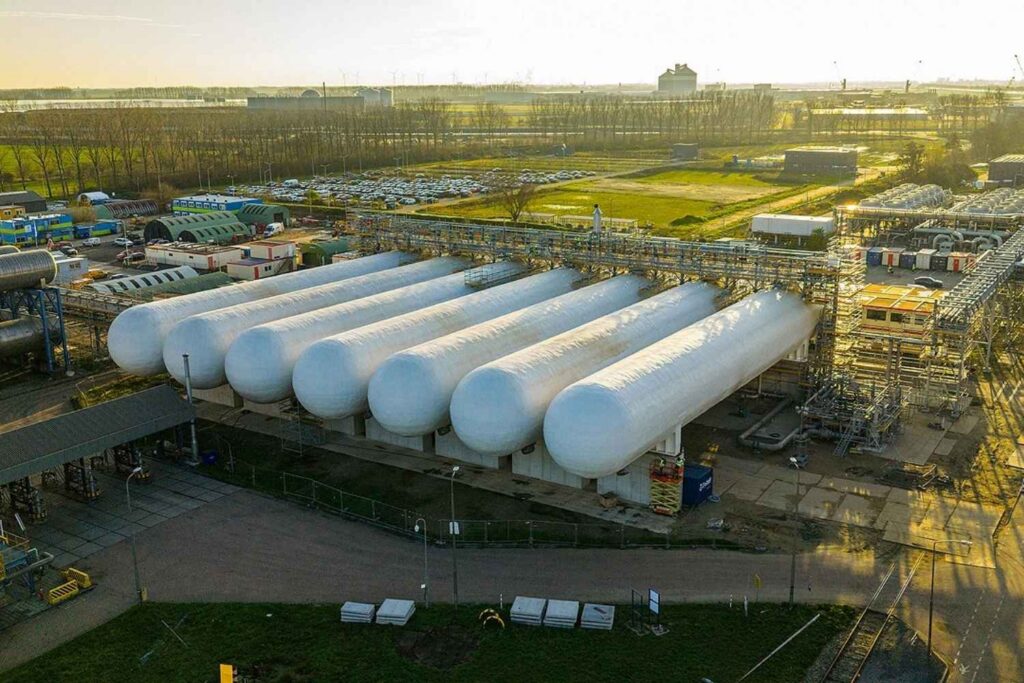
On September 7, Europe inaugurated its largest industrial CO2 capture facility. The plant, operated by Yara—a Norwegian group and world leader in fertilizer production—in Sluiskil, in the Netherlands, promises to capture up to 800,000 metric tons of carbon dioxide per year, transport it by ship to Norway, and bury it “forever” 2,600 meters below the seafloor of the North Sea.
If it works, it will be Europe’s first fully integrated cross-border system for the capture, transport, and permanent storage of CO2 (Carbon Capture and Storage, or CCS). But while politicians and officials are hailing the project as proof that large-scale industrial decarbonization is possible, the overall numbers tell a somewhat different story: projects running behind schedule, costs exceeding projections, performance falling far short of promises, and a technology that remains fragile.
A State Ceremony
The inauguration on September 7 was held with all the honors of a state ceremony. In attendance were Norwegian Prime Minister Jonas Gahr Støre, Dutch Prime Minister Rob Jetten, European Commissioner for Climate Wopke Hoekstra, and Yara International President Svein Tore Holsether. At the Sluiskil plant—Europe’s largest facility for the production of ammonia and fertilizers—the system is capable of capturing CO2 generated during the production process, liquefying it, and preparing it for transport to Norway.
“This is an important day for Yara and for European industry,” Holsether said. “The CO2 capture facility in Sluiskil demonstrates that large-scale industrial decarbonization is possible today. As global competition intensifies, Europe must find a way to reduce emissions while keeping industry, jobs, and strategic value chains within Europe.”
The project is, in fact, a first of its kind from a logistical standpoint as well. The CO2 captured at Sluiskil is transported by ship to Øygarden, Norway, where it is temporarily stored in tanks before being injected through the subsea pipelines of the Northern Lights project, jointly operated by Equinor, Shell, and TotalEnergies—three major oil and gas companies. Northern Lights is the offshore storage arm of the Norwegian supply chain, designed specifically to provide permanent CO2 storage services to European industrial projects.
Project Statistics
According to Yara’s estimates, the entire supply chain is expected to enable the permanent storage of approximately 12 million metric tons of carbon dioxide over the next 15 years. The captured CO2 will also exempt the Norwegian group from the emissions taxes imposed by the European ETS market—a significant economic advantage in an energy-intensive sector such as fertilizers and ammonia production.
“Europe needs practical climate solutions that deliver real emissions reductions while strengthening industrial competitiveness,” said Commissioner Hoekstra. “The carbon capture and storage project in Sluiskil shows what is possible when innovation and cross-border cooperation come together. This is exactly the kind of project Europe needs to combine climate ambition with a strong and resilient industrial base.”
There’s a problem
Official statements paint an optimistic picture. But international CCS figures remain modest and problematic. According to an analysis by GlobalData published last August, there are approximately 140 operational projects worldwide, with a cumulative capacity of about 62 million metric tons per year—a small volume compared to global emissions. Furthermore, many of these projects have yet to overcome the commercial, regulatory, and infrastructural hurdles necessary for construction and commissioning.
But what exactly is CCS, a technology viewed very negatively by environmentalists and very favorably by major oil companies? The idea is to capture CO2 produced by combustion or other industrial processes directly from the smokestacks of industrial facilities: coal-fired steel mills, oil refineries, cement or brick factories, and so on. It is captured, purified, compressed, and transported via pipeline to be stored at high pressure in liquid form in deep underground layers, such as depleted oil or gas wells (this is Carbon Capture and Storage in the strict sense). Alternatively, it is used as a raw material in other production and industrial cycles (Carbon Capture and Utilization, or CCU).
An ambitious goal
The European Union has set itself an ambitious goal: to reach at least 50 million metric tons per year of CO2 injection capacity by 2030. As of March 2026, however, only three storage sites had been authorized, with a total capacity of 3.54 million metric tons per year. Seven projects had submitted applications for authorization for an additional 15.6 million metric tons. Adding it all up brings the total to just over 19 million metric tons: a mere 38% of the target. Approximately 31 million metric tons per year of capacity are still needed to meet the goal.
In Italy, a study by the Energy & Strategy School at the Politecnico di Milano, published in January 2026, concluded that CO2 capture is not economically sustainable without substantial, permanent public subsidies: fully decarbonizing the cement, combined-cycle gas turbine, and waste-to-energy sectors using CCS alone would require up to 3 billion euros per year for a period of 10 to 15 years.
The European Commission, too, in a report last May, described CCS as “a technology that is still immature” as a solution for decarbonizing industries on a large scale. The Ravenna project, developed by Eni and Snam, fits into this context. It has already launched a pilot phase handling approximately 25,000 metric tons of CO2 per year and aims to reach commercial operation by the end of the decade, with an estimated injection capacity of 3.85 million metric tons per year.