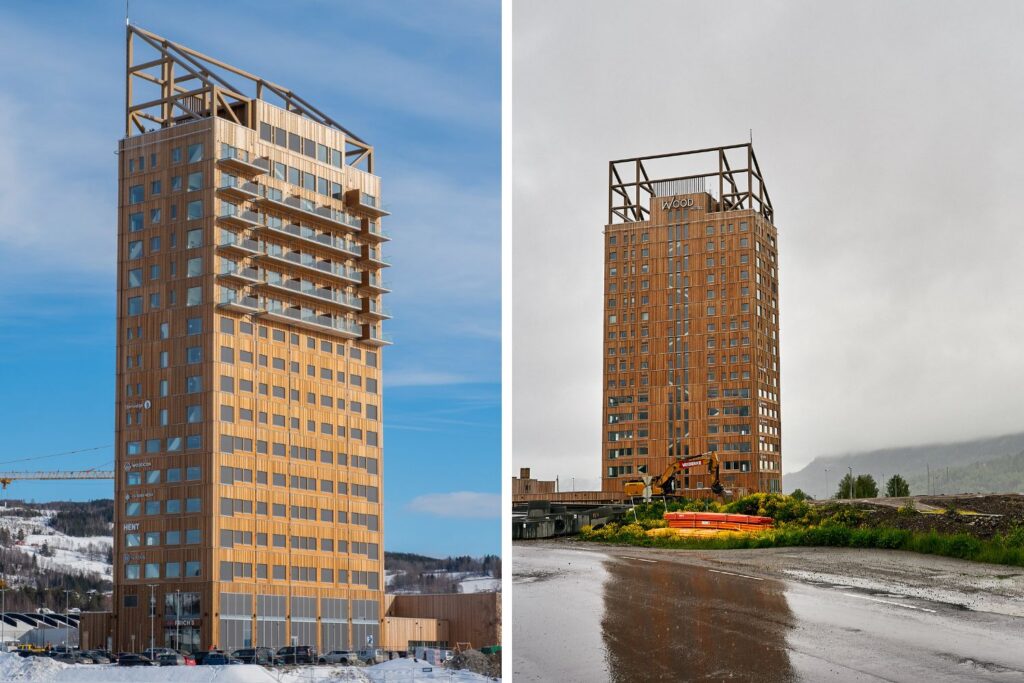
On the shore of Lake Mjøsa, an hour’s drive from Oslo, stands a burnt-orange tower. It is 84 meters tall, has 18 floors, and houses a hotel, apartments, and offices. And—a detail not to be overlooked—it is made almost entirely of wood. The Mjøstårnet is the world’s tallest wooden skyscraper, and it was conceived by Arthur Buchardt, a 70-year-old real estate developer who lives in a penthouse on the 18th floor. The tower is built with glulam (glued laminated timber): thousands of precisely cut blocks of spruce and Norwegian pine, pressed together with extremely strong adhesives and assembled like a giant Lego set.
The load-bearing column in the corner of the hotel room measures 60 centimeters by one and a half meters and is made of dozens of smaller logs. You can still see the grain and natural knots of the wood beneath the protective wax. And the fire hazard is relative. When glulam beams burn, they char on the surface, creating a protective layer that slows combustion and maintains the structural strength of the inner core. In laboratory tests, the columns continued to support the load even after hours of exposure to fire.
The CO2 Footprint
Cement and steel alone account for nearly 8% of global CO2 emissions. Every traditional mid-rise building generates between 1,500 and 2,000 metric tons of carbon dioxide during the construction phase alone. A wooden building of similar size sequesters between 600 and 1,000 metric tons, because trees absorb CO2 as they grow and continue to store it even after they are cut down and turned into beams.
The Mjøstårnet cost 100 million euros—between 10 and 15 million more than a traditional tower. But according to industry experts, the cost difference is rapidly shrinking as laminated wood technology becomes more widespread, and the environmental costs of concrete begin to be factored into economic calculations. Building with wood is easy, aside from the problem of wind: very tall wooden buildings are extremely lightweight compared to concrete towers, and when the wind blows at the top, the structure sways. To prevent “seasickness” among guests on the upper floors, they had to weigh down the upper floors with layers of concrete. This is the only concession to traditional materials, along with the building’s central core and the basement levels.
Hybrid Skyscrapers
The Norwegian experiment has set a precedent. Stockholm is building an entire neighborhood out of wood—Stockholm Wood City— comprising 250,000 square meters of offices, homes, and stores. In Switzerland, they are about to inaugurate the Rocket, a 100-meter-tall wooden tower. Just this September, the record for the tallest hybrid tower went toAtlassian Central in Sydney, which stands over 180 meters tall: an office skyscraper with a glulam load-bearing structure, the tallest of its kind ever completed. In Denmark, the TRÆ tower in Aarhus has reached 81.7 meters. And Japan’s Sumitomo Forestry has plans for a 350-meter colossus by 2041, which would become the tallest building in Japan.
One European project worth noting is the Sara Kulturhus in Skellefteå, in northern Sweden. Standing “only” 75 meters tall with 20 floors, the building houses a cultural center, a theater, a library, an art gallery, and a hotel. The load-bearing structure is made entirely of laminated timber, with a concrete core for the stairwells and elevators. Skellefteå is a small town of 35,000 residents in the heart of Swedish Lapland: the Sara Kulturhus was conceived as a catalyst for local development, demonstrating that wood construction can also serve as a tool for regional policy.
The wooden endoskeleton
In Italy, so far, wooden skyscrapers have remained on paper. But things are starting to change. In the Veneto region, a network of universities and companies is working on a comprehensive sustainable construction supply chain that could change the face of our cities, thanks to the iNEST consortium—coordinated by the IUAV University of Venice and funded so far by the PNRR and then by the Veneto Region with 900,000 euros. The Recofit project, led by the company Biohabitat Service, has developed a wooden “endoskeleton” system to reinforce existing buildings without demolishing them. It is an additive structure that is added to the original frame, making it earthquake-resistant and improving its energy efficiency. The wood chosen is paulownia, a fast-growing species native to China. The connections are reversible: they are assembled and disassembled with bolts, without welding or concrete casting. When the building reaches the end of its life cycle, the components can be reused elsewhere.
In Venice, the ReMu project is tackling a centuries-old problem: Murano glass waste. The island’s glassworks produce works of art, but also tons of non-recyclable material that ends up in landfills. The startup Rehub, in collaboration with the Nicolamoretti glassworks, has developed a process to transform this waste into a moldable paste at room temperature, without the need for high-temperature melting. The result is single-material slabs and surfaces that can be used in construction and design, closing the waste cycle and creating a new material.
Permeable Paving
In the Vicenza stone-cutting district, where marble and building stone are processed, the Nonsibuttavianiente project has demonstrated that it is possible to reduce raw material waste by up to 35 percent. Using “Matryoshka”-style 3D cutting techniques, the blocks are utilized to their fullest potential. Processing scraps, dust, and sawing slurry are mixed with natural binders to produce new composite materials.
The Ekonia project, coordinated by Bellitalia, has developed permeable pavement that uses byproducts from the steel and glass industries. These are slabs for sidewalks, bike paths, and road shoulders that filter rainwater and trap pollutants. The system has two filtration levels: a mechanical one for coarse contaminants and a chemical one to absorb heavy metals such as cadmium and lead. In tests, over 95% of the contaminants present in the water were trapped by the material. The slabs also incorporate fragments of Murano art glass, adding a significant aesthetic appeal.