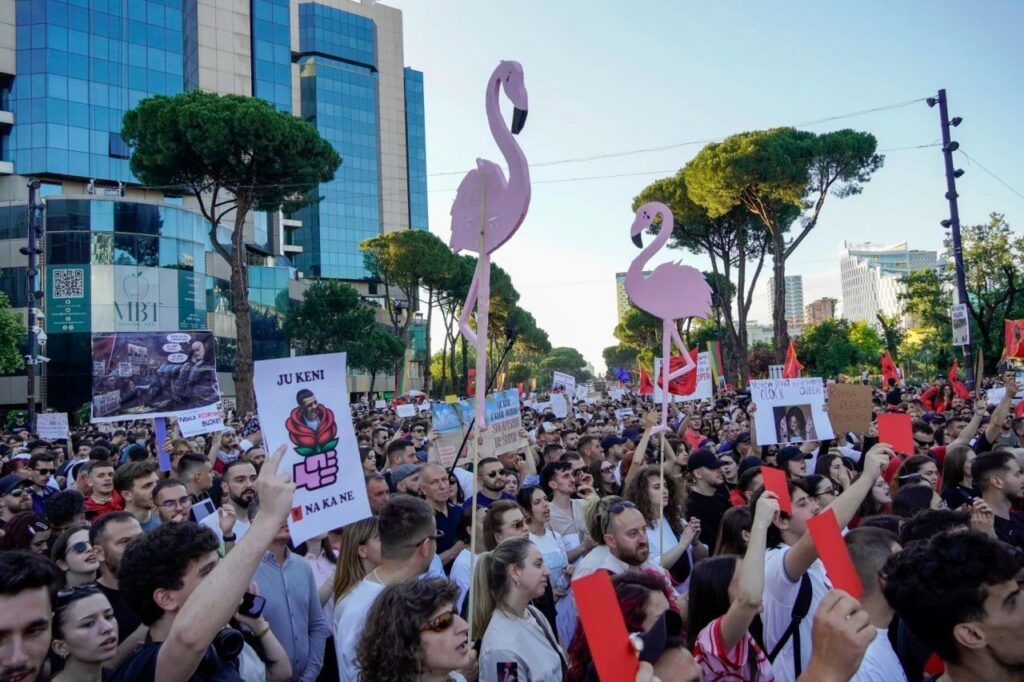
The so-called “flamingo revolution” is changing shape. Born as a local reaction against a giant tourism project on the Adriatic coast, after nearly two weeks of mobilization the protest in Albania has turned into a European political test. At stake is environmental protection, but also the delicate balance between foreign investment and Tirana’s path to EU membership.
At the center of the clash is the luxury resort being promoted by Affinity Partners, the firm of Jared Kushner, U.S. financier and Donald Trump’s son-in-law. The site in question is Zvernec, abutting the protected Vjosa-Narta landscape, one of the most important wetlands in the Balkans, crucial for migratory bird routes and the survival of protected marine species.
The Brussels constraint and the 2030 deadline
The turning point in the affair, however, is diplomatic. The European Commission has intervened directly in the dossier, calling on Albania to act quickly to ensure compliance with EU environmental legislation. Spokesman Guillaume Mercier pointed out that ecosystem protection is not an optional extra, but one of the cardinal requirements for candidate countries to join the Union.
Brussels confirmed that it is in close contact with the Albanian authorities, warning that Tirana should avoid any initiative capable of undermining integration requirements. Albania has a stated goal of joining the EU by 2030, and environmental chapters are historically the most complex to negotiate.
Edi Rama’s hard line
Despite the appeal and the crowded squares, Prime Minister Edi Rama, in power since 2013, shows no signs of backing down. In an interview with Reuters just as protesters’ chants rang out near his offices, the prime minister doubled down on the deal: “It will be a beautiful project and we will implement it.”
Rama hails the investment as an essential economic development opportunity and dismisses criticism from environmentalists: “We are proud of what we have done for wildlife. The European Commission has no reason to doubt our firm resolve to protect what needs to be protected.”
Beyond tourism: a question of credibility
Government reassurances are not enough to stop a mobilization that, according to reports by Reuters and Al Jazeera, now taps into a deeper discontent related to public transparency and land management. Activists report that while the environmental impact assessment has not yet been completed, preliminary work and construction of access infrastructure have already begun.
The Vjosa-Narta case thus ceases to be the story of yet another concrete assault on the coast and becomes a mirror of a European contradiction: to what extent can candidate countries derogate from EU ecological standards in the name of immediate growth? Tirana’s answer will weigh on the future of a lagoon and the very credibility of EU accession rules.