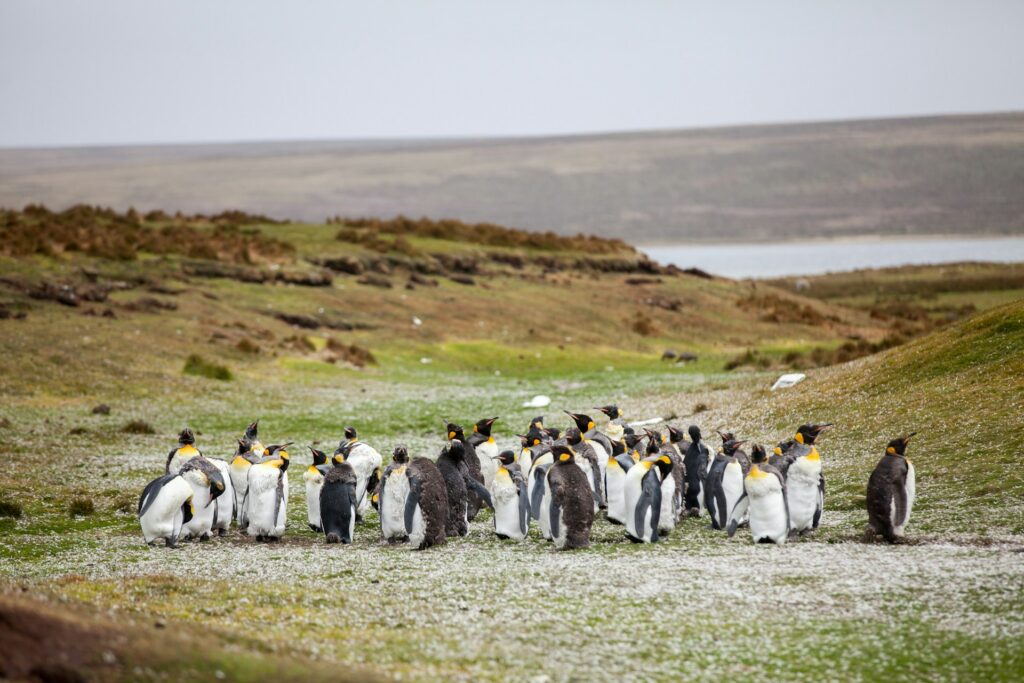
For decades they called it Useless Bay. Today it is home to the only permanently nesting colony of king penguins on the mainland,outside the subantarctic islands where the species normally breeds.
Cecilia Durán Gafo is 72 years old and not a biologist but a former kindergarten teacher who notices in the 1990s that some king penguins have begun nesting on her property. Then self-styled researchers arrived, captured the animals and took them away. “We found that many had ended up in zoos or as pets,” he tells the Guardian. After that episode, the penguins disappeared for more than a decade.
The collapse
When they returned in 2010, impromptu tourists approached the nests, stole eggs, and disguised the penguins for selfies. “They dressed them up in little hats and sunglasses. Horrible things,” Durán says. Within a year, the colony collapses from 90 individuals to eight.
At that point the reserve was born: thirty fenced acres, controlled access, remote observation.
Durán spends his days on the beach with a thermos watching over the animals. The threat, in fact, comes not only from humans. Mink and gray foxes, invasive species introduced to Tierra del Fuego in the last century, begin to prey on eggs and chicks. The response is field adaptation: night shifts, scraps of meat distributed away from the colony to get predators used to hunting elsewhere, dogs used to mark territory.
What the state doesn’t do
Behind this story is also a political fact. A study published in Nature Ecology & Evolution in 2022, based on more than 15 thousand private protected areas around the world, shows how these reserves often succeed in protecting habitats that public systems do not adequately protect.
The Useless Bay is a case in point because it shows that conservation sometimes depends on a fence, on controlling access, on someone willing to guard an area.
Today the colony has nearly 200 king penguins. In 2025, 23 chicks survived, a record.Antarctic Research Trust researchers have observed that penguins from far-flung colonies are able to adapt quickly to the local diet, a dietary plasticity that biologist Klemens Pütz says could help them withstand the effects of the climate crisis.
The most interesting point of Cecilia Durán’s story is that a woman without political power has identified before others a very simple truth: biodiversity survives where someone decides to defend the space necessary for its existence.