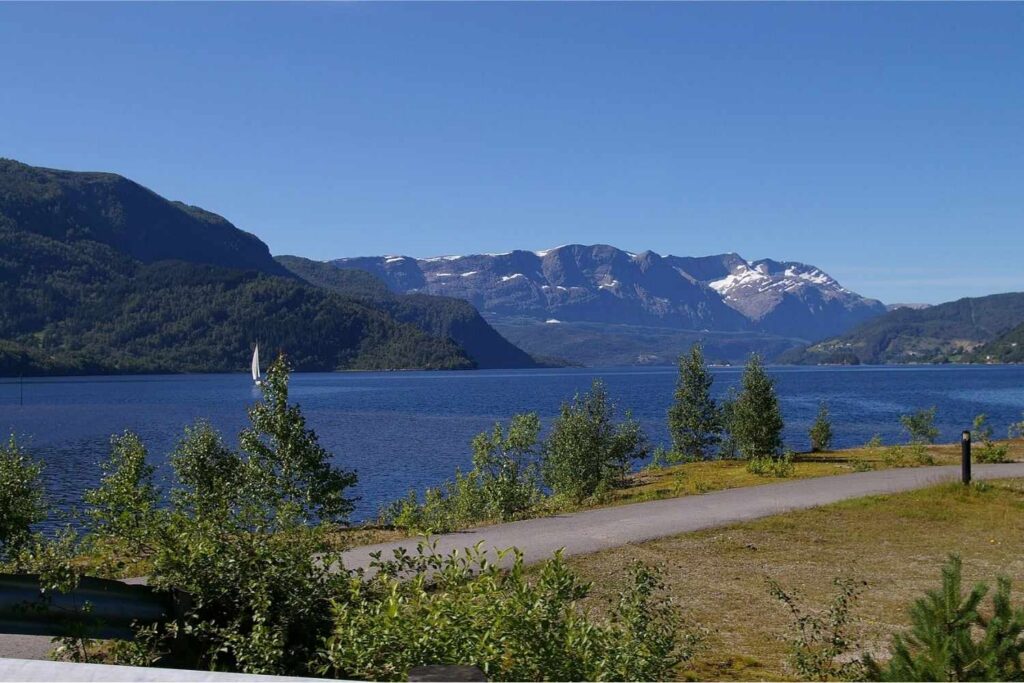
In Norway, there is a fjord called Førde that has been at the center of a bitter battle between environmental protection and mining interests for years. On June 17, 2026, the Norwegian Supreme Court appeared to have put an end to a 17-year-long legal battle: the ruling had determined that the permit granted to the Engebø mine to discharge its waste into the fjord was illegal. Yet, in reality, the situation has not changed. Just four days after the judges’ decision, the company that owns the facility, Nordic Mining, applied for a new permit. In late September, the Norwegian Ministry of Climate and Environment granted it for a period of three years.
Rutile, the mineral from which titanium is extracted
To understand the gravity of the situation, we need to take a step back. At the Engebø mine, near the village of Vevring on Norway’s west coast, rutile is mined—the ore from which titanium is extracted. Titanium is a lightweight, durable metal that is indispensable to the aerospace industry, medicine, and green transition technologies. This is why the government in Oslo is defending the facility: as a ministry spokesperson confirmed to The Guardian, the site is home to one of the world’s largest deposits of this mineral. The authorities’ position is further strengthened by the European Union’s decision in 2020 to include titanium on the list of critical raw materials, thereby increasing its strategic and economic value.
However, the mining process comes at a very high environmental cost. To separate rutile from the rock, the extracted material is finely crushed and treated with chemical additives. What remains is a toxic slurry that Nordic Mining disposes of through what is known as Submarine Tailings Disposal—that is, the underwater disposal of mining tailings. In practical terms, enormous pipes descend hundreds of meters into the fjord to discharge the waste directly onto the seabed. According to data reported by the British newspaper, this technique is banned in most parts of the world, including countries such as the United States, Canada, Australia, Russia, Brazil, China, and nearly all of Europe.
A well-known neurotoxin
Studies conductedby the Norwegian Institute of Marine Research (IMR) paint a troubling picture for the health of the fjord. While the heavier rock fragments sink quickly, the finer particles are carried by ocean currents over considerable distances. Just a few millimeters of sediment are enough to irreversibly alter the seafloor fauna. Furthermore, the fine sediment clings to fish eggs, reducing their buoyancy and hindering the hatching of the larvae.
The tailings also contain chemicals that degrade to produce carbon disulfide, a known neurotoxin. Terje van derMeeren, a researcher at the IMR, compared this dust to a suspended slurry capable of suffocating the entire basin. These scientific concerns are confirmed by historical precedents: in Repparfjord, in the Norwegian Arctic, where a copper mine discharged tailings for six years in the 1970s, researchers still found abnormal concentrations of lead, arsenic, and chromium in fish muscles as recently as 2016.
The legal crux of the matter revolves around the European Union’s Water Framework Directive, which Norway implements by virtue of its membership in the European Economic Area. The directive stipulates that a natural body of water may be polluted only in the presence of an “overriding public interest.” According to the Supreme Court, the reasons the government gave for granting approval in 2015 were too weak to justify the environmental damage. The ministry, however, circumvented this obstacle by arguing that, with the EU’s classification of titanium as a critical resource in 2020, that public interest had suddenly become a priority, thereby legitimizing the granting of the new temporary permit.
Deep Divisions in the Financial World
Meanwhile, the mine—which officially began operations at the end of 2024—continues to operate at full capacity. Økokrim, the Norwegian agency for economic and environmental crimes, is considering whether to open an investigation into the legality of the discharges that continued immediately after the ruling. The case also reveals deep divisions within the financial world. Nordic Mining’s financiers include the British subsidiaries of Morgan Stanley, UBS, and Goldman Sachs, while other international banking groups, including Citigroup and Standard Chartered, expressly prohibit—under their internal regulations—support for projects that involve the discharge of mining waste into the sea.
The battle over Førde Fjord is playing out in an ecosystem that is already severely strained. According to data from the Sunstone Institute, in 2025 intensive salmon farms discharged 75,000 metric tons of nitrogen and 360,000 metric tons of organic carbon into Norwegian waters, a pollution load equivalent to the untreated sewage of over 17 million people, in a country with a population of just 5.5 million. Because they are semi-enclosed bodies of water, the fjords accumulate these nutrients, triggering algal blooms that consume the oxygen needed by marine life.
The crisis is also evident inland, where this year 155 of Norway’s approximately 450 rivers inhabited by wild salmon have been closed to fishing. In Vevring, residents and environmental activists are already preparing to challenge the three-year permit, but the legal process is expected to be lengthy, and the mine’s pipelines will continue to pump tailings into the fjord.