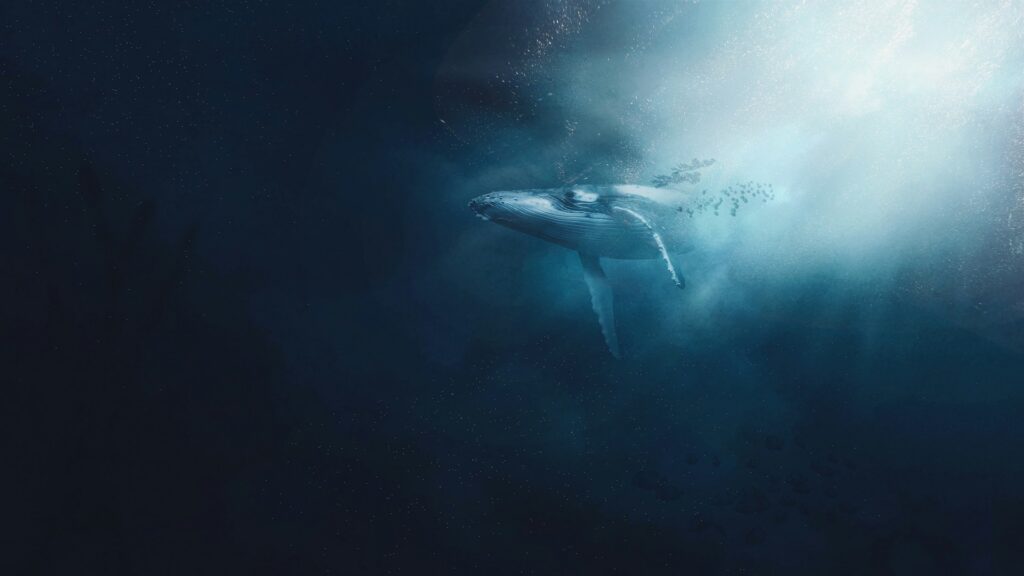
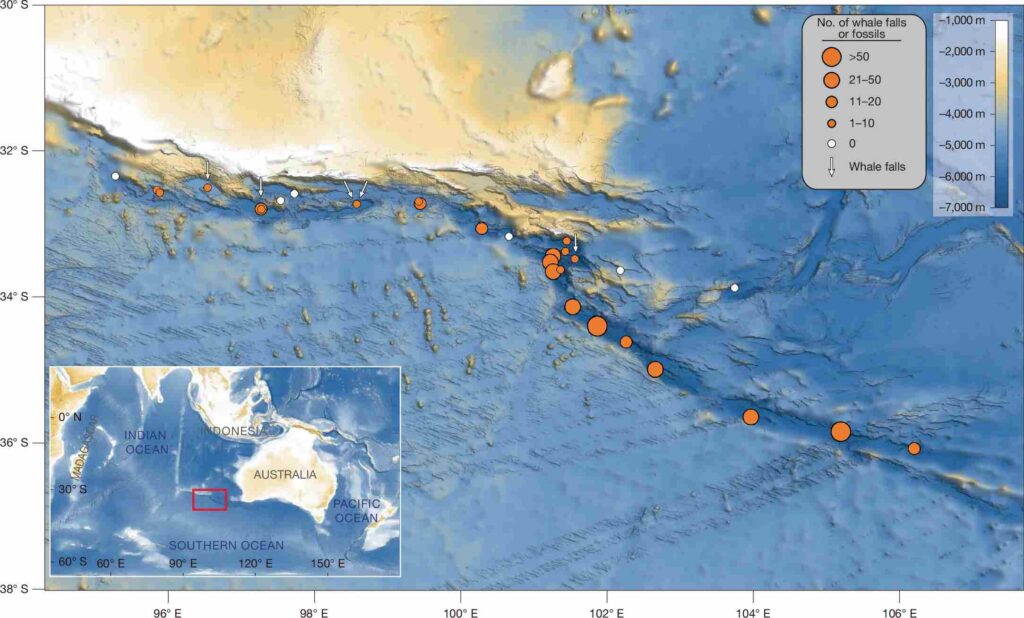
The deepest, largest, and oldest whale graveyard ever documented is located in the southeastern Indian Ocean, in the Diamantina Fracture Zone, not far from Australia. This was revealed in a study published in Nature, the result of an international scientific expedition that explored the seafloor using the Fendouzhe submersible, capable of reaching depths of 11,000 meters.
A 1,200-kilometer-long necropolis
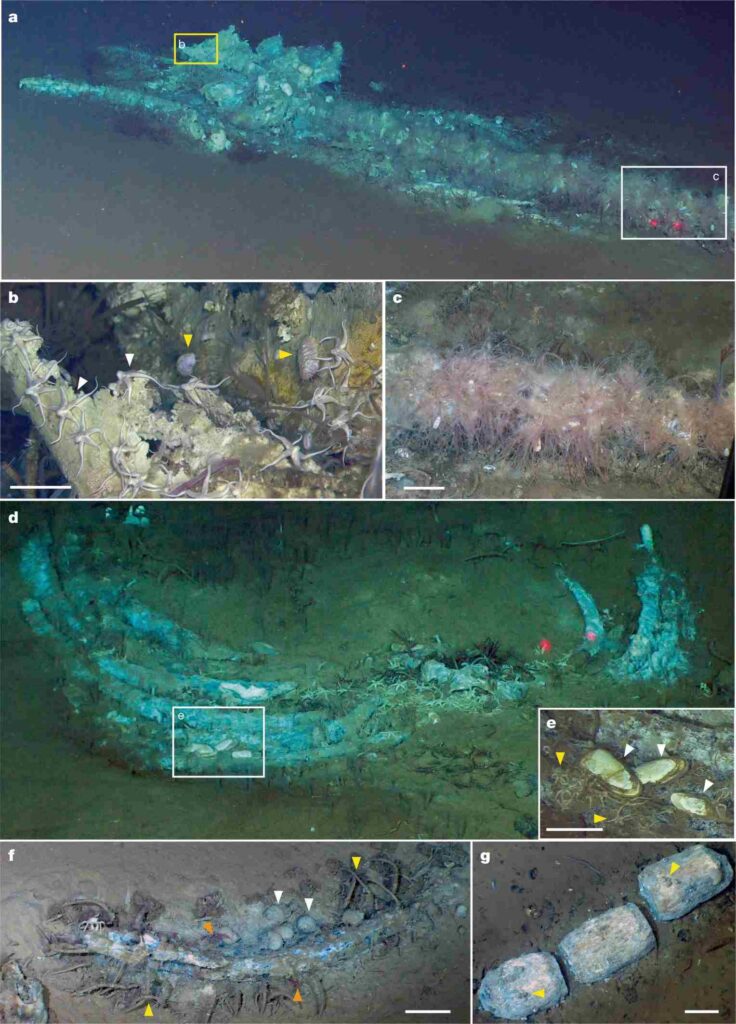
Researchers have identified 485 sites containing cetacean fossils and five still-decomposing carcasses at depths ranging from 4,600 to 7,002 meters. The remains are distributed along an axis of approximately 1,200 kilometers, a concentration never before observed in the oceans. The study openly refers to a possible “supercorridor of deceased whale communities,” a natural biological infrastructure capable of sustaining life in the planet’s deepest depths.
“This discovery shows that these extreme and unexplored environments are home to species and ecosystems still unknown to science,” explained Giovanni Bianucci of the University of Pisa, a co-author of the study.
5.3-million-year-old fossils
The most striking aspect of the discovery concerns the age of the fossils. Isotopic analyses of the fossils indicate that some whales sank in that area at least 5.3 million years ago, during the Pliocene. Among the identified remains is also a new species of beaked whale, named Pterocetus diamantinae. The ocean floor has thus preserved an archive of cetacean evolution for millions of years. The extremely low sedimentation in the area prevented the remains from being buried quickly, allowing for their exceptional preservation.
Where death gives rise to life
Whale carcasses become ecological oases. Around the bones, scientists have observed worms that feed directly on bone tissue, symbiotic mollusks, crustaceans, brittle stars, and other specialized life forms. Many of these may be new to science. At one of the deepest sites, at nearly 6,800 meters, a biological community lived on the vertebrae of a beaked whale. It is the deepest active “whale fall” ever documented.
Why there, of all places?
The authors of the study hypothesize that the Diamantina area is a natural accumulation site for dead whales. On one hand, it lies along a migration route for large filter-feeding cetaceans, such as minke whales and sei whales; on the other, the deep oceanic rift is an ideal hunting ground for beaked whales, which specialize in extreme dives in search of squid. The “V”-shaped topography of the seafloor may channel the carcasses toward the center of the rift, while the extremely low sedimentation rate facilitates their preservation over geological time.
A frontier yet to be explored
As industrial interest in deep-sea mining grows, an ecosystem is emerging that harbors unique biodiversity and a biological memory stretching back millions of years. “Life can adapt and evolve even in extreme environments where there is no light and the pressure is extremely high,” added Bianucci. For oceanography and marine biology, the Diamantina necropolis represents a new chapter in our understanding of life in the deep ocean.