Yesterday in Frankfurt, the European Central Bank unveiled the ten finalist designs for the new euro banknotes, the first complete redesign since 2002. Starting today and through September 21, citizens can vote for their favorite design online; the final decision will be made by the ECB’s Governing Council by the end of the year.
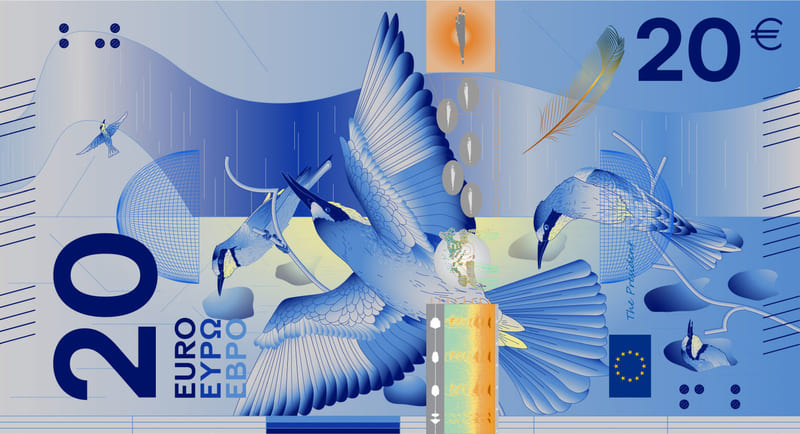
There are two themes in the competition:“European Culture,” featuring figures such as Leonardo da Vinci, Maria Callas, and Marie Curie, and“Nature: Rivers and Birds,” featuring species that symbolize the continent’s biodiversity paired with EU institutions. Behind the aesthetics, however, the ECB included a less visible but explicitly stated goal in the project brief: to make the new euro banknotes more sustainable.
The New 2026 Euro Banknotes: Culture or Nature—How to Vote
An independent jury of 21 experts in graphic design, communication, neuroscience, and history—one from each national central bank in the euro area— shortlisted the ten finalists from among more than 1,200 entries received from across the European Union. There are five designs for each of the two selected themes.
In the “European Culture” series: Maria Callas on the 5-euro note, Ludwig van Beethoven on the 10-euro note, Marie Curie on the 20-euro note, Miguel de Cervantes on the 50-euro note, Leonardo da Vinci on the 100-euro note, and Bertha von Suttner, Nobel Peace Prize laureate, on the 200-euro note. On the “Nature: Rivers and Birds” series, each banknote pairs a native European bird species with an EU institution: the Eurasian nuthatch with the European Parliament, the kingfisher with the Commission, the common bee-eater with the ECB, the white stork with the Court of Justice of the EU, the avocet with the European Council and the Council of the European Union, and the northern gannet with the European Court of Auditors.
Why the redesign of euro banknotes is also an environmental issue
Changing the design of a banknote isn’t just about choosing a face or a landscape. It also means reevaluating the materials, the production processes, and, potentially, the way that banknote will be handled over the next twenty years. The ECB says it openly: the redesign is an opportunity to optimize the production and environmental sustainability of banknotes. To understand what this really means, we need to start with a question that’s simpler than it seems: what are euro banknotes made of today?
What Are Euro Banknotes Made Of? (You Might Not Know This)
Most people handle banknotes every day without realizing that they aren’t made of paper—at least not in the common sense of the word. Euro banknotes are made of pure cotton paper, not wood pulp like a regular sheet of printer paper. It is the cotton that gives a banknote its characteristic crispness , its resistance to creases, tears, and moisture, and the ideal surface for watermarks, holograms, and security threads.
There’s one detail that’s rarely mentioned: the cotton used isn’t grown specifically for making banknotes. It comes from what are known as “comber noils”—fibers that are too short to be used by the textile industry, which are purchased by paper mills and turned into cotton paper. In other words, the banknote in your pocket is literally made from the scraps of a T-shirt.
In 2014, the Eurosystem launched the Sustainable Cotton Program, with the goal of gradually replacing conventional cotton with cotton from sustainable sources (Fairtrade, organic, Better Cotton). The 100% target was set for the end of 2023; according to the ECB’s latest Environmental Statement, it has indeed been achieved: starting in 2024, the cotton fibers used in euro banknote paper will come exclusively from sustainable sources.
How Much Pollution Do Euro Banknotes Actually Cause? The ECB’s Official Figure
Here’s the number that really matters. Since 2020, the ECB has been measuring the environmental footprint of cash using the Product Environmental Footprint (PEF), the European Commission’s standardized methodology for assessing a product’s life cycle, from raw materials to disposal.
Based solely on the climate indicator, expressed in kilograms of CO2 equivalent, the result for the average annual number of cash payments made by a euro area citizen is 1.43 kg of CO2 equivalent: a very small share (0.017%) of a person’s total greenhouse gas emissions from final consumption in the EU.
Where does this impact come from? Not where you might expect. The main factors are the energy consumption of ATMs and transportation, followed by processing at national central banks, paper production, and the authentication of banknotes in stores. The production of the banknote itself (cotton, printing, security features) actually accounts for very little: production and distribution account for 13% and 87% of the overall score, respectively—a figure due to the long lifespan of banknotes and the fact that they are used for a vast number of payments over the course of their lifetime. And progress has already been made: between 2004 and 2019, improvements in the energy efficiency of ATMs led to a 35% reduction in their environmental footprint.
A Comparison with Digital Payments
While cash has a single institutional study—conducted over time and using a transparent methodology—digital payments do not yet have a direct equivalent. The available studies, commissioned by players in the digital payments industry—not by a third-party organization—focus on individual transactions rather than the annual total, and yield highly variable results depending on where they draw the line for their calculations: from 2.45 grams of CO2 for a digital payment at the point of sale, according to the Oxford Economics study commissioned by the European Digital Payment Industry Alliance (EDPIA), up to nearly 37 grams per cash transaction if the entire supply chain is included, according to another study conducted on behalf of the fintech company Worldline.
By cross-referencing ECB data on the average frequency of cash and digital payments with Oxford Economics’ estimates per transaction, we arrive at a rough but consistent estimate: cash generates about 1.2–1.4 kg of CO2 equivalent per year per citizen (in line with the official ECB figure), compared to about 0.4 kg for digital payments. Cash therefore has a carbon footprint about three to four times greater than digital payments. But this ratio must be viewed in its proper context: we are still talking about just over one kilogram of CO2 per person per year—the equivalent of driving a few kilometers—an infinitesimal fraction compared to the several metric tons of CO2 that the average European citizen emits each year through their overall consumption.
How and When to Vote
The ECB’s public consultation will remain open until September 21, 2026. At the same time, an independent research firm will conduct a survey of a representative sample of the euro area population. The final decision, expected by the end of the year, will take into account both the public’s votes and the jury’s technical assessments. Production of the first banknotes in the new series will begin in 2027, but they will not actually enter circulation until a few years later, while banknotes from the previous series will continue to be legal tender.