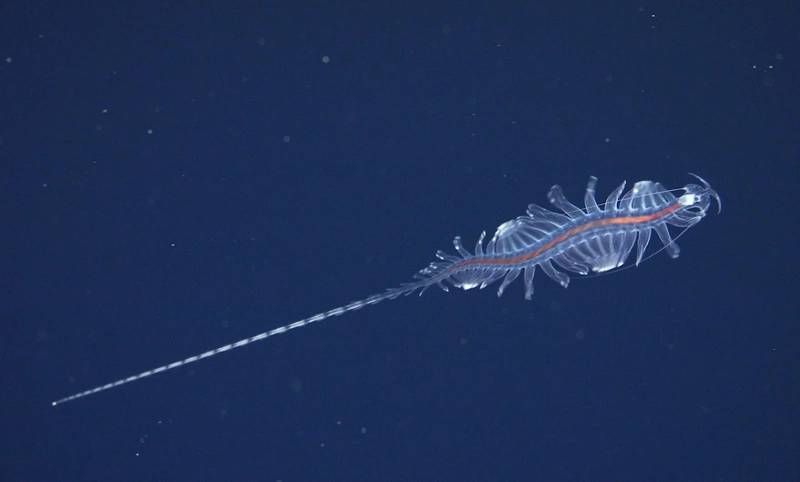
Thirty-one new species in fourteen days. That is the result of the expedition conducted aboard the Falkor (too), operated by the Schmidt Ocean Institute, which explored the international waters of the tropical South Atlantic off the coast of Salvador, Brazil, between May and June 2026. A pace that scientific lead Karen Osborn, of the Smithsonian National Museum of Natural History, described as close to a record for the number of new animals identified in such a short time. On board were about twenty experts from the United States, Australia, Brazil, and Japan, collaborating for the third time on these midwater observation technologies.
Among the most significant observations was a female pelagic octopus (Haliphron atlanticus) filmed at a depth of 800 meters as it devoured a bright red jellyfish—a behavior rarely documented in the wild. The team also filmed transparent squids and a Solmissus jellyfish feeding on a ctenophore. Describing a new species usually takes years, sometimes decades; here, confirmation came within days.
What’s in the mesopelagic zone?
The mission’s target was the mesopelagic zone, the layer of water between the sunlit surface and the seafloor. According to the team, this layer accounts for about 90% of the planet’s habitable space, yet it remains one of the least studied environments. Among the discoveries: an amphipod, a filamentous worm faster than its shape would suggest, nine jellyfish, seven siphonophores, seven ctenophores with luminescent cilia, four larvaceans living in mucus casings, and two giant rhizarians, single-celled organisms visible to the naked eye.
Technology That Saves Time
This speed is made possible by the combination of non-invasive imaging and on-board genetic sequencing. The DeepPIV and EyeRIS instruments, developed by MBARI’s Bioinspiration Lab, use lasers to reconstruct 3D images without capturing the animals. A shadowgraph camera from Japan’s JAMSTEC is also used, capturing details invisible to the scans.
The most significant development involves Squid, a special microscope developed at Stanford: for the first time in an oceanographic expedition, it has made it possible to observe the three-dimensional cellular structure of a living organism in real time.
The Context of Funding Cuts
The expedition, funded by the Sasakawa Peace Foundation’s Ocean Shot program in partnership with the University of Western Australia and the Bigelow Laboratory, took place while the Trump administration in the United States was proposing to dismantlethe Ocean Observatories Initiative, a network of over 900 instruments worth $368 million that monitors currents, climate variability, and marine biodiversity. The plan was later withdrawn following protests from the scientific community, but the contrast between the two events highlights the gap between what remains to be discovered in the ocean and the fragility of the instruments that make such discoveries possible.
Every night, mesopelagic organisms undertake a vertical migration toward the surface to feed under the cover of darkness: a mass movement that affects the ocean’s ability to absorb carbon. Understanding how these populations are distributed provides more reliable data on a process that affects the entire planet.