There is a missing item in global environmental budgets. An important item, but one that no government is required to declare, that does not appear in official reports sent to the United Nations, that is not part of the commitments made in international climate agreements. This item is called war. While the public debate focuses on emissions from transportation, industry and agriculture, armed conflicts produce amounts of greenhouse gases that would put many productive sectors to shame. So says systematic research conducted by Lennard de Klerk, founder of the Initiative on GHG Accounting of War, the project that for years has been trying to measure what the international community prefers to ignore.
The analysis will be presented tomorrow at Padua Climate Action Week. “Bringing this discussion to Padua, in a festival built from the bottom up, means giving a voice to those working concretely to counter the crisis and propose alternative ways and solutions,” stresses Daniele Pernigotti, CEO of Aequilibria and promoter of Padua Climate Action Week, the first widespread climate festival organized from the bottom up.
The numbers of the war in Ukraine
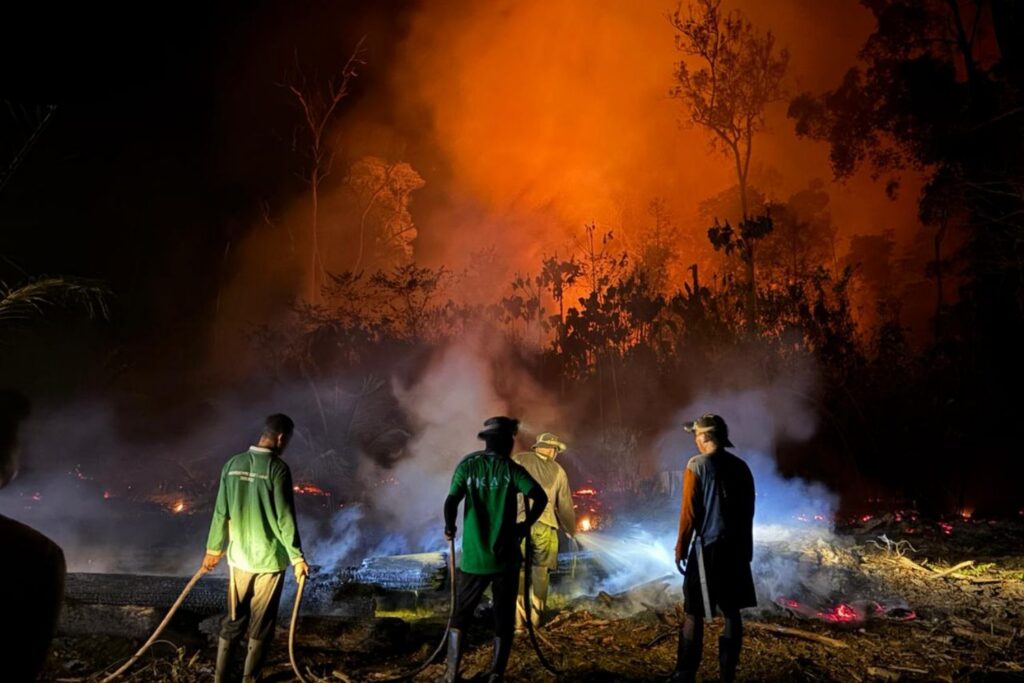
Four years after the large-scale Russian invasion, greenhouse gas emissions attributable to the conflict in Ukraine have crossed the threshold of 311 million tons of CO₂ equivalent. That is a number roughly equivalent to what the whole of France emits in the course of a year. Contributing to this budget are not only direct military operations, with fuels consumed by armored vehicles, aircraft and ships, or explosions of fuel depots and industrial infrastructure. There is also another factor: forest fires. Fighting triggers fires under increasingly extreme conditions, with high temperatures and increasing drought making the fire very difficult to control. Global warming, in turn, exacerbates these conditions. It is a self-perpetuating cycle in which war and climate crisis reinforce each other in a progressive way that is difficult to reverse.
Gaza: a decades-long damage
While the accounting in Ukraine concerns a still ongoing and expanding conflict, the case of Gaza offers a glimpse into a different dimension of the problem. A study published in the scientific journal One Earth estimated that the total cost of the conflict in Gaza, taking into account infrastructure destruction, mass population displacement and future reconstruction, exceeds 31 million tons of CO₂ equivalent. A figure higher than the combined annual emissions of Costa Rica and Estonia.
Rebuilding razed cities means producing concrete, transporting materials, fueling construction sites for years. Each building destroyed and then rebuilt has twice the carbon footprint. Added to this logic is the collapse of water, sanitation and energy systems, forcing populations into highly polluting emergency solutions. War, in other words, not only emits CO₂ the moment it is fought: it also emits it in the decades that follow, between rubble that must be removed and walls that must be raised.
The black hole in climate governance
The most critical point, however, is not about the numbers themselves. It concerns the fact that these numbers do not have to be reported by anyone. States have no obligation to report military emissions to the UN climate body. The result is that one of the world’s most significant sources of greenhouse gases operates in a complete vacuum of international accountability.
This gap is not accidental. Military emissions were excluded from the Kyoto agreements and have remained essentially out of subsequent agreements as well. It was a political choice masquerading as technical complexity that allowed governments to set ambitious climate targets on paper while continuing to fund and fuel conflicts without any weight on their official commitments.
Ukraine has chosen to break this pattern. At COP30 in Brazil it announced its intention to hold Russia accountable for climate damage caused by the invasion as well. The requested compensation, calculated on a social cost of carbon of $185 per ton, exceeds $57 billion in the category of environmental damage alone, within the International Damage Register. It is a legally and politically unprecedented move that could open a whole new front in states’ environmental responsibility.
Counting for change
The methodology developed for Gaza is now being applied to the conflict in Iran as well, further expanding the map. This is not an academic exercise. Putting an accurate number on war emissions means making them visible, and making them visible means paving the way for the possibility of including them in international accountability mechanisms.
As long as wars stay out of climate accounting, any global efforts to reduce emissions are bound to remain incomplete. You cannot fight the climate crisis by ignoring one of its most powerful accelerators. Beginning to count is the first possible political act.