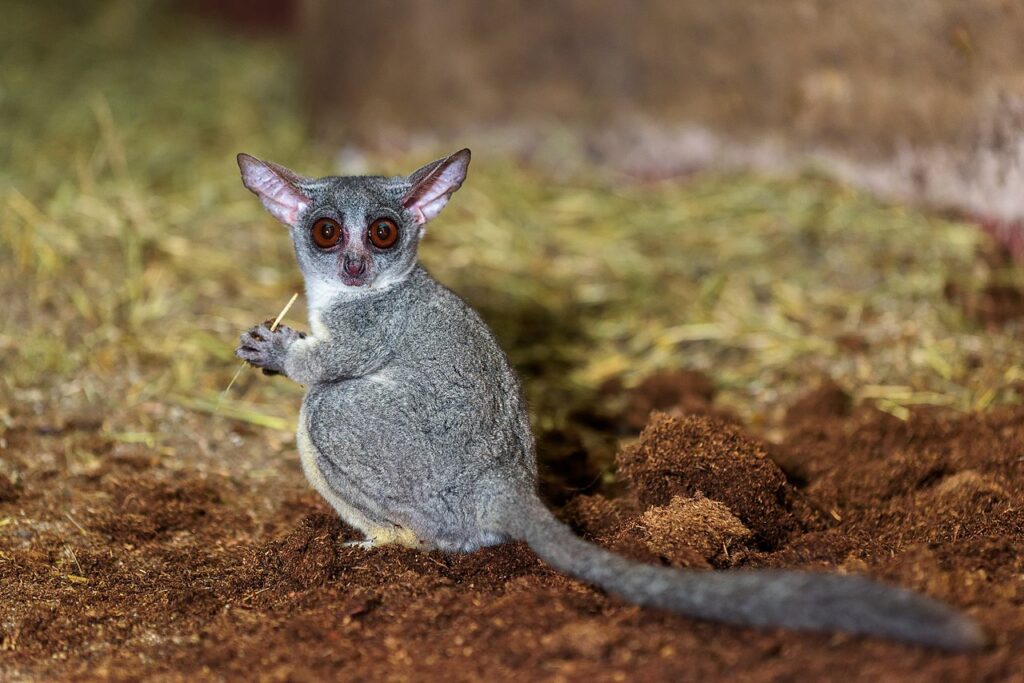
Big round eyes, pointed ears and spectacular leaps between branches: the galago, a small nocturnal primate from southern Africa, looks like something out of a fairy tale. Its recent history, however, resembles more a tale of endurance. Once widespread in South Africa, the thick-tailed galago has now been reclassified as a “near-threatened” species. A wake-up call for destroyed habitats, increasingly busy roads, and difficult coexistence with humans.
Habitats shrink
When researchers Frank Cuozzo and Michelle Sauther began studying these primates in 2012, they did not imagine they would come across dead specimens so often. Traffic collisions and attacks by domestic dogs proved to be a disturbing constant.“Human threats are everywhere, for all species,” Cuozzo explained to Euronews. “But we’ve been able to document that the ones galagos are exposed to are increasing.”
Deforestation is the primary culprit. Galagos live in trees and feed mainly on the gum of the acacia tree. But agricultural and urban expansion is reducing their habitats by about 3.6 percent every decade. Driven out of forests, the animals venture into residential neighborhoods in search of food, increasing the risk of accidents and conflicts.
The trap of cities
At one time their presence near homes was almost folkloric: they would sneak in to steal kibble from dog bowls or beg for scraps from tourists on safari. Today, however, this familiarity with humans has turned into a danger. Roads bisect territories, vehicles become death traps, and dogs defend their space. In some areas, such as north of Pretoria, entire populations seem to have disappeared after infrastructural interventions have drained the forests.
To counter this spiral, researchers have made a few proposals. The first is common sense: do not leave animal food outdoors overnight and do not feed galagos, to discourage them from entering human settlements. The second is more spectacular: build rope suspension bridges over roads, true aerial corridors that allow primates to move around safely.
These steps, already proven in the Amazon and other regions of the world, drastically reduce investment and help keep populations connected, avoiding genetic isolation. WWF calls them a “critical mitigation measure” for all those species forced to move through fragmented landscapes.
The challenge of resources
The problem, as is often the case, is funding.“There is so little money available for conservation that even building a simple rope bridge can take time,” the researchers pointed out. Still, any targeted intervention can make a difference. Studying the galagon better means investing more effectively, avoiding waste and maximizing results.
The real battle, however, remains against deforestation. Without habitat protection, bridges and best practices risk becoming mere palliatives. The fate of the galago is inextricably linked to human choices: protecting forests means protecting a fragile balance that we can no longer afford to ignore.
Saving this tiny primate is therefore a test of our ability to coexist with the rest of the Planet, without reducing it to a patchwork of smaller and smaller, less and less living islands.