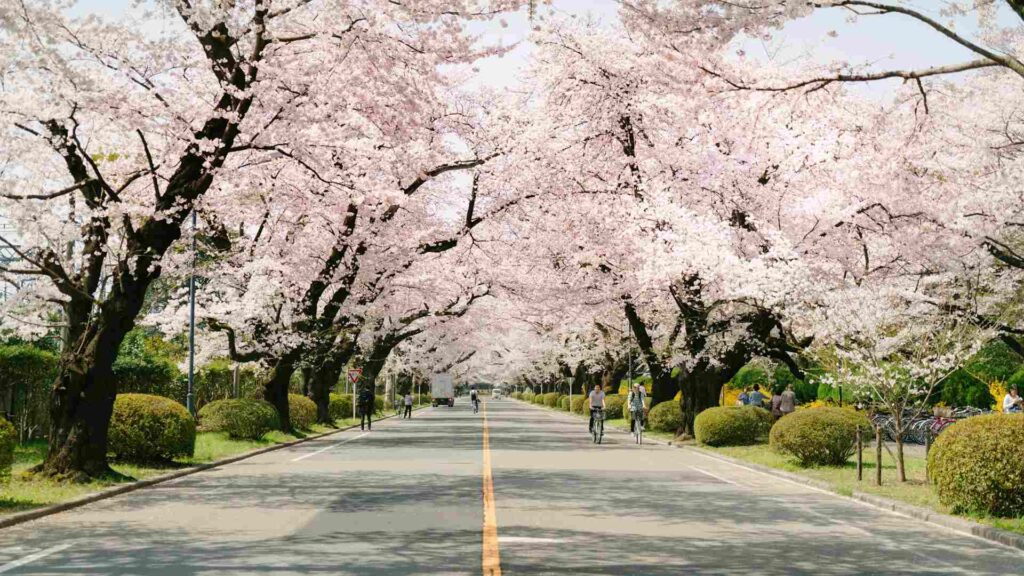
In Japan, spring is heralded by the blossoming of the cherry trees. It has been that way for centuries: court chronicles, diaries and festival records have fixed with almost ritualistic precision the moment when the branches fill with blossoms. Today those same annotations, placed side by side, become a historical series: they precisely indicate the day of peak bloom year by year and make visible the gradual shift of spring over time.
In many cases early, as would be expected with warmer springs. But not always. In some parts of Japan, especially in the south, cherry trees color later and haphazardly, with fewer and less synchronized blossoms.
The knot lies in the cold months. Cherry trees, like many species in temperate areas, enter a dormancy phase. To get out of it, they need to accumulate cold for a sufficiently long period. Without this transition, the biological cycle loses coherence.
Research published in 2026 in theInternational Journal of Biometeorology analyzes precisely this mechanism in Japan’s most common ornamental cherry tree, Somei-yoshin. When winter is too mild and accumulated cold remains below an indicative threshold of about 1,500, flowering behavior changes.
In several observed cases, the peak arrives even weeks later than in colder areas. Despite favorable spring temperatures, the tree fails to properly complete the previous phase.
Flowers that do not open
The difference can be seen with the naked eye. Under normal conditions, almost all buds open within a few days, creating the compact mass of flowers that characterizes Japanese boulevards and parks. When there is insufficient winter cold, this does not happen. A substantial proportion of the buds remain closed or fall off before blooming. In the most extreme cases documented by the study, only a small proportion actually reach bloom.The distribution over time also changes: instead of being concentrated in a few days, the opening of the flowers is diluted, reducing the overall effect.
An increasingly unreliable calendar
Data collected between 1965 and 2024 show increasing fluctuations. At warmer sites in southern Japan, flowering can occur up to more than a month later than at cooler locations, precisely in years when winters have been particularly mild. This makes one of the most closely monitored natural phenomena less predictable. Predictions remain possible, but with larger margins of error than in the past.
In Japan, cherry blossom is linked tohanami, the flower viewing, which moves huge tourist flows and organizes the calendar of public events each year. A less compact bloom changes the experience: less visual intensity, longer times, greater variability between trees. The impact on pollinating insects and fruit production in related species is also receiving increasing attention.
A problem set to expand
Winter temperatures are on the rise, and the conditions observed today in southern Japan tend to appear more frequently. If the trend continues, similar phenomena could spread to other regions. Options under study include selecting varieties with lower cold requirements or introducing different species into urban settings. Interventions that have not only environmental but also cultural consequences because they change a symbolic landscape.
Long data, rapid change
Time series constructed from ancient documents make it possible to compare the present with a very wide time span. It is precisely this comparison that makes the gap obvious: variations that once took centuries today are observed within a few decades. Cherry trees continue to mark the arrival of spring. Only, increasingly, they do so in a different way than the chroniclers of a thousand years ago were accustomed to.