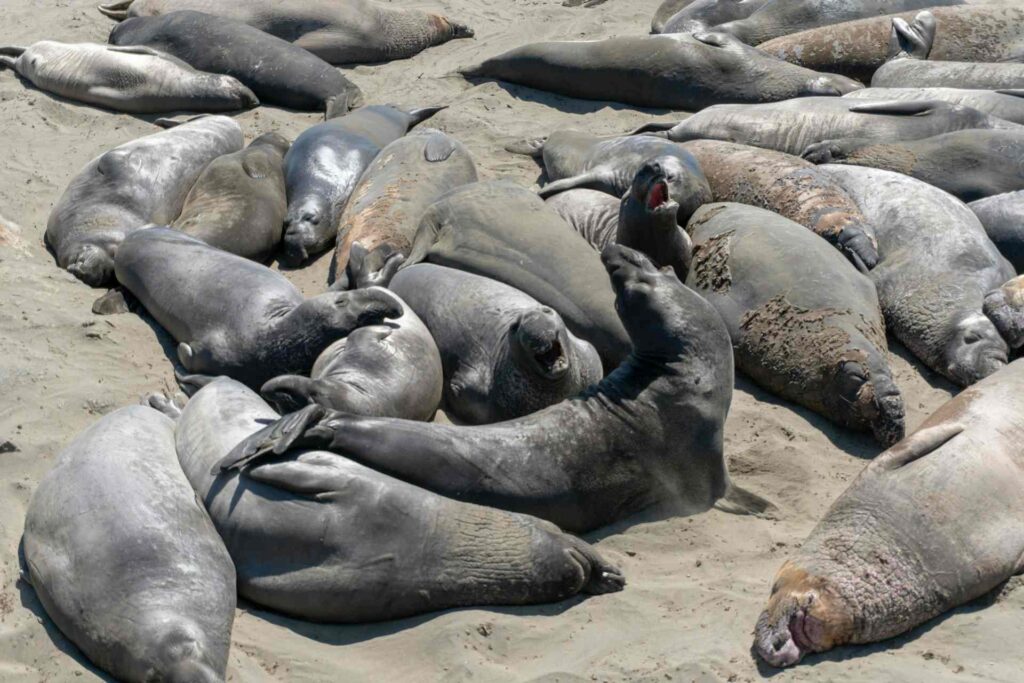
Thirty elephant seals in a few days, seven cubs tested positive for the H5N1 virus, a colony of 5,000 animals under special observation. Avian flu arrives for the first time among these California mammals and opens a new front in the global health emergency.
The outbreak was identified in Año Nuevo State Park, north of Santa Cruz, home to one of the most studied elephant seal colonies in the world. Here, for more than sixty years, researchers have monitored thousands of specimens each breeding season, many of them individually identifiable. It is precisely this continuous surveillance that has allowed them to quickly intercept early signs: weaned pups with abnormal neurological and respiratory symptoms, tremors, weakness, and convulsions.
Samples analyzed by the University of California at Davis confirmed the presence of the highly pathogenic H5N1 strain. This is the first time the virus has been detected in northern elephant seals and more generally in a marine mammal in the state.
An outbreak under control for now
At the beginning of the outbreak there were about 1,350 seals on the beach. Most of the adult females had already left the colony for seasonal migration, reducing the risk of large-scale contagion. According to researchers, no exponential increase in mortality is observed so far, but the situation remains extremely delicate.
“This is an exceptionally rapid detection,” explained Christine Johnson, a veterinary epidemiologist at the University of California at Davis. “Active surveillance made it possible to detect the very first cases.” As a precaution, the park has closed observation areas and suspended tours, while science teams and environmental authorities monitor the colony daily.
The long shadow of precedent
Concern arises primarily from what happened in the southern hemisphere. Between 2023 and 2024, H5N1 devastated southern elephant seal populations in Argentina and subantarctic islands, with tens of thousands of animals dying. In those cases, the virus appeared to transmit directly among seals, showing particularly alarming mammalian adaptability.
“We are very concerned about the trajectory of the epidemic,” said Roxanne Beltran, an ecologist at the University of California at Santa Cruz who leads the monitoring program in Año Nuevo. “We cannot predict how it will evolve.”
An increasingly cross-cutting virus
Originating in Asian poultry farms in the 1990s, H5N1 has made a global expansion in three decades, moving from wild birds to poultry and now involving an increasing number of mammals: foxes, bears, cats, cattle. Human cases have also been reported in the United States, albeit rare.
Species hopping poses the greatest risk: each new infection provides an opportunity for the virus to mutate and improve its ability to adapt. That’s why researchers are using drones, environmental sensors and new analytical technologies to track the spread of infection along the Pacific coast.
For the public, the risk remains low, but authorities urge caution: do not approach animals, do not touch carcasses, keep dogs away. Small precautions that serve to protect both public health and one of California’s iconic biodiversity colonies.
On the beaches of Año Nuevo, meanwhile, life continues under constant observation. Each new sick pup is a sign to be deciphered.