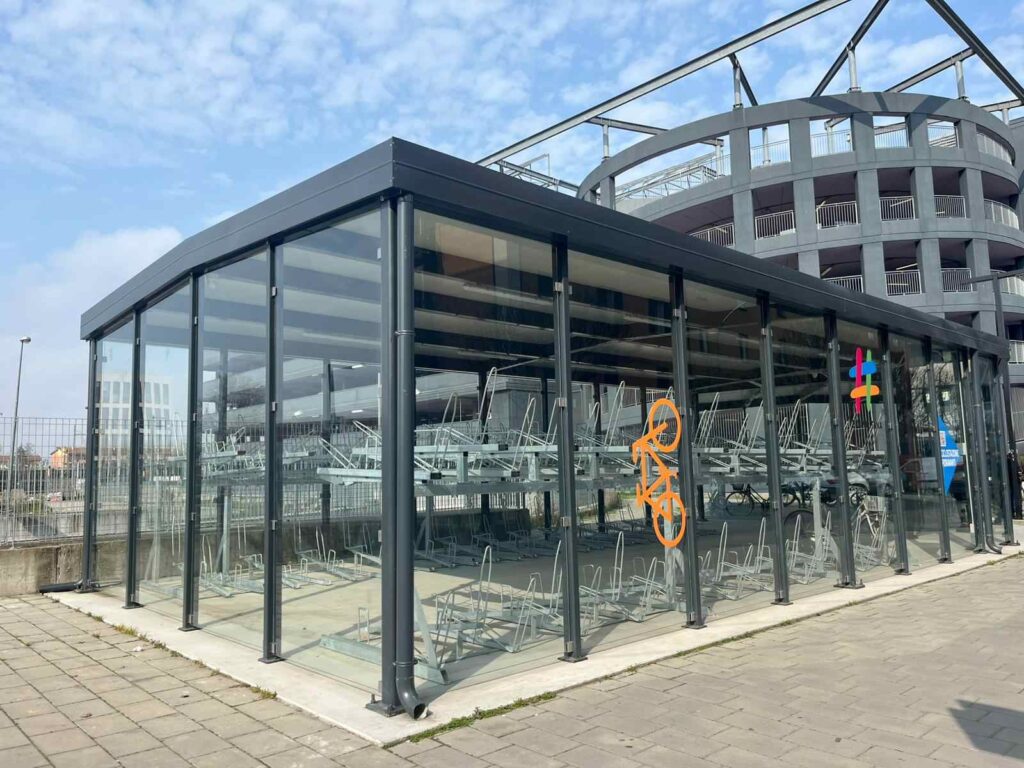
In Bologna, the sustainable mobility takes the concrete form of five new bike stations near metro stops. Four hundred total bike spaces, autonomous access with apps, e-bike charging and maintenance tools: it’s one more piece in the municipal Biciplan to make it really easy to switch from bike to train.
The project cost 675,000 euros, financed in part by the municipality and 320,000 euros with European funds managed by the Emilia-Romagna Region. The goal is to support intermodality in a city where use of the Metropolitan Rail Service is growing steadily, especially on the Pianoro to Porretta loop, which is experiencing double-digit increases.
Where they are found and how they work
These are not simply covered racks. They are enclosed, video-monitored spaces, accessible 24 hours a day via the Bomob app after signing up for a subscription. The system is fully automated: you enter with a smartphone, park your bike in a secure environment, and you can also recharge your e-bike thanks to dedicated outlets. There are also maintenance and tire inflation stations.
The service is chargeable but with low fees: three euros for daily access, ten euros per month, thirty euros per year. A cost that aims to be sustainable for those who use the bike as a regular means of transportation and not only for leisure.
Bike and train, a necessary alliance
Indeed, it is not enough to incentivize bicycle use if there is a lack of a safe place to leave it. Theft remains one of the main deterrents to the purchase of quality vehicles, especially electric ones. And it is precisely the more expensive e-bikes that make it even more urgent to provide protected spaces.
The upgrading of bicycle stations comes at a time when the Metropolitan Rail Service is experiencing significant growth in ridership. If trains increase and demand grows, facilitating the last mile becomes crucial. Many cyclists choose bikes for speed and convenience: being able to park them safely next to the station makes the entire commute smoother.
The Sfm’s bicycle stations represent a different, lighter and more widespread model designed to intercept those arriving at the station by pedaling from neighborhoods or municipalities in the metropolitan area.
A cultural bet before a technical one
Infrastructure such as this works if it is used and respected. Access is not guarded but regulated by subscription and electronic control. The idea is to empower users and create a community of regular cyclists who are mindful of shared spaces.
Bologna, which has been investing in bike lanes and soft mobility for years, thus tries to fill one of the most obvious gaps in the system: safe parking. Because pedaling is fine, but knowing where to leave your bike without anxiety helps.