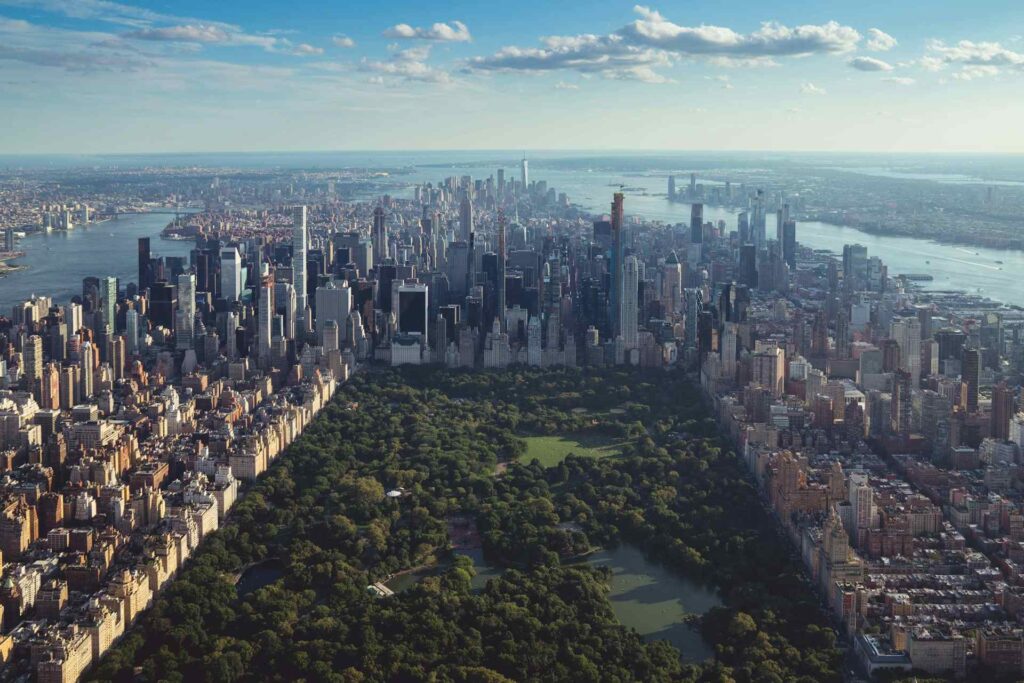
New York learned its lesson the hard way. It was October 2012 when Hurricane Sandy turned Manhattan into an inferno: flooded neighborhoods, subways submerged, hospitals evacuated, millions without electricity. An event that single-handedly changed the way the city looks to the future. Today, more than a decade later, that memory is translating into construction sites. Along Manhattan’s East Coast, especially on the Lower East Side, a complex system of coastal defenses is under construction that many have summarized with a simple word: “wall.” In reality it is something much more articulated.
The nearly $2 billion project is not a continuous concrete barrier, but a set of interventions that combine engineering and public space: raised embankments, redesigned parks, mobile barriers, and infrastructure integrated into the urban fabric.
The heart of the intervention is the so-called East Side Coastal Resiliency Project, a plan designed to protect about two miles of coastline between Montgomery Street and East 25th Street. The project is based on the idea of raising the city instead of enclosing it behind a seawall. Basically, the level of some parks and public spaces are raised by two to three meters, creating a kind of natural barrier against storm surges. Where necessary, retaining walls and mobile systems are added that can be activated in the event of a storm.The result is a “hybrid” system that does not separate the city from the river, but tries to live with it, while protecting densely populated neighborhoods and crucial infrastructure.
Two billion to defend themselves
The total cost of the work is approaching $2 billion, funded largely with federal funds appropriated after Sandy, along with city and New York State resources. A huge figure, but one that is the child of necessity: adapting to climate change costs, and will always cost more. According to estimates, the damage caused by Sandy exceeded $19 billion for New York City alone. In this sense, the investment seems almost inevitable.
But it is not just an economic issue. It is a political choice: deciding to protect entire neighborhoods, many of them inhabited by low-income communities, also means addressing climate justice.
The project stems from a well-established fact: sea levels along the New York coast are rising and will continue to rise in the coming decades. Added to this is another factor, more difficult to predict but equally decisive: the intensity of storms. In addition, much of the infrastructure-from subways to electrical systems-is located a few feet above sea level. All it takes is one extreme storm surge to send the entire system into crisis.
A new idea of a coastal city
The Manhattan project is not an isolated case. From Rotterdam to Miami via Venice, cities are rethinking their relationship with water. But New York introduces one more element: the transformation of public space. The new raised parks are not just barriers, but places to live, designed to resist flooding without losing their social function.This approach marks a paradigm shift. It is no longer just about defense, but adaptation, integrating climate solutions into the daily life of the city.
There is no shortage of controversy. Some urban planners and local associations have criticized the project for its impact on neighborhoods, denouncing the temporary loss of green space during construction and the risk of overly invasive solutions. Others point out that interventions of this kind, while necessary, do not solve the root of the problem. Defending a city will always cost more, and not every city will be able to afford it.