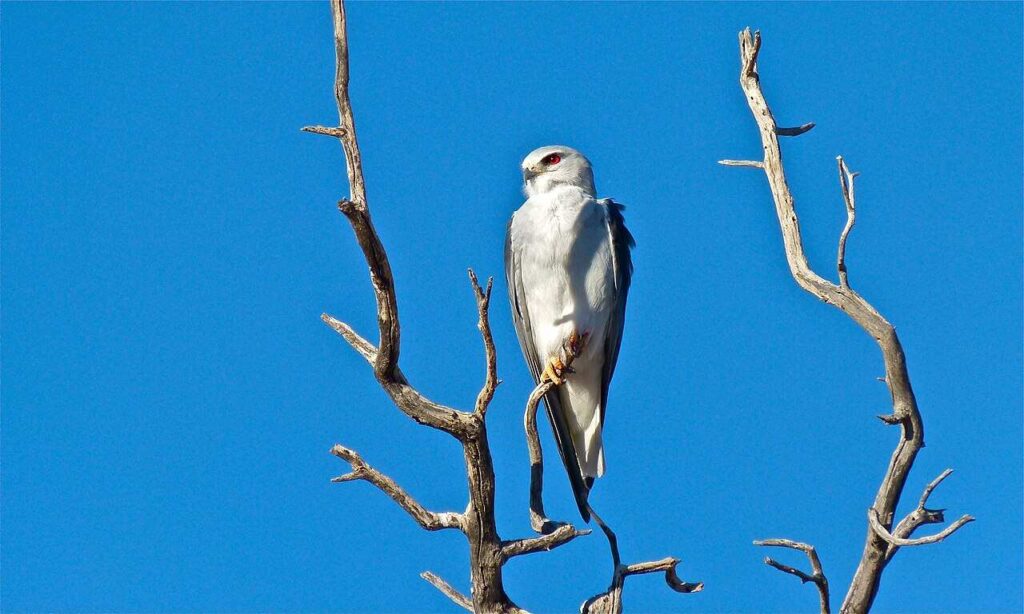
It was Aug. 15, 2024, when ornithologists from the Ornithologists Association of Emilia-Romagna (AsOER) in Imola were conducting routine monitoring in an agricultural area on the border between the provinces of Bologna, Ferrara and Modena. Two adult specimens of white kites – Elanus caeruleus, a raptor with unmistakable white and gray plumage and large red eyes – were hunting in the fields. The initial hypothesis was trivial: a post-reproductive movement, perhaps passing animals from France or the Iberian Peninsula.
Then something changed. Over the next few days, experts began to observe the “prey exchange”: the male transferring food to the female in flight, a behavior typical of the breeding phase in raptors. On August 26, the two began carrying branches. They were building a nest.
The nest on the dog rose
On September 10, after weeks of discreet observation, the ornithologists located the nest: on a rosebush, just over two meters above the ground, in an abandoned fenced area. Inside were two hatchlings about 20 days old. The eggs had been laid in July.
From then on, surveillance became more careful. On September 21 the chicks were well developed, on September 26 they tried their first flights, and on October 10 they were already able to follow their parents on the hunt. The first documented nesting of the white kite in Italy had been successfully completed.
An unexpected success: ornithologists had immediately taken action to restrict hunting activities in the area and protect the site. Without that timely intervention, the two juveniles would have had little chance of flying off undisturbed.
From the Po Valley to the Maremma
The news, kept confidential throughout the breeding season, only became public in April 2026 with the publication of the study by Andrea Ravagnani, Fabio Gardosi and Alessio Farioli in the ornithological journal Picus. But something had already moved in the meantime.
By November 2025, the Maremma Park in Tuscany had become a pilgrimage destination for birdwatchers and nature photographers from all over Italy: a white kite had chosen the protected area as its winter home. “Since 2019, observations in Italy have increased,” explained Francesco Pezzo, a zoologist and park adviser, commenting on the arrival. For Tuscany, it was the sixth observation ever.
It is not a nesting, but it is one more piece in a picture that is becoming clearer and clearer: the white kite is systematically exploring Italian territory.
A species on the march eastward
The white kite is widespread in Africa, the Indian subcontinent and the Iberian Peninsula. In Spain and Portugal it has been permanently present for decades. Since the 1990s it has been moving eastward, colonizing southern France. From there, in recent years, it has begun to overlook Italy-first as an incidental host, then irregularly, now, with nesting in summer 2024, as a potential new breeding species.
“The first nesting in Italy of the white kite was predictable considering its expansion, but it is very significant,” said ornithologist Francesco Barberini. “It is a sign of important environmental and climatic changes and the effective adaptive abilities of this nomadic species.”
This is not necessarily good news in an absolute sense-climate change that pushes species to relocate often has severe consequences for overall biodiversity. But the white kite is an adaptable species, able to exploit agricultural habitats that many other raptors avoid, and its presence can be a valuable indicator of the health of lowland ecosystems, too often ignored in conservation policies.
What is certain is that the story is just beginning. The question is no longer whether the white kite will return to nest in Italy, but where and when.