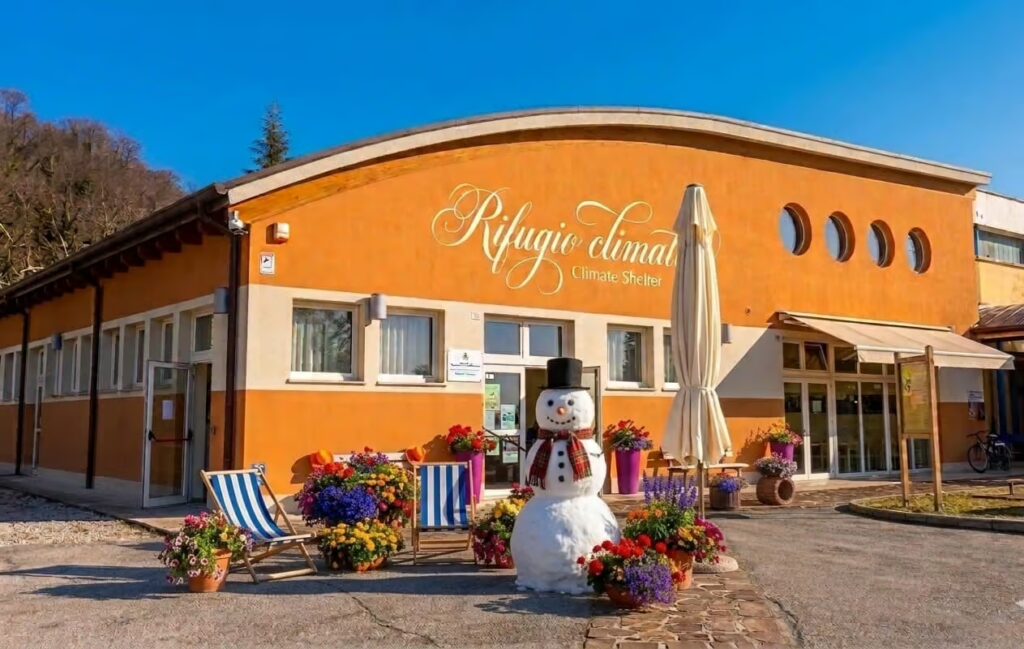
Summer has become an endurance test: June 2025 broke every European heat record, and 2026 promises to follow suit. Cities are finding themselves increasingly vulnerable. Some major metropolises, such as Paris and Barcelona, have built structured networks of cool spaces accessible to all. Now Poggio Torriana, in the Rimini area, is also entering this map: the province’s first climate shelter was born here.
It was realized by theQuotidianacom association, transforming the theater room of the local community center into a free space where citizens of the Marecchia Valley can take shelter during heat peaks, with a program of artistic and social activities. Three mornings a week for two months: free access, water, services and a calendar of shared readings, music, theater and documentaries.
Thermal loneliness
“We designed this project for the inactive population–retirees, students, Neet youth–who tend to isolate themselves at home,” they explain from the association. It is an accurate reading of the problem. Heat waves don’t affect everyone equally: those who live alone, those who don’t have an air conditioner, those who can’t afford to stay out of the house during the hottest hours, accumulate a risk that is not only physical. Prolonged heat worsens isolation, increases anxiety, and compresses social relationships. According to data from the National Institute of Health, during weeks of extreme heat, mortality among those over 75 living alone can increase by up to 30 percent over the seasonal average. This is not a future emergency: it already happens, every summer.
To cover the costs-from utilities to fees for the professionals involved-the association activated a campaign on ideaginger.it with an “all or nothing” formula: if the goal is not met, the funds are returned to donors. A transparent mechanism, but one that also says something uncomfortable: in Italy, ensuring an essential service like a cool place in the summer still depends on crowdfunding.
The European gap
While Poggio Torriana organizes from below, Europe plans from above. Barcelona operates a network of 350 shelters-libraries, schools, civic centers, churches-mapped so that 98 percent of citizens have one within a ten-minute walk. This is not an aesthetic fact: it means that the network is designed to actually work, not to exist on paper. Paris has responded with “cool islands,” more than 1,300 urban micro-oases including green areas, swimming pools, and mobile shade structures designed to last well beyond the 2024 Olympic emergency.
Italy, on the other hand, is moving in short order. Florence has surveyed 44 shelters with strict criteria – shading above 70 percent, drinking water, air conditioning – all mapped on an interactive platform. Bologna has activated several in libraries and parks, with GPS coordinates and travel times. Milan exploits Neighborhood Houses as summer drop-in centers. In Naples, a private association, Cleanap, has done the mapping, identifying 28 points among parks and tree-lined streets. Rome is still compiling its list. Each municipality invents its own solution, often without shared resources or recognizable signage.
Toward a standard
UNITEL, theNational Union of Local Government Technicians, has proposed eight minimum requirements for climate shelters: free access, availability of water, constant 26-degree indoor temperature, dedicated signage, and promotion of social and recreational activities. Reasonable criteria, borrowed from the Barcelona experience. But without a national framework law, they remain technical recommendations that many municipalities, lacking funds and staff, struggle to follow.