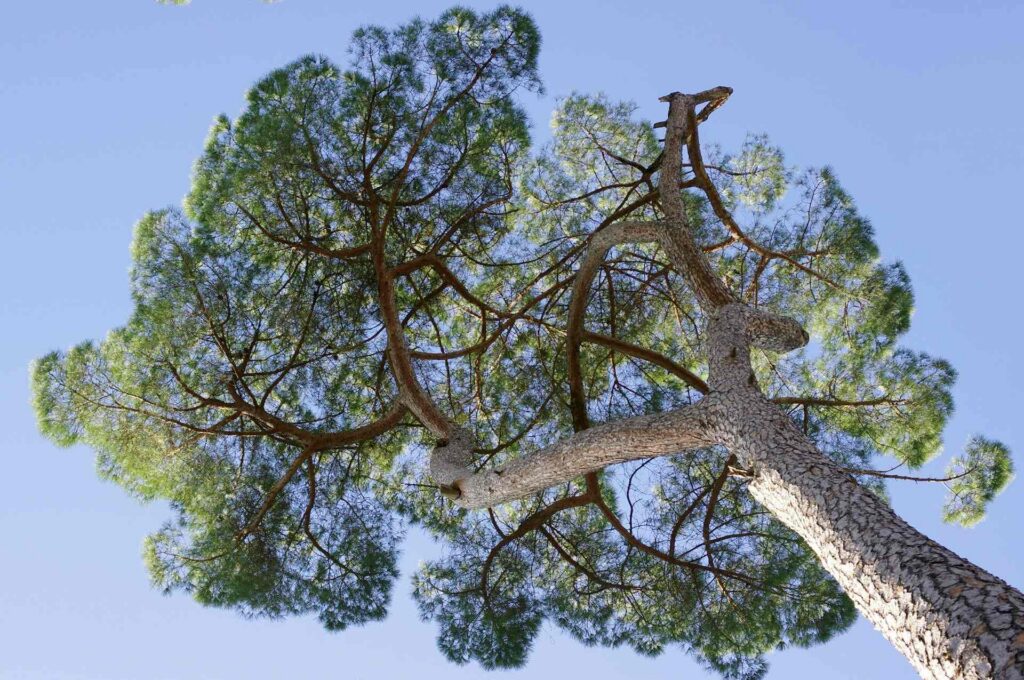
The right loves to level the accusation of “ideologization.” Even air conditioning everywhere is presented as an inalienable right, challenged by fanatical environmentalists. But is the goal to stay cool or to flex our muscles? Because if the goal is to cool down cities, there’s no need to keep disrupting the planet’s natural balance by increasing fossil fuel-based electricity consumption and dumping the heat from air conditioners onto the streets. Artificial cooling—perhaps using the most efficient heat pumps—can be employed when needed, after first lowering the temperature using nature-based solutions, such as trees.
This is demonstrated by the Mirificus project (Monitoring of Reforestation Initiatives for the Urban Heat Island via Satellites), conducted by ISPRA and coordinated by CNR-IBE with the support of the Italian Space Agency. Simulations carried out on two pilot areas —Settecamini in Rome and the Mercafir/Piazza Artom area in Florence—indicate that new trees, green spaces, and heat-reflective paving can lower temperatures by more than 4 degrees between 9 a.m. and 3 p.m., the most critical hours of the day. On a daily basis, the benefit remains around 2–2.2 °C: a structural solution, not a temporary cooling measure that comes at a high cost—including on energy bills.
A Look at Temperatures in Italian Cities
The findings are based on a historical record of surface temperatures from 2013 to 2023, which paints a picture of a country increasingly exposed to the effects of heat islands. In the summer, surface temperatures in nearly all regional capitals exceed 40 degrees: Rome averages 43.7 °C, Florence exceeds 44 °C, Milan is at 43.1 °C, Turin at 43, Naples and Bologna at 42.7, while Cagliari, at 42.9 °C, is the hottest coastal city. The countryside surrounding these cities is, on average, 5.6 degrees cooler, with a difference of up to 9.4 °C in the case of Naples. The reason is well known: asphalt and concrete absorb solar radiation and release it as heat, while natural soil and vegetation help moderate temperature fluctuations.
Furthermore, it’s not just a matter of how much green space there is, but also of how the neighborhoods are laid out. Mirificus interpreted the urban structure as a sort of “climatic DNA”: the layout, height, and materials of buildings directly affect the distribution of heat. In Florence, compact, mid-rise areas reach 44.6 degrees, while in areas where buildings give way to urban forests, the temperature drops to 35.9—a natural cooling effect of nearly 9 degrees. In Rome, industrial neighborhoods, with large areas exposed to the sun, reach as high as 57.2 °C.
A free tool for municipalities
The project goes beyond diagnosis. A WebGIS platform and a web app based on Google Earth Engine—both of which are free—allow each municipality to access the data, cross-reference temperature, land use, and green spaces, and simulate the effects of interventions before implementing them.
“We can reduce heat in cities, and we know how to do it,” summarizes Michele Munafò, project manager at ISPRa, emphasizing that these measures also reduce health risks and improve the quality of urban life. For Marco Morabito, coordinator for CNR-IBE, satellite data thus become “operational tools to support public administrations”: interactive maps, heat stress indicators, and simulations provide decision-makers with a scientific basis for planning urban reforestation and adaptation to the climate crisis.
The path is clear: more trees, more natural soil, less concrete. But to follow it, we must put an end to anti-green ideology. There are cities, such as Rome and Florence, that know how to act on the scientific community’s recommendations. And there are governments, like Giorgia Meloni’s, that are cutting funding for the environment while defending funding that benefits the fossil fuel economy. Who knows if the bullying of the “Joker of the White House”—as Trump has been aptly dubbed—will help set things back on course.