Air travel emissions could be cut in half without reducing the number of trips. This is the surprising yet data-backed conclusion of a global analysis that identifies three very concrete measures: eliminating premium seats in favor of all-economy cabins, filling planes to near-95% capacity, and systematically using the most efficient aircraft models available today. Rather than banking on “sustainable” fuels—which are still scarce and expensive—or on controversial offset schemes, the researchers suggest focusing on what’s right under our noses: how we choose, configure, and load aircraft.
Without corrective measures, emissions will double
The starting point is not encouraging. Emissions per kilometer have gradually declined thanks to technological advances, but the growth in traffic has far outpaced these improvements. Without corrective measures, according to independent estimates, they could double or even triple by 2050. At the same time, many of the solutions currently being discussed—from biofuels to carbon credits—are struggling to gain traction: the former have limited supply chains and high prices, while the latter face criticism regarding their effectiveness and governance.
The study, published in *Communications Earth & Environment*, analyzed more than 27 million commercial flights out of approximately 35 million operated in 2023, covering 3.5 billion passengers and 6.8 trillion kilometers traveled, equivalent to 577 million metric tons of CO2, equivalent to Germany’s annual emissions. The key metric is grams of CO2 per passenger-kilometer (g/pkm): the global average is 84.4 g/pkm, but with enormous variations across routes, airports, and regions.
The first finding is striking: in the United States, which accounts for a quarter of global aviation emissions, flights are on average 14% more polluting than the global average. China, the second-largest emitter, shows efficiency levels slightly above average, while the United Kingdom ranks just below that. Looking at airports, Atlanta and New York rank among those with the worst overall performance, nearly 50% worse than the most efficient airports, such as Abu Dhabi and Madrid. Geography also plays a role: in the U.S. and Australia—especially at smaller airports—as well as in parts of Africa and the Middle East, the most polluting flights are more frequent; India, Brazil, and Southeast Asia, on the other hand, are dominated by routes with lower emissions.
Dispersion Among Routes
There is extreme variation among routes. The most efficient route connects Milan to Incheon, near Seoul: 31.6 g CO2/pkm, thanks to modern aircraft, cabins with few premium seats, and high load factors. In contrast, Papua New Guinea has the worst figures; in the United States, the route between Ironwood and Minneapolis/St. Paul registers 805 g CO2/pkm. The recurring explanation? Old aircraft and cabin configurations skewed toward spacious seats, combined with suboptimal load factors. In 2023, the global average load factor stood at around 80%.
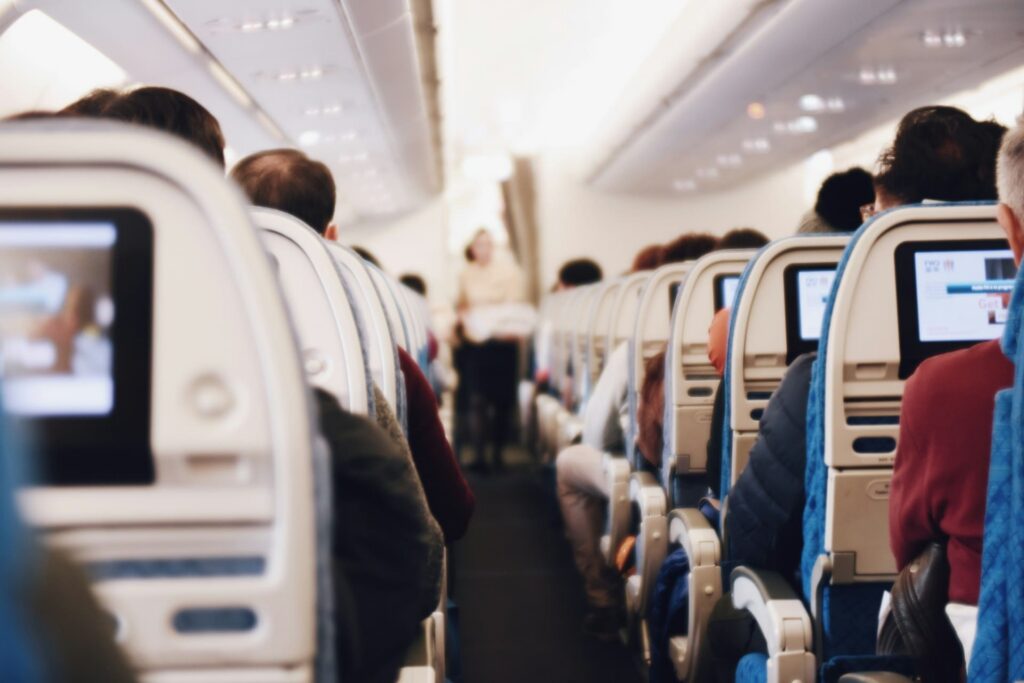
According to Stefan Gössling, who led the research, replacing premium seats with an all-economy configuration is likely the single most effective measure. Overall, first- and business-class passengers generate more than three times the emissions of those flying in economy class, and up to 13 times as much in more spacious cabins. When combined with the latest-generation aircraft and load factors around 95%, the reduction in fuel consumption—and thus CO2 emissions—can reach 50–75%. Such a reduction would transform the industry’s climate footprint and drastically reduce the amount of sustainable fuel needed to move toward carbon neutrality in the future.
Narrow Margins
There is no shortage of objections and constraints. The industry operates on slim margins, and renewing fleets is costly. Furthermore, the supply chain has accumulated delays: according to IATA, the global airline association, the backlog of orders exceeds 5,000 aircraft. IATA believes that the bulk of progress will come from sustainable aviation fuels (SAF), the Corsia offset system, and route optimization. However, CORSIA, the ICAO’s offsetting scheme, has been described by many as unambitious and problematic, and it has not yet required any airline to use credits.
On the policy front, the researchers propose a range of measures. The “softest” is transparency: requiring airlines to provide an efficiency rating for each route—similar to energy ratings for household appliances—to give passengers clear and comparable information. A more effective measure is price signaling: airports that adjust landing fees based on a flight’s carbon footprint and local air quality. Finally, regulation: banning the most polluting aircraft, as has already been done with the noisiest models.