More than half of the world’s landmass has been without water for at least a month. Seven hundred and ten thousand heat-related deaths in a single year—more than those caused by malaria and HIV combined. Over one trillion dollars in income lost because it was too hot to work. This isn’t the plot of a disaster movie: it’s the assessment that the tenth Lancet Countdown on Health and Climate report, published in The Lancet on the eve of COP31 in Antalya, presents to governments. Ten years after the Paris Agreement, the damage is outpacing the solutions.
The Deadly Heat
Between 2016 and 2023, heat was associated with an average of 540,800 deaths per year—nearly 36% more than in the previous decade. And human activity is playing an increasingly significant role: the proportion attributable to global warming rose from 55% to 68%. The year 2023 set a record with 710,000 deaths, 71.5% of which would not have occurred without the climate crisis. The overall toll is heavy: in eight years, nearly 3 million lives lost due to heat that we ourselves have caused. Then there’s the economic impact. In 2025, extreme temperatures wiped out 573 billion potential work hours, equivalent to $1,070 billion: this marks the third consecutive year above the $1 trillion mark.
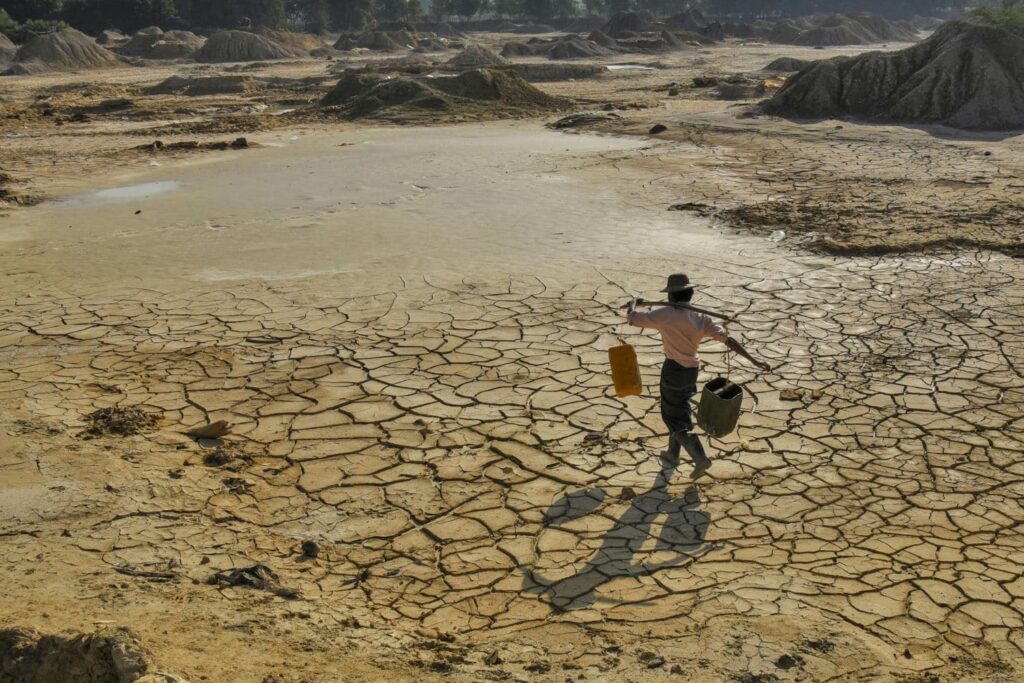
The extreme drought in 2025 gripped 51.8% of the world’s landmass—a figure surpassed only by that of 2023. Since 2016, the affected area has been expanding at a rate eight times faster than in the previous decade. But the problem isn’t just a lack of water—it’s the disruption of the water cycle. Satellite data show that since 2003, 80% of the Earth’s surface has experienced drastic changes in its soil and groundwater reserves, with 43% drying up and 37% increasing. The heaviest rains now strike 17.2% of the land each year, compared to 14.8% a decade ago. The result: crops at risk, landslides, and floods.
Italy is gasping for breath
Our country is on the front lines. 82.7% of the days marked by heat waves between 2021 and 2025 are a result of climate change: without it, they would not have occurred. Those who suffer the most are the most vulnerable: young children and the elderly. And on construction sites, the price paid is particularly high: in 2025, the heat cost $4.6 billion in potential income, and 44% of that loss fell on construction workers.
Yet the battle is not lost, and the report demonstrates this with the numbers. In 2025, the world invested a record $2,100 billion in clean energy—82% more than the $1,160 billion allocated to fossil fuels. Between 2016 and 2023, the share of electricity generated from new renewable sources more than doubled, from 5.5% to 13.5%. And the benefits are palpable—literally: cleaner air saves about 323,000 lives a year in at least 77 countries where pollution from fossil fuels has declined since 2016. The healthcare sector is also gearing up: 56 countries have a national adaptation plan—up from 14 in 2015—and where early-warning systems are in place, the number of victims of extreme weather events is rising more slowly.
Politics as a Brake
The problem is the pace. Fossil fuels still account for more than 80% of the world’s energy, and in 2024, emissions reached a new high. The 100 largest oil and gas companies aim to extract 150% more by 2040 than what is permitted under the 1.5-degree target for temperature rise: a year ago, the projected overshoot was 138%. Since 2016, governments have poured $6.2 trillion in net subsidies into fossil fuels, and in 2024, ten countries spent more on subsidizing them than on healthcare for their citizens.
Meanwhile, politicians are backtracking: the United States has withdrawn from the Paris Agreement, and at the UN General Assembly, the proportion of countries citing the link between climate and health has plummeted from 65.9% in 2021 to 26.3% in 2025. Developing countries received $1.1 billion for health adaptation efforts—one-third of the $3.3 billion per year needed to meet the minimum requirement.
Hence the authors’ call: to recognize climate change as a global health emergency and to put health at the center of every decision—from emissions cuts to funding, which should be provided as grants rather than loans. “There is no shortage of evidence; what is lacking is the political will to act,” warns Helen Clark, chair of the Lancet Countdown board. The tools to curb the crisis are available. In Antalya, we’ll see who decides to use them.