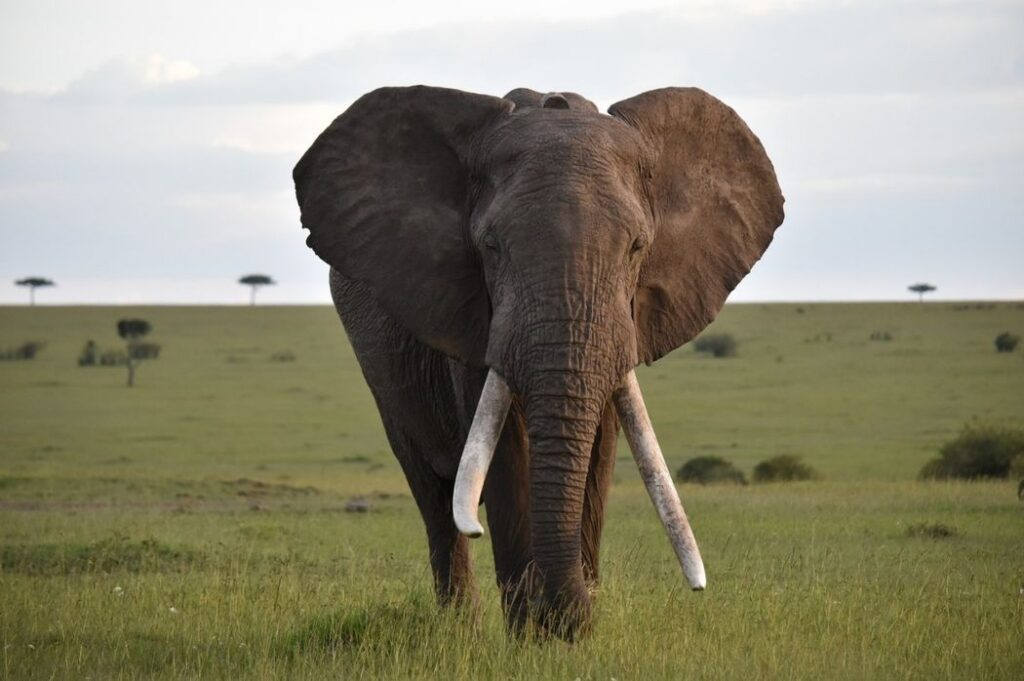
For thirteen years, his every step was tracked on a map. Since 2013, a satellite collar has tracked Fred across the grasslands of the Masai Mara in Kenya. It recorded his routes to water, his favorite corridors, and the areas where he lingered the longest. Now that signal has gone silent. The elephant died of natural causes at about 55 years of age. The Mara Elephant Project, the organization that monitored him in collaboration with the Kenya Wildlife Service and the Wildlife Research and Training Institute.
For an animal like Fred, dying of old age was by no means a given. He was a “super tusker”—one of those males with tusks so large they nearly touched the ground; his weighed over 45 kilos each. It’s an extremely rare genetic trait, and for decades it was also a death sentence, because poachers target the specimens with the most ivory first. Fred was born in the early 1970s. He survived the darkest period for African elephants, when the ivory trade halved their populations, until the international ban was enacted in 1989.
The Disappearing Tusks
The hunt for large males has not only reduced their numbers—it has changed the species. In Gorongosa National Park, in Mozambique, studies have shown a clear effect. After years of civil war and intensive poaching, the proportion of females born without tusks has risen sharply. In other words, ivory has become an evolutionary disadvantage. The most alarming statistic must be viewed in this context: according to Africa Geographic’s estimates, there are just 85 super tuskers remaining on the entire continent, at least 26 of which are in East Africa.
Fred, after all, is the second giant that Kenya has lost in just a few months. On January 3, Craig, 54, a symbol of Amboseli National Park who also had extremely long tusks, died.
What remains after the signal
Fred’s value, however, cannot be measured in kilograms of ivory. Researchers cross-referenced the data from his collar with field observations. This gave them a better understanding of how large males move, which areas they traverse, and where they are most vulnerable. Based on this, conservation strategies for the other super tuskers have been revised. This is the result of a collaboration between public institutions and private organizations that has yielded concrete results in Kenya.
For once, the death of a super tusker isn’t a story of guns and ivory. Fred passed away as all elephants should: in old age, on his own territory. The challenge now is to ensure that he doesn’t remain an exception.