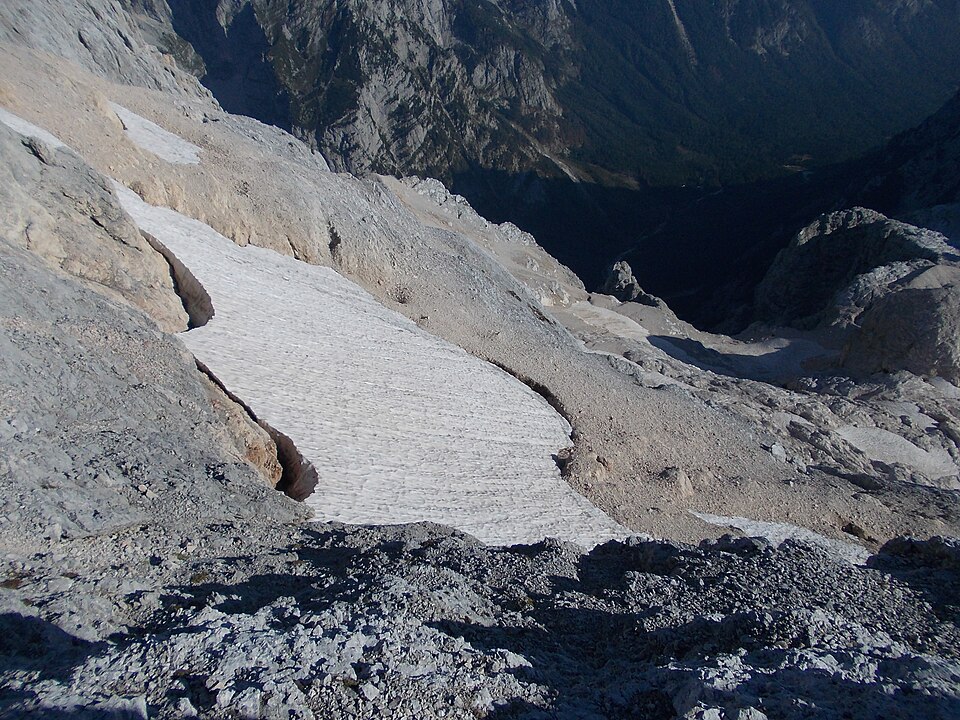
The Triglav Glacier, on Slovenia’s highest mountain, has disappeared. After a summer marked by exceptionally high temperatures, even the last remnants of ice have melted, exposing the rock at an elevation of nearly 2,900 meters. This is confirmed by photographs taken on October 19, 2026, by researchers from the Anton Melik Geographical Institute and published by The Guardian, which document the disappearance of one of the most iconic glaciers in the southeastern Alps.
This news holds special significance for Slovenia. Mount Triglav, which stands 2,864 meters tall, appears on the national flag and is one of the country’s main symbols of identity. Its gradual loss of ice has been monitored for decades, but temperatures in recent years have accelerated a process that is now irreversible.
From 40 hectares to just a few meters of ice
In the mid-19th century, the glacier covered about 40 hectares, equivalent to about 50 soccer fields. By 1946, when systematic scientific measurements began, its area had already shrunk to 14 hectares. Between 1983 and 2003, the glacier lost 93% of its area, shrinking to less than one hectare.
For more than twenty years, the few remaining fragments withstood rising temperatures. Then, over the past five years, the ice has thinned further and broken up into small, isolated pockets. By early October, only a few meters of the main mass remained. Subsequent images confirmed the complete disappearance of the surface ice.
Matija Zorn, director of the Anton Melik Geographical Institute, has been monitoring the evolution of Triglav since 2001. He recounted a significant incident to The Guardian: in 2002, researchers took an ice core about five meters deep. When they returned to the same spot the following year, they found only rock.
The Alps are losing ice at an increasing rate
The disappearance of Triglav is part of the rapid retreat of Alpine glaciers, driven by rising temperatures linked to greenhouse gas emissions. According to data from Swiss glaciologists cited by the British newspaper, Switzerland has lost nearly one-fifth of its glacial ice over the past five years. For 2026 alone, a 5.5% reduction in volume is estimated.
In Slovenia, the Skuta Glacier remains, though it, too, has shrunk significantly. Its more shaded location should allow it to survive for a few more years. Below Triglav, however, researchers have identified ice deposits inside caves that were exposed as the glacier retreated.
This loss also has implications for scientific research. Glaciers preserve information about past climate conditions and allow us to measure the effects of global warming by tracking changes in their surface area and thickness.
A National Symbol Disappears
For Slovenia, the disappearance of the glacier also takes on a cultural dimension. Generations of mountaineers have known Triglav as a mountain covered in ice, whereas today the landscape is dominated by rock. Miha Pavšek, a glaciologist and mountain guide, keeps a photograph of his parents taken on the glacier in 1957. He shared his thoughts on the mountain’s transformation with The Guardian: “As the glacier melts, a part of me is gone too.” He added: “There are things that humans believed to be eternal. Glaciers, evidently, are not.”