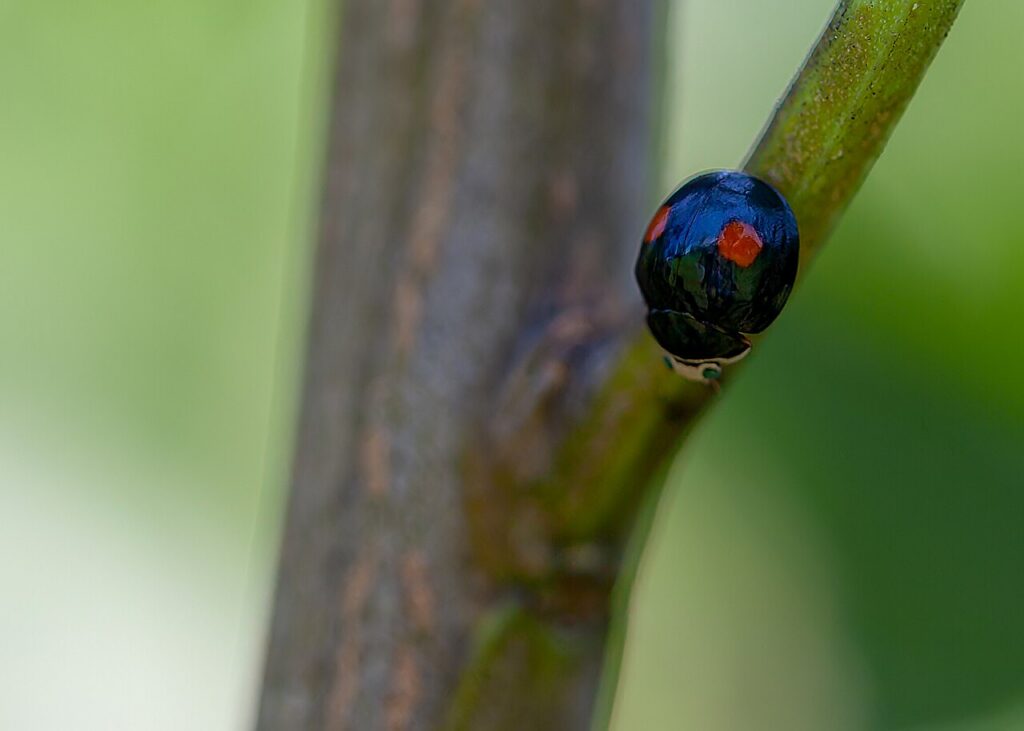
To stop the pine killer, Italian researchers are turning to nature. At the Mostra d’Oltremare in Naples, the world’s first experiment has begun using the beetle Thalassa montezumae, native to Central America, as a natural predator of the turtle scale insect (Toumeyella parvicornis), the pest that has caused the death of thousands of pine trees in Campania over the past decade and has now spread to Lazio, Tuscany, Marche, Abruzzo, and Puglia.
An alternative to chemical treatments
One hundred specimens of the beetle were released in the Mostra grove; the species was selected following years of research coordinated by CREA Defense and Certification in the invasive insect’s native habitats in the Caribbean. The project is sponsored by the Ministry of Agriculture, coordinated by the Campania Region through the Regional Plant Health Service, and carried out with scientific support from the Department of Agriculture at the University of Naples Federico II.
The goal is to determine whether the results obtained in the laboratory can be confirmed in a natural environment. “It’s a one-of-a-kind experiment,” said Regional Agriculture Commissioner Maria Carmela Serluca. If the predator proves effective in the field as well, it could become a tool for controlling the pest without resorting to pesticides, especially in urban and coastal areas, where chemical interventions are more complex and have greater environmental impacts.
The challenge is to restore balance
Biological control, the researchers explain, does not aim to eradicate the mealybug. “The goal is to achieve a natural balance between predator and prey, keeping the pest population at levels that no longer cause the death of plants,” explained CREA researcher Giuseppino Sabatini.
Prior to the release, assessments were conducted on the potential ecological impact of introducing Thalassa montezumae. According to Antonio Garonna, professor of entomology at Federico II University, the scientific data collected allowed the Ministry of the Environment to authorize the trial, on the basis that there should be no negative consequences for ecosystems.
A test that looks beyond Naples
Monitoring will be carried out by the Regional Plant Health Service and Federico II University. It will be used to assess the beetle’s survival, its ability to reproduce, and its effectiveness in controlling the mealybug. The first results could be available as early as next year. If they are positive, the Neapolitan trial could pave the way for biological pest management in other parts of the country as well, offering a solution to an emergency that continues to put pressure on Italy’s tree population.