Those who are suffering from the heat, those traveling in a city they don’t know, and those who simply don’t feel like searching through ten different municipal websites to find a place to cool off: for all these people, in this summer of 2026 marked by relentless heat waves, knowing where the cooling centers are can make a real difference. The problem, until now, was that every municipality has its own map, with different criteria and different links—often inaccessible to those who don’t even know they exist.
Junker, the environmental services app already installed on millions of smartphones in Italy, has decided to solve the problem in the simplest way possible: by compiling all existing municipal maps into a single section of the app, which anyone—whether a resident or a passing tourist—can access for free.
How it works: one map, all the cities
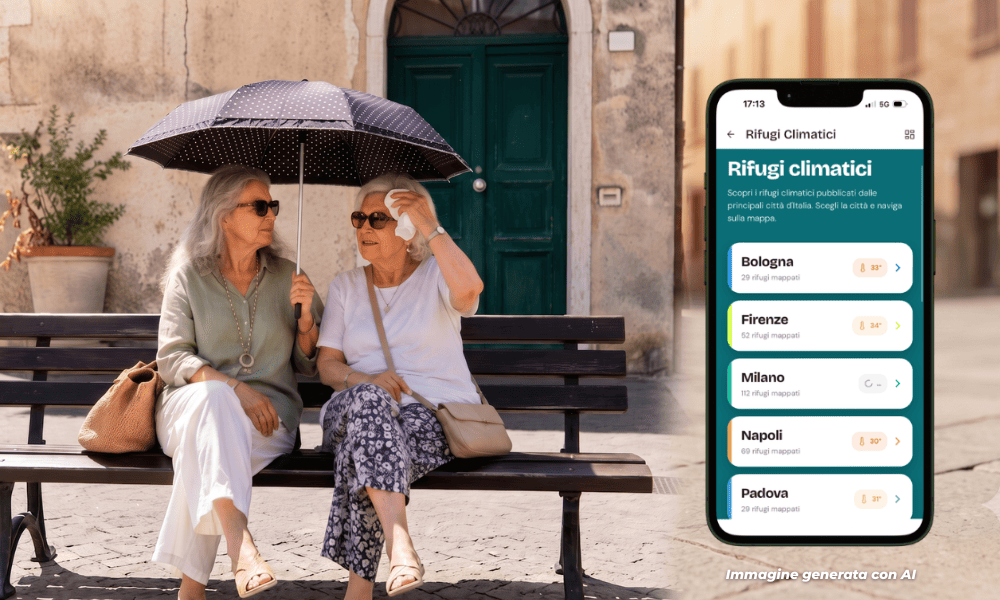
By accessing the “Climate Refuges” section of Junker, users can select the city of their interest and navigate directly on the map, filtering by type of space: libraries, parks and gardens, community centers, swimming pools, water stations, and public drinking fountains. “All the information comes from official and public data. We’ve compiled it into a single source that’s free and easily accessible to everyone,” explains Noemi De Santis, co-founder and communications manager for the app.
It’s exactly the kind of solution designed for when it’s really needed: August is the month when the heat is at its peak and, at the same time, the month when the most people are on the move—between vacations, people returning home, and tourism in major cities. A tourist visiting Rome for the first time has no way of knowing that the city’s Heat Plan exists; an elderly person traveling to join family in another city isn’t going to browse ten different websites to find an air-conditioned library. Having everything in a single app—already installed on your phone—reduces this barrier to almost zero.
Where It’s (Really) Most Common: Rome Leads the Way, but Bologna Is the Most-Searched City
In terms of numbers, Rome remains the Italian city with the most extensive network: the city’s “Piano Caldo” initiative includes a total of 676 mapped locations, including parks, libraries, museums, senior centers, and municipal swimming pools, in addition to thousands of public drinking fountains and “Case dell’Acqua” water stations located throughout the city.
There is, however, one statistic worth noting: although Rome has the most extensive network, Bologna is the Italian city where people search online most frequently for “climate refuges,” with a search volume that significantly exceeds that of Rome, Milan, and Turin combined. This is a sign that Bologna—one of the first cities in Italy to have drawn up an official list of these spaces—has also built a communication strategy around the topic that is truly effective at reaching those who are searching for them.
The other cities on the map
In addition to Rome and Bologna, the map compiled by Junker covers Italy’s other major tourist cities. In Milan, the city government has identified 116 “Spazi Freschi, ” located in parks such as Sempione and Lambro, municipal libraries, and community centers. In Florence, the network includes 44 locations, including 37 gardens and 7 libraries, selected in part based on the percentage of shade they provide. In Naples, an association called Cleanap created the first map in collaboration with the city government and Federico II University, identifying places in the city where people can find relief from the heat. Turin, Padua, and other cities have also joined the effort, with their city governments having begun to catalog these spaces over the past two years.
Why You Only Need One App
Behind Junker’s initiative lies a structural problem that remains unresolved: Italy lacks a national framework law on climate shelters. UNITEL, the National Union of Local Government Technicians, has proposed eight common minimum requirements (free access, availability of water, constant indoor temperature, and dedicated signage), inspired by the Barcelona model, which, with nearly 400 shelters, ensures that 98% of the population has one within a ten-minute walk. Without a national standard, however, each Italian municipality operates independently, using different criteria and tools.
In this fragmented landscape, an app that aggregates all existing maps doesn’t solve the underlying problem, but it does make it less burdensome to deal with in the short term: Anyone who needs a cooling shelter today—whether while traveling or simply on a day of extreme heat—shouldn’t have to wait for a national law to find one. All they need to do is open an app on their phone.